You searched "Shopify review" or "is Shopify worth it" before taking out the card. Good instinct: online ratings go from 1.3 to 4.4 for the same product, and nobody takes the time to explain why. I spend my days inside Shopify stores, new and established. Here is what holds, what genuinely annoys, and who I would send elsewhere.
Is Shopify worth it? Verdict by profile
- You are starting and every euro counts: yes. A 3-day trial with no card, €1 a month for 3 months, then €27 a month billed yearly on Basic. Budget the real cost (subscription, domain, two or three apps), not ten apps the first month.
- You want to launch a brand without spending weeks: yes. The platform is not the bottleneck, design, product pages and visuals are. That is where AI generation changes the pace, more at the bottom.
- You are a developer or want to own everything: no. WooCommerce gives you the control Shopify refuses, in exchange for maintenance. Details in Shopify vs WooCommerce.
- Your product is very technical (configurator, B2B, negotiated pricing): test variant limits and checkout before signing, or look at Shopify Plus.
- You sell in a sector Shopify Payments treats as risky (CBD, supplements, second-hand, a big share of pre-orders): plan a backup gateway and cash that survives a payout hold.
Is Shopify reliable? The facts
Yes. Shopify has existed since 2006, has been listed on the NYSE since 2015, and by its own page processes 10% of US e-commerce, over $1 trillion in cumulative sales and 675 million unique shoppers in 2023. It is not a SaaS that will vanish with your store inside.
Technically, it is the part you never hear about: managed hosting and CDN, SSL included, PCI DSS compliance for payments, backups. The Shopify status page showed "All Systems Operational" and no incident between 28 August and 11 September 2026. During a traffic spike, the store holds.
What the platform's reliability does not say: the reliability of the stores running on it. Half of the bad reviews come from that confusion.
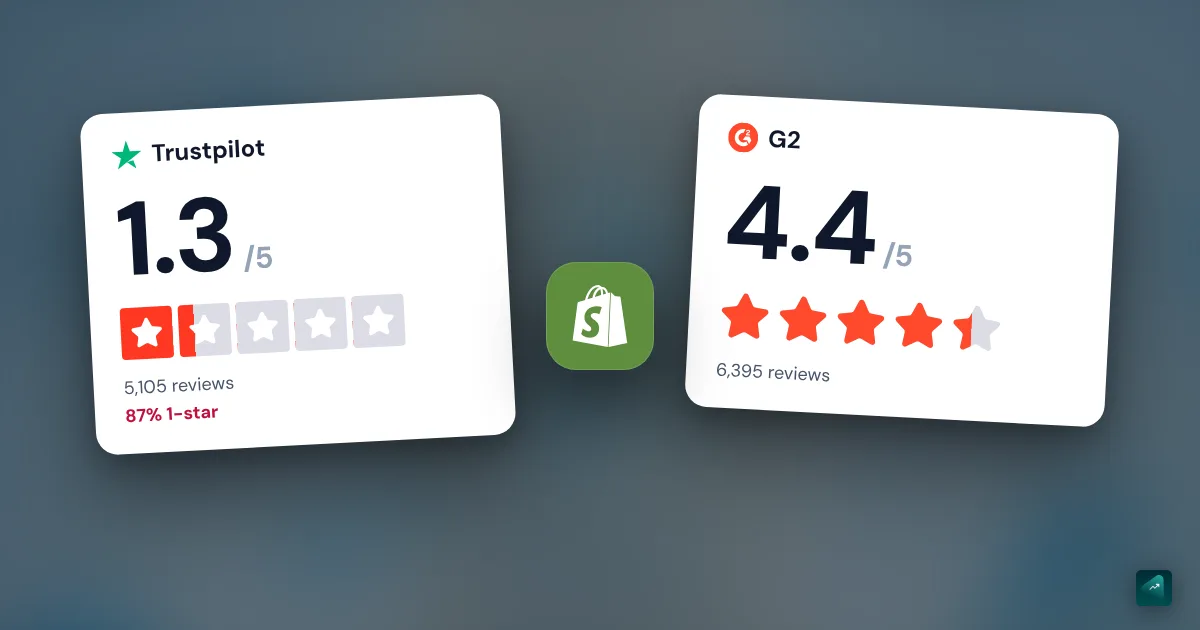
Why 1.3 on Trustpilot and 4.4 on G2
As of 11 September 2026, Shopify shows 1.3 out of 5 on Trustpilot, 5,105 reviews, 87% 1-star and 6% 5-star. On G2, 4.4 out of 5 on 6,395 reviews, last checked in June 2026. Both scores describe the same product. They do not describe the same people.
Read the Trustpilot reviews: a large share is not written by merchants. A review from 11 August 2026 accuses Shopify of "protecting scammers" after reporting a Hong Kong store. Another from 5 September advises "do not buy from any company using Shopify as a payment method" after a lost dispute. These are shoppers burned by a store hosted on Shopify, rating the host. It is like rating your phone carrier because a telemarketer called.
The other share is angry merchants, and their complaints revolve around four topics: funds held by Shopify Payments during a check, an account suspended without a clear explanation, support that routes through an AI chat before a human, misunderstood fees. Those complaints are real, more below.
The 6% of 5-star reviews almost always talk about support when it works: a 9 September 2026 review describes a page problem fixed live by an agent.
G2, on the other hand, rates the day-to-day tool, by professional users: onboarding, reliability, ecosystem. There, Shopify dominates its category.
The drawbacks I can confirm
Support. Complaint number one, and it has gotten worse: first contact goes through an AI-assisted chat, reaching a competent human takes patience. While everything works, you do not notice. The day your funds are held, it becomes unbearable.
Funds held by Shopify Payments. An anti-fraud check can block a payout for days or weeks, especially on a sudden sales spike, a sensitive sector or many pre-orders. It is not specific to Shopify, Stripe and PayPal do it too, but it is the main reason for merchants' 1-star reviews. Countermeasures: a cash buffer, business documents ready, and a backup gateway configured.
Fees outside Shopify Payments. If you charge through a third-party gateway, Shopify adds 2% on Basic, 1% on Grow, 0.6% on Advanced, on top of the gateway's fees. With Shopify Payments, you pay 1.5% + €0.25 per card payment on Basic, and nothing else. Figures from the European pricing page on 11 September 2026, unchanged on 15 September. You can see what these fees take from each order in the Shopify profit margin calculator.
Costs that stack. The subscription is only the entry ticket. Reviews, upsells, email, translation: each app can add a subscription. I laid out the full budget in is Shopify free: about €550 of platform cost the first year excluding apps, on €10,000 of sales.
The locked checkout. Deep customisation of the payment page requires Shopify Plus, from €2,100 a month. For a standard store, the native checkout mostly saves you from maintaining critical code.
You rent, you do not own. Shopify can suspend an account that breaches its terms, and you cannot leave with your theme and database under your arm in one click. If full ownership is non-negotiable, it is WooCommerce.
What actually holds up
- Everything you no longer manage. Security, updates, server load: handled, all the time. For someone who wants to sell rather than administer, there is no serious equivalent.
- Shopify Payments. Cards, Apple Pay, Google Pay, no additional transaction fees, no configuration.
- The ecosystem. Over 13,000 apps and over 200 themes on the official stores, developers everywhere, answers already documented to almost every problem.
- It scales. The same platform runs the store cashing its first sale and brands doing tens of millions. You will not change tools as you grow.
What it costs, in one line
3 days free with no card, €1 a month for 3 months, then Basic €27 a month billed yearly or €36 monthly, Grow €79 or €105, Advanced €289 or €384, before tax, as displayed in Europe on 11 September 2026. US visitors see a dollar grid with the same structure. Details, fees and the 12-month cost are in is Shopify free.
Form your own opinion in an hour
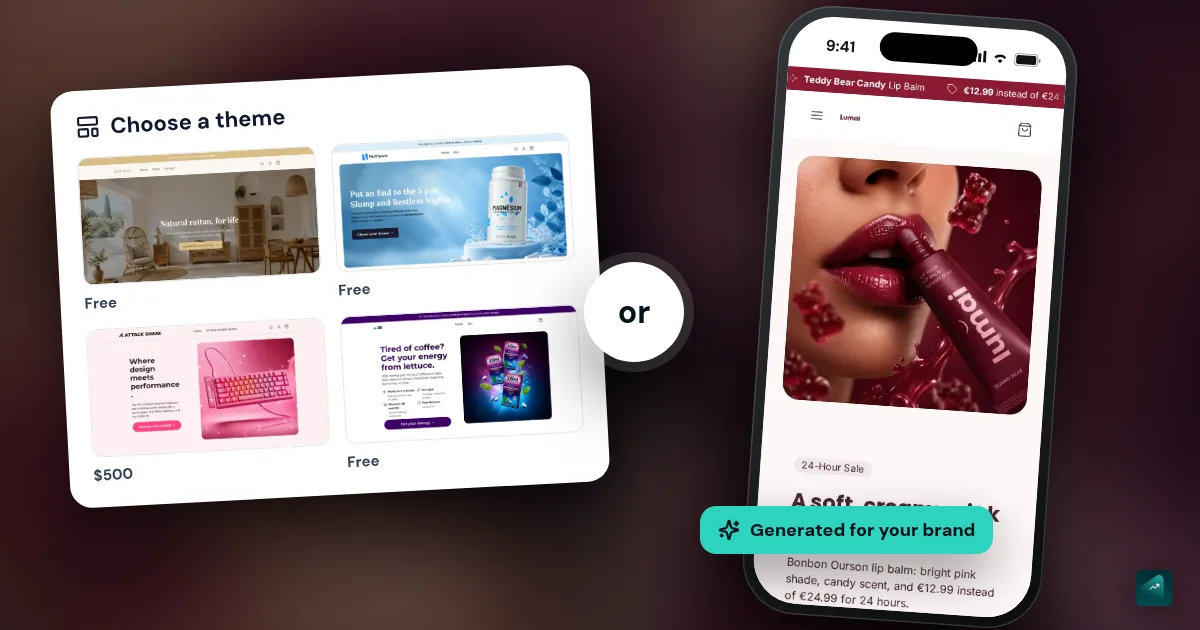
The store below is a demo generated by Scale Ova from a description: a supplements brand, its positioning, its range. Theme, collections, product pages and copy included. You can visit it page by page.


The best review of Shopify is yours, with your store in it. Describe your project, look at what comes out, ask the AI for changes ("make the home page more clinical", "add a 3-month course collection", "rework the product page for a sporty audience"), click an element to adjust it. It is free and has no time limit. You start the Shopify trial when the store is ready to publish, and the Scale Ova subscription, from €49 a month, is only needed to publish.
Going further
For the step by step once decided, the complete guide to building your Shopify store. To compare with the other platforms, the best online store builder. And to see your store before choosing, describe your project to Scale Ova.
FAQ
Is Shopify reliable?
Is Shopify a scam?
Why does Shopify have 1.3 out of 5 on Trustpilot?
What are Shopify's drawbacks?
Is Shopify free?
Is Shopify worth it for a beginner?
What do forums like Reddit say about Shopify?
Can you leave Shopify easily?
Sources
- Shopify on Trustpilot, rating, distribution and quoted reviews, checked 11 September 2026
- Shopify on G2, 4.4 out of 5 on 6,395 reviews, last checked 11 June 2026 (page unreachable on the 11 September check)
- Shopify, about, 10% of US e-commerce, $1 trillion in sales, 675 million shoppers in 2023, 13,000+ apps, checked 11 September 2026
- Shopify status page, no incident from 28 August to 11 September 2026
- Shopify, pricing, trial, plans and fees, checked 11 September 2026