You are looking for an AI SEO tool for Shopify because editing every product page by hand takes hours. Good reason. If you hope an app will rank you on Google in one click, you will mostly add a subscription.
There are four different jobs behind "AI SEO": writing, fixing a catalogue in bulk, finding technical issues, and tracking your visibility in ChatGPT's and Google's answers. No single tool does all four well. We take them one at a time.
The 7 AI SEO tools for Shopify, prices checked on 11 September 2026
| Tool | For what | App Store rating | Starting price | Main limit |
|---|---|---|---|---|
| Shopify Magic | Writing descriptions, pages, posts | Built in | Free on every plan | No audit, no rank tracking, no meta |
| Smart SEO | Meta, alt text, images, JSON-LD, broken links | 5 out of 5, 953 reviews | Free (20 AI generations) then $14.99 a month | Features overlap with other apps |
| StoreSEO | Meta, alt text, images, schema, llms.txt, 5 tracked keywords | 5 out of 5, 745 reviews | Free up to 25 products then $14.99 a month | Tiers by product count |
| SearchPie | Audit, speed, schema, bulk AI tags | 4.9 out of 5, 2,459 reviews | Free (50 AI tags) then $39 a month | AEO and llms.txt only on the $99 plan |
| Semrush | Keywords, competitors, rankings, AI visibility | External platform | €112.52 a month billed yearly | Oversized under 100 products with no content calendar |
| Surfer | Optimising a page against the SERP, AI tracking | External platform | €49 a month; €82 for AI tracking alone | Does not touch the store's technical SEO |
| Writesonic | Content and ChatGPT, Gemini, AI Overviews tracking | External platform | $79 a month billed yearly | Perplexity only on the Enterprise plan |
What changed since July: SEOWILL (formerly SEOAnt) shows "app currently unavailable" on the App Store, Writesonic's entry plan went from $49 to $79, Semrush and Surfer folded AI visibility tracking into their plans.
1. Shopify Magic: start with what is already free
"Shopify Magic tools and experiences are available for free, regardless of your subscription plan." That is the Shopify Help Center's sentence. Magic generates product descriptions, page and blog content, email subject lines, headings, support replies, images (background removal, banners) and theme blocks.
What it does not generate: meta titles and meta descriptions. The Help Center does not list them. You edit those by hand in Shopify's native SEO fields, which exist on every product, collection and page.
My verdict: under a few dozen products, Magic to get past the blank page, Search Console to see what surfaces, and a proofread. An extra app is justified when a repetitive task becomes painful, not before.
2. Smart SEO: the simple choice for bulk work
5 out of 5 on 953 reviews. The free plan covers 100 pages of broken-link checks, 50 images, 20 AI generations, a 20-page audit, meta and alt tags, sitemap and noindex tags. Pro at $14.99 a month, Business at $24.99, Premium at $49.99, with a 7-day trial.
On the AI side: generated meta tags, alt text and descriptions, JSON-LD, and two features aimed at AI engines, an "LLM Catalog" and an MCP server for agents. A 30 June 2026 review sums up the use: auditing every product page "with an easy rating system".
I would take it for an established catalogue, when editing the same fields page by page takes hours. Not just for schema: Shopify themes already output part of it, and a duplicate makes more noise than it helps.
3. StoreSEO: SEOWILL's replacement, a French developer
5 out of 5 on 745 reviews, developer Storeware, based in France. The free plan covers 25 products, 200 AI credits, 25 images and 5 tracked keywords. Lite at $14.99 a month (100 products), Essential at $39.99 (250 products, schema), Advanced at $249.99 (10,000 products, multilingual SEO).
On the AI side: bulk generation of meta titles, descriptions, product copy and alt text; llms.txt generator; JSON-LD and FAQ schema; image compression and conversion. A 9 September 2026 review mentions an onboarding session before seeing scores rise.
Built-in keyword tracking is what sets it apart from the other two apps: five free queries is enough to watch the pages that matter without paying for Semrush.
4. SearchPie: the clearest tiers, AEO at the top
4.9 out of 5 on 2,459 reviews. Starter free: daily SEO monitoring, 50 compressed images, basic schema, sitemap, 50 AI-generated SEO tags. Premium at $39 a month: 500 images, price, rating and FAQ schema, 250 AI tags. Enterprise at $99: unlimited images, "Optimize for AI search (AEO)" and llms.txt, 5,000 AI tags, keyword tracking.
The free version is enough for a first audit and to understand what surfaces. At $99 a month, I would compare with Semrush: at that price, you need a regular content and measurement process. A 9 September 2026 review praises what runs "on autopilot": missing alt text fixed, heavy images compressed. That is exactly the scope where an app makes sense.
5. Semrush: deciding what to target
Semrush is not a Shopify app. It is a full platform: keyword research, competitor analysis, rank tracking, and since 2026 visibility tracking across "Google Search, ChatGPT, Perplexity, Gemini & more" included in every plan, from 50 to 200 prompts tracked daily depending on the tier. SEO plan at €112.52 a month billed yearly, Starter at €158.40, Pro+ at €238, Advanced at €436.99. 7-day trial.
I would choose it when the store regularly publishes collections, guides and comparisons. For five product pages and no calendar, you would pay for data you will not use.
6. Surfer: reworking an important page, and AI tracking on its own
Surfer compares a page with already-ranking results and suggests coverage, structure and terms. Discovery at €49 a month billed yearly, Standard at €99 (with 25 AI prompts tracked weekly, ChatGPT only), Pro at €182 (50 prompts daily across ChatGPT, Perplexity, Google AI Mode, AI Overviews and Gemini). And an "AI Search Analytics" plan at €82 a month, AI tracking alone, without the content editor.
Useful on a collection, a buying guide or a strategic article. It does not fix your theme and does not build backlinks. Its content score is a hint: adding every suggested term produces a page that smells of stuffing.
7. Writesonic: content plus AI engine tracking
Starter at $79 a month billed yearly, Basic at $199, Growth at $399. All three track ChatGPT, Gemini and Google AI Overviews; Perplexity, Claude, Copilot and the others are reserved for the Enterprise plan, "all 10 AI platforms tracked".
That tracking becomes interesting when your brand is already searched, you have identified your competitors, and someone turns the reports into actions. At launch, Search Console gives you more directly usable information, for free.
Tracking your visibility in ChatGPT and AI engines: what it measures, and what it is worth
An "AI visibility" tool asks ChatGPT, Gemini, Perplexity or Google AI Mode a list of questions every day, and records whether your brand or your pages are cited, in which position, with what sentiment. It is rank tracking transposed to generated answers.
Three figures to frame it, from Ahrefs' 2026 studies:
- 99.9% of Google AI Overviews trigger on informational queries. On shopping queries, 3.2%. Your product and collection pages keep their organic click, your guides lose part of theirs.
- On queries with an AI Overview, the number one result loses 58% of its clicks. Being first is no longer enough on informational.
- 28% of the pages most cited by ChatGPT have no Google visibility at all. AI engines form a separate discovery layer, with their own sources.
What it means for a store: what gets a brand cited is complete product data, pages that answer a precise question, and mentions elsewhere (reviews, comparisons, videos). An llms.txt file, which Smart SEO, StoreSEO, SearchPie or Yoast generate, is an access element, not proof of authority. No button guarantees a citation.
The options to measure, by budget:
| Need | Tool | Price checked |
|---|---|---|
| AI tracking alone, 50 prompts daily across 5 engines | Surfer AI Search Analytics | €82 a month |
| AI tracking plus full SEO | Semrush, every plan | from €112.52 a month |
| AI tracking plus content | Writesonic Starter (ChatGPT, Gemini, AI Overviews) | $79 a month |
| Nothing paid | Manual search of your brand in ChatGPT once a week, Search Console for Google | €0 |
What Shopify's Agentic Storefronts change
Shopify lets eligible stores make their products purchasable in ChatGPT, Google AI Mode, Gemini, Microsoft Copilot and Meta. The feature is "active by default for eligible stores", after accepting the supplemental terms, through Shopify Catalog.
It is not a replacement for SEO. To be picked by an assistant, a product needs readable data: precise title, complete attributes, consistent images, price, availability, shipping, returns. A product page that answers questions serves both at once.
Which tool for your store size
- Under 30 products: Shopify Magic, Search Console, proofreading. Zero apps.
- 30 to a few hundred products: one app for meta, images and bulk fixes. Smart SEO or StoreSEO on the free plan, SearchPie if you want the daily audit.
- Large catalogue with a content strategy: Semrush to know what to target, Surfer on a few priority pages.
- Brand that wants to track ChatGPT: Surfer AI Search Analytics or Semrush, provided someone acts on the reports.
A word on Yoast, which you may know from WordPress: the Shopify version is $19 a month, rated 4.3 out of 5 on 173 reviews, and a 31 August 2026 review describes code injected into the theme with visible changes on the customer side. I would not put it first.
Checks before installing an app
An SEO app can change hundreds of fields at once. Before handing it the keys:
- Export existing meta and alt text.
- Run the automation on five products, not the catalogue.
- Check the theme on mobile and measure speed before and after.
- Check structured data to avoid duplicates.
- Write down the expected metric: time saved, errors fixed, impressions or clicks.
If you do not know which metric should move, do not buy the tool yet.
Where Scale Ova fits
Scale Ova is not an SEO tracking tool. It generates the complete store, pages, collections, product pages and copy included, on a clean technical base, then you rework the content by talking to the AI. The store below is a demo generated from a description: a cosmetics brand, its positioning, its range. You can visit it page by page.
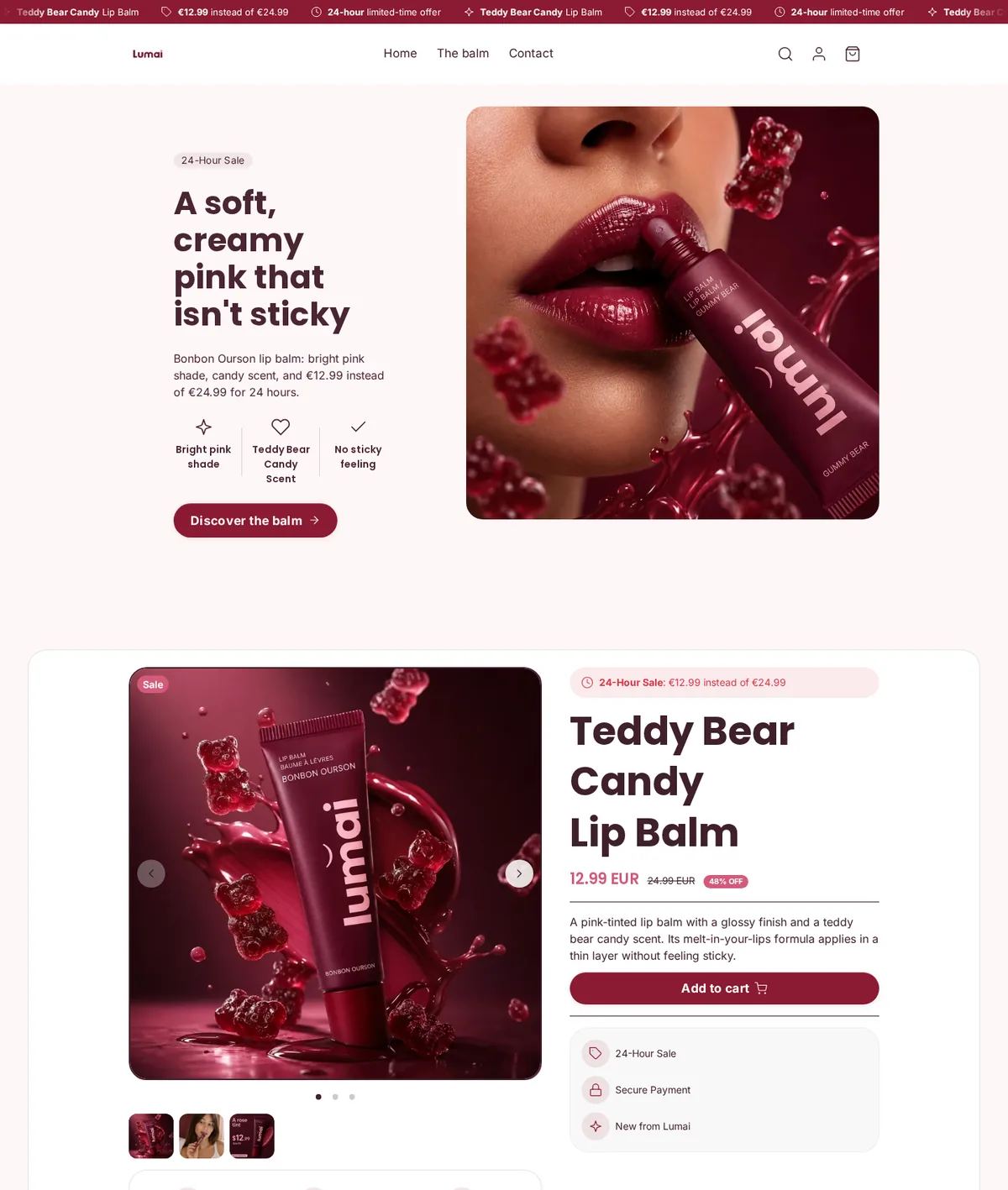
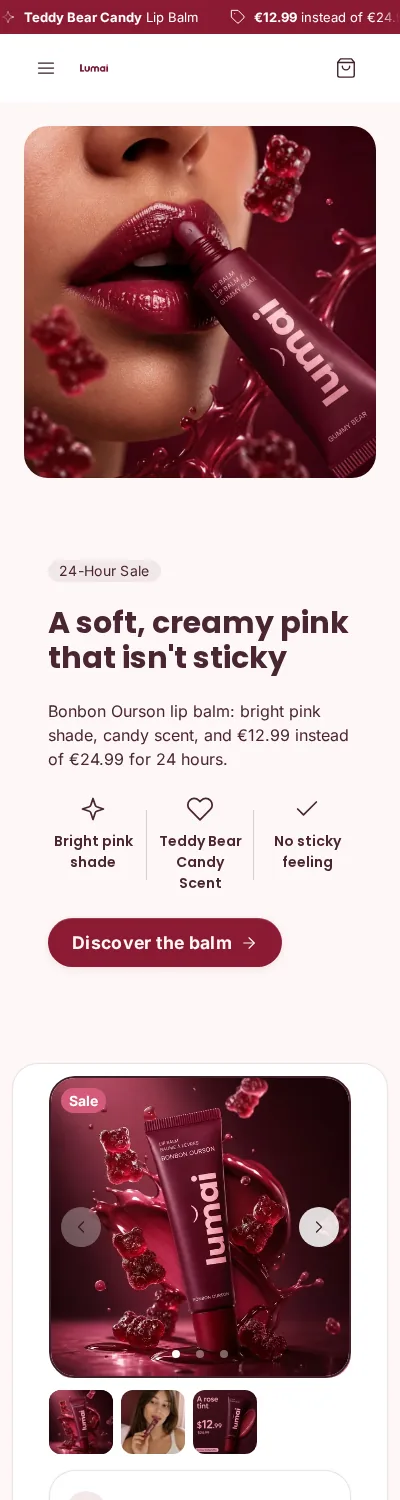
The ongoing work stays in Search Console and, if the catalogue grows, in one of the apps above. But you start from a store where every page already has a title, a structure and copy written for your project, not from an empty theme to fill before you can optimise it.
Going further
For the broader role of AI in a store, the AI for Shopify guide. If you start from an empty theme, generate your store with Scale Ova, check pages and copy for free, and only pay to publish. If the store already exists, start with Search Console and a single app.
FAQ
What is the best AI SEO tool for Shopify?
Is Shopify Magic free, and does it do SEO?
Do you need to pay for a Shopify SEO app?
What happened to SEOWILL?
Can an AI SEO app rank a store on Google?
How do you appear in ChatGPT with a Shopify store?
Is the llms.txt file useful?
Can you install several Shopify SEO apps?
Sources
- Shopify Help Center: Shopify Magic, "available for free, regardless of your subscription plan", checked 11 September 2026
- Smart SEO on the Shopify App Store, rating, plans and reviews, checked 11 September 2026
- StoreSEO on the Shopify App Store, rating, plans and reviews, checked 11 September 2026
- SearchPie on the Shopify App Store, rating, plans and reviews, checked 11 September 2026
- SEOWILL on the Shopify App Store, "app not currently available", checked 11 September 2026
- Yoast SEO on the Shopify App Store, rating, price and reviews, checked 11 September 2026
- Semrush, pricing, plans and included AI tracking, checked 11 September 2026
- Surfer, pricing, plans and AI tracking, checked 11 September 2026
- Writesonic, pricing, plans and tracked engines, checked 11 September 2026
- Shopify Help Center: Agentic Storefronts, channels and default activation, checked 11 September 2026
- Ahrefs, AI search studies (2026): AI Overviews share by intent, click loss of result 1, pages cited by ChatGPT with no Google visibility