You've read that e-invoicing is becoming mandatory in France, and you wonder what it means for your Shopify store. Most articles are about invoices between businesses. Your store sells mostly to consumers. That's exactly the case the reform handles separately.
This guide is for a business established in France, or for anyone who runs one. It explains what the reform actually asks of you, depending on who you sell to. Then it shows what Shopify does for your invoices, and what it doesn't. This isn't tax advice. Your accountant is still the right person to confirm your case.
Key dates
| Date | Who | What becomes mandatory |
|---|---|---|
| September 1, 2026 | All businesses | Receiving e-invoices from your suppliers |
| September 1, 2026 | Large and mid-sized companies | Issuing e-invoices and sending e-reporting |
| September 1, 2027 | Small and micro businesses | Issuing e-invoices and sending e-reporting |
A new Shopify store is almost always a micro or small business. For you, the date that matters for issuing is September 1, 2027. Receiving is already in force.
Micro-entrepreneurs under the VAT exemption (franchise en base) are included. The French tax site says it plainly. Even if you invoice without VAT because of the exemption, you're covered.
E-invoicing or e-reporting: what applies to you
The reform has two parts, and they target different sales.
E-invoicing covers sales between businesses established in France and registered for VAT. The invoice no longer goes out as a PDF by email. It goes through an approved platform, in a structured format machines can read.
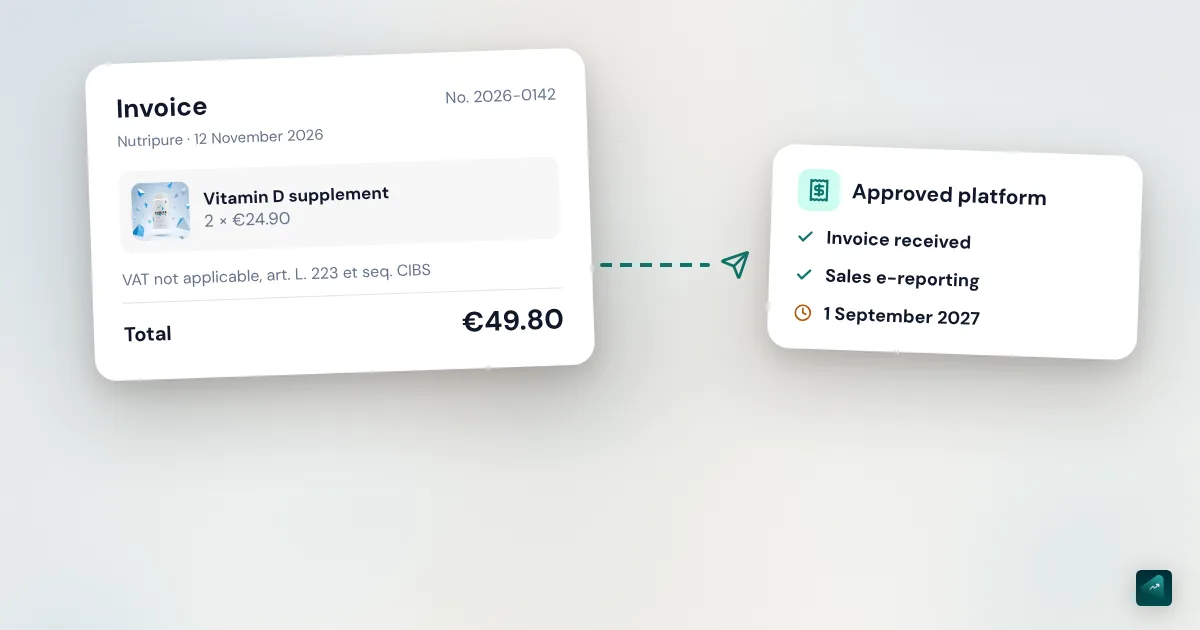
E-reporting covers sales to consumers, in France and abroad. It also covers purchases and sales with foreign businesses. You don't send invoices to the tax authority. You only send your sales total per day, split by VAT rate if needed. No personal data about your customers is sent.
For a Shopify store selling products to consumers, the part that matters is e-reporting. There's also payment e-reporting. It covers transactions where VAT is due on payment, such as services. If you sell physical goods, that one generally doesn't apply to you.
How often do you send e-reporting?
It depends on your VAT regime. Under the VAT exemption, you report every two months. The data is due by the 25th to 30th of the month after the period. Other regimes report more often, up to three times a month under the monthly standard regime. If you had no sales in a period, there's nothing to send.
What if you also sell to businesses?
Some of your orders may come from professionals, such as a shop buying your stock. For those sales to French businesses, you'll need to issue a real e-invoice from September 1, 2027. It will carry four new details:
- the customer's SIREN number;
- the delivery address, if it differs from the billing address;
- the type of transaction, meaning goods, services or both;
- the option to pay VAT on invoicing, if you chose it.
That's where Shopify falls short. A Shopify order number isn't an invoice number.
Do you still need an invoice for an online sale to a consumer?
Yes. In France, a sale of goods to a consumer requires an invoice in three cases. The customer asks for one, or it's a distance sale, or it's an exempt delivery to another EU country. A sale on your Shopify store is a distance sale. So every order calls for an invoice.
That invoice doesn't have to be an e-invoice in the reform's sense. Service-public says sales to consumers are generally outside the e-invoicing obligation, and a PDF is still valid.
It must still carry the mandatory details. It has a unique number in a continuous chronological sequence. It shows your identity with your SIREN, the product details and the totals before and after VAT. Each missing detail costs a €15 fine, capped at 25% of the invoice amount.
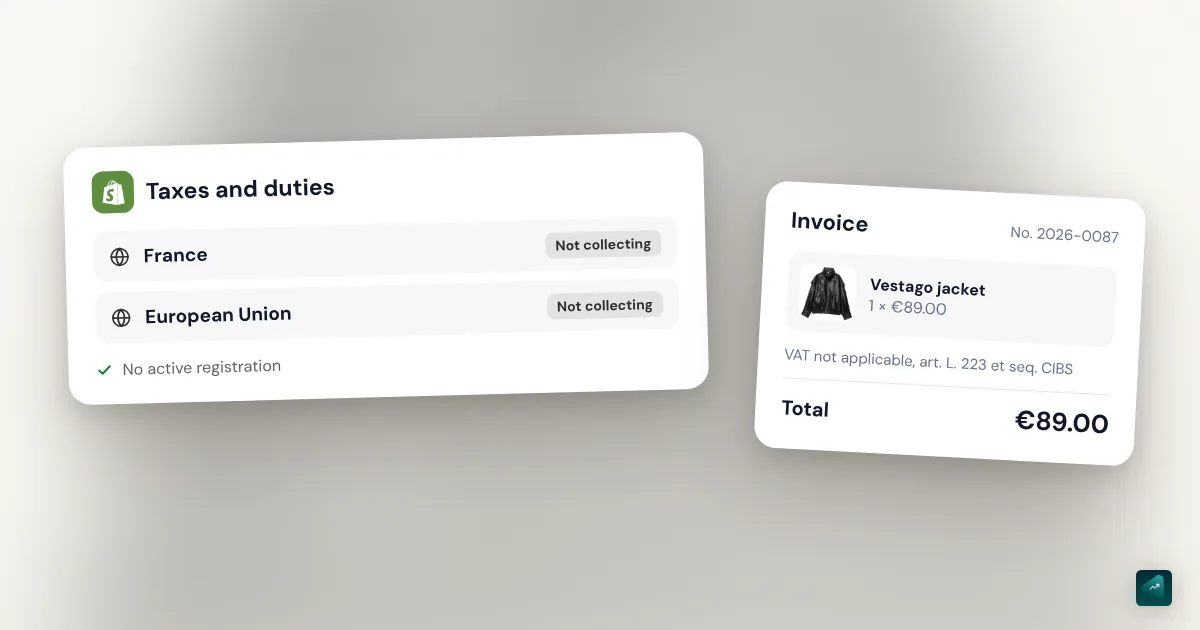
If you're under the VAT exemption, the wording changes. Since September 1, 2026, it reads "TVA non applicable, art. L. 223 et s. du code des impositions sur les biens et services". The old wording citing article 293 B of the CGI is accepted until December 31, 2027. So you have time to update your invoice template. To set up Shopify under the exemption and place this wording, read Shopify VAT in France for micro-entrepreneurs.
What Shopify does for your invoices
Shopify isn't invoicing software. It handles orders, customers and payments. It doesn't create invoices numbered the French way, and it isn't an approved platform.
Here's what it does offer:
- Order Printer, a free app made by Shopify. It prints invoices, packing slips and receipts from your orders. Templates can be customized in HTML and Liquid. It doesn't create e-invoices and doesn't talk to any approved platform.
- Shopify Flow, with the "Send order invoice" action. It emails an order invoice when an event happens. That's handy for a B2B order paid later, but it isn't an e-invoice.
- Shopify Payments invoices. They cover the fees Shopify charges you, not your sales. You download them in Settings > Payments, then View payouts and Documents.
For everything else, you need an invoicing app connected to Shopify. It picks up each order, assigns a real invoice number and adds the required details. The better ones also prepare the data for your approved platform.
Invoicing apps for Shopify
Several Shopify App Store apps target the French reform. Here's what their listings say, checked on October 29, 2026. These are their claims, not a test.
| App | What its listing says | Listed price |
|---|---|---|
| Sufio | E-invoicing via an approved platform (plateforme agréée), Factur-X and Peppol. Rated 4.9 out of 5 (470 reviews) | From $7 a month for 15 invoices, 14-day trial |
| Regulo | Factur-X invoices and FEC export for your accountant. Rated 5 out of 5 (31 reviews) | From $9 a month for 100 documents, 14-day trial |
| Facturii | Factur-X invoices compliant with "PA" and bookkeeping, by Huggii. Rated 5 out of 5 (4 reviews) | From $20 a month, 15-day trial |
| Order Printer | Prints PDF invoices, made by Shopify | Free |
None of those three listings mentions e-reporting. Yet that's what a store selling to consumers will need in 2027. Before installing an app, ask it two questions in writing. The first is which approved platform it works with. The second is whether it sends your daily sales for e-reporting, or whether you'll have to do it yourself.
Some apps still say PDP when they mean these platforms. The French tax site now says approved platforms (plateformes agréées), and publishes their list.
What to do, in order
- Choose your approved platform now, if you haven't. It receives your suppliers' invoices since September 1, 2026. The official list is on impots.gouv. Your bank or accounting software may offer one.
- Check your current invoice. Each order should produce an invoice with a continuous number and the required details. If you're under the VAT exemption, switch to the new VAT wording before the end of 2027.
- Install an invoicing app if you don't have one. Pick it for its ability to talk to your approved platform.
- Prepare e-reporting before September 1, 2027. Ask your app or platform how your daily sales will be sent, and how often.
- Have your accountant sign off. Especially if you also sell to businesses or abroad.
Fines are real but capped. An e-invoice not issued costs €50 per invoice. A missed e-reporting costs €500 per transmission. In both cases, the total is capped at €15,000 a year. A first mistake corrected quickly isn't penalized. Having no platform to receive invoices first triggers a three-month formal notice, then a €500 fine.
Where does Scale Ova fit?
Ova doesn't do your invoices. It doesn't connect to an approved platform or to your accounting software. It handles the store itself, from product pages to terms of sale and legal pages. For the launch settings, the complete guide to building a Shopify store covers the rest. Business status and the VAT exemption are covered in how to start an online store.
FAQ
Does Shopify create e-invoices for France?
Can Shopify send an invoice automatically for every order?
I'm a micro-entrepreneur under the VAT exemption. Am I affected?
I only sell to consumers. Do I need to issue e-invoices?
What does e-reporting send for a consumer sale?
How much does the reform cost a small store?
Sources
- Service-Public Entreprendre, e-invoicing is coming: receiving and issuing timeline, new invoice details, updated February 27, 2026
- Service-Public Entreprendre, e-invoicing penalties are changing: €50 per invoice, €500 per transmission, caps, no platform, 2026 Finance Act, article 123
- Service-Public Entreprendre, all about invoicing: invoice required for distance sales, required details, new exemption wording, checked August 7, 2026
- Impots.gouv, switching to e-invoicing: reform page, updated September 1, 2026
- Impots.gouv, I don't issue invoices or I invoice without VAT: VAT exemption and e-reporting, updated January 16, 2026
- Impots.gouv, sheet 7, transaction data reporting: B2C e-reporting from September 1, 2027, daily sales, updated October 2026
- Impots.gouv, payment data reporting: transactions covered and frequencies
- BOFiP, transaction data transmission: frequencies by VAT regime
- Impots.gouv, list of approved platforms: updated October 13, 2026
- Shopify Help Center, Order Printer: printing invoices from orders, read October 29, 2026
- Shopify Help Center, Send order invoice action: read October 29, 2026
- Shopify Help Center, Shopify Payments in France: Shopify Payments fee invoices, read October 29, 2026
- Shopify Order Printer on the Shopify App Store: free app made by Shopify, checked October 29, 2026
- Shopify App Store listings for Sufio, Regulo and Facturii: prices, ratings and stated features, checked October 29, 2026