This guide covers selling from France, where the business number is called a SIRET. If you sell from another country, the Shopify part still applies, but the legal part is your own country's. In the US, for example, licenses depend on your state and city.
You want to test your idea on Shopify before doing any paperwork. The answers online contradict each other. Some videos say Shopify checks nothing, others talk about jail. Both are partly right, because they're not talking about the same thing. Shopify has its own rules, and French law has others. Let's look at both, then at how to sell legally without spending weeks on it.
What Shopify actually asks for
At sign-up, no business number
To create your store, Shopify asks for your legal name and how to reach you. Its terms of service don't ask for any business number. They set two other rules. You must be at least 18, and you confirm that you use Shopify for a business activity. They also state that your taxes and legal compliance are your job, not Shopify's.
So you can build your whole store without a SIRET. During the free trial, it stays in private mode anyway. Nobody can buy from it until you launch it.
To take payments, "Individual" or "Sole proprietorship"
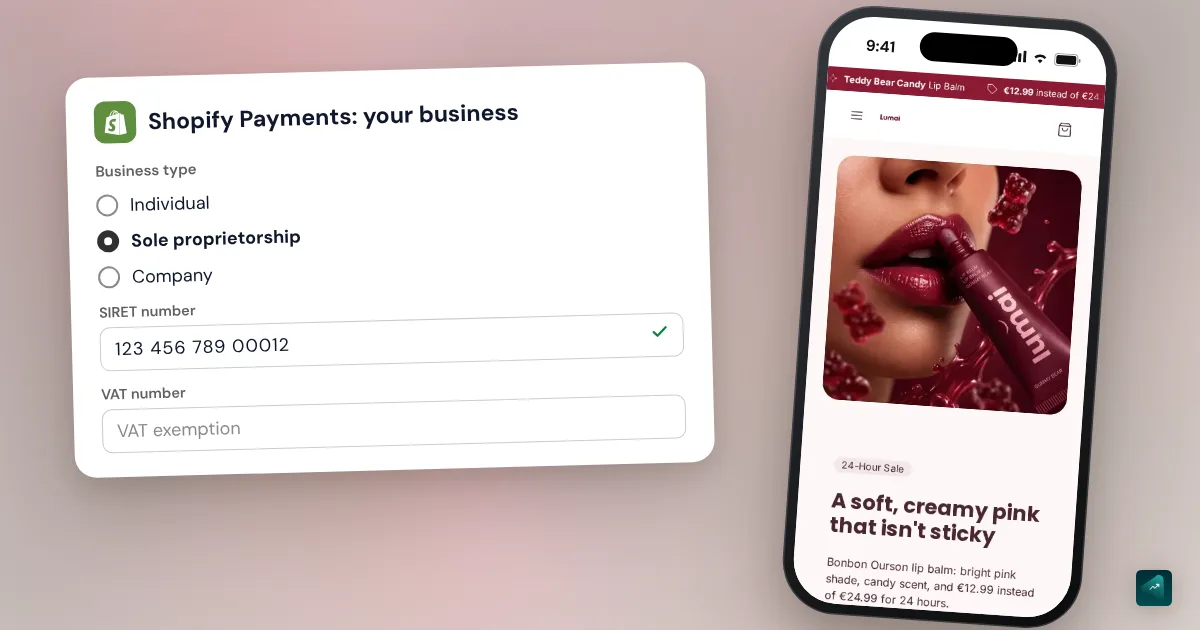
Shopify looks at your business status when you turn on Shopify Payments, under Settings > Payments. It then asks for your business type. Its help page for France gives the rule. Without a SIRET number, you select "Individual." A French micro-entrepreneur or auto-entrepreneur selects "Sole proprietorship" and enters their SIRET.
As an "Individual," Shopify checks your identity and your home address, which has to be in mainland France. It also asks for your 13-digit personal tax number, the one printed on your latest income tax return. Payouts go to a euro bank account, with an IBAN that accepts SEPA transfers.
Don't put this check off. Since June 2026, a new Shopify Payments account in France has 90 days after its first order to complete it. After that, Shopify may automatically refund the orders you took.
What that choice doesn't settle
Shopify checks who you are because financial crime rules require it. It doesn't check whether you're allowed to sell. The "Individual" option exists, but it doesn't make your activity legal. To know whether you need to register, you have to read the law, not Shopify's form.
What French law says
Selling your own stuff or selling to make money
The law separates two situations. Reselling things you're getting rid of, on Vinted or at a yard sale, isn't taxable. There are a few exceptions, like a piece of jewelry or art sold for more than €5,000.
Buying or making products to sell them is a different story. Service-Public, the French government's information site, says it plainly. The income from that activity is taxable, and you have to declare it. A Shopify store almost always falls into this case. With dropshipping or print-on-demand, you're selling products bought to be resold.
No small amount exempts you from declaring. Service-Public states that side income is taxable whatever the amount. Under €305 of sales a year, you simply pay no income tax on it.
What you risk if you sell without registering
Running an activity without registering it counts as undeclared work, in the form of concealed activity. The government's page on illegal work cites exactly this case, with no registration in the RCS or RNE business registers. The offense carries up to 3 years in prison and a €45,000 fine. Unpaid social contributions are claimed back with a 35% surcharge.
Your store itself puts you at fault. A website that sells must show the seller's registration number in its legal notice. Without a SIRET, that page is incomplete from day one. For a sole trader, leaving out this information carries a fine of up to €75,000.
Against those risks, registering costs nothing. That's what makes selling without a status such a hard bet to defend.
Testing without selling
Building your store isn't selling. While it's in private mode, nobody can place an order, so you don't collect anything. The status question comes up the day a customer can pay.
The simplest path is to run both in parallel. You build the store while your micro-entreprise gets registered. You open once you have your number.
Registering your micro-entreprise before you open
The micro-entreprise is the simplest status to start with. Registration is free, and so is the entry in the RCS and RNE registers for a commercial activity. If a website charges you for it, it's a middleman and not the government.
- Go to the one-stop portal, formalites.entreprises.gouv.fr. Every business registration in France goes through it.
- Declare a commercial activity selling online. Have your ID and a proof of address ready. You also sign a sworn statement that you have no criminal conviction.
- Wait for your RNE registration certificate. It shows your 9-digit SIREN number. Your SIRET is that SIREN followed by the 5 digits of your business location.
- Choose "Sole proprietorship" in Shopify Payments. Enter your full 14-digit SIRET. Shopify names the classic mistake, which is entering only the 9 digits of the SIREN.
- Complete your legal notice with your number, as explained below.
After that, you pay social contributions on what you collect. For selling goods, that's 12.3% of revenue. The rate goes up to 13.3% if you choose to pay your income tax at the same time, through the optional flat-rate payment. You declare your revenue every month or every quarter.
The micro regime holds as long as your sales revenue stays under €203,100 a year. Going over once doesn't push you out, it takes two years in a row. Torn between a micro-entreprise and a company? The guide on how to start an online store from zero compares the options, including keeping a job on the side.
Your store's legal notice
A store run by a micro-entrepreneur must show the following information, on a dedicated page or in the terms of sale.
- Your first and last name, followed by "entrepreneur individuel" or "EI."
- Your business address.
- An email address and a phone number to reach you.
- Your RCS or RNE registration number.
- Your EU VAT number, if you have one.
- The contact details of the host, which is Shopify.
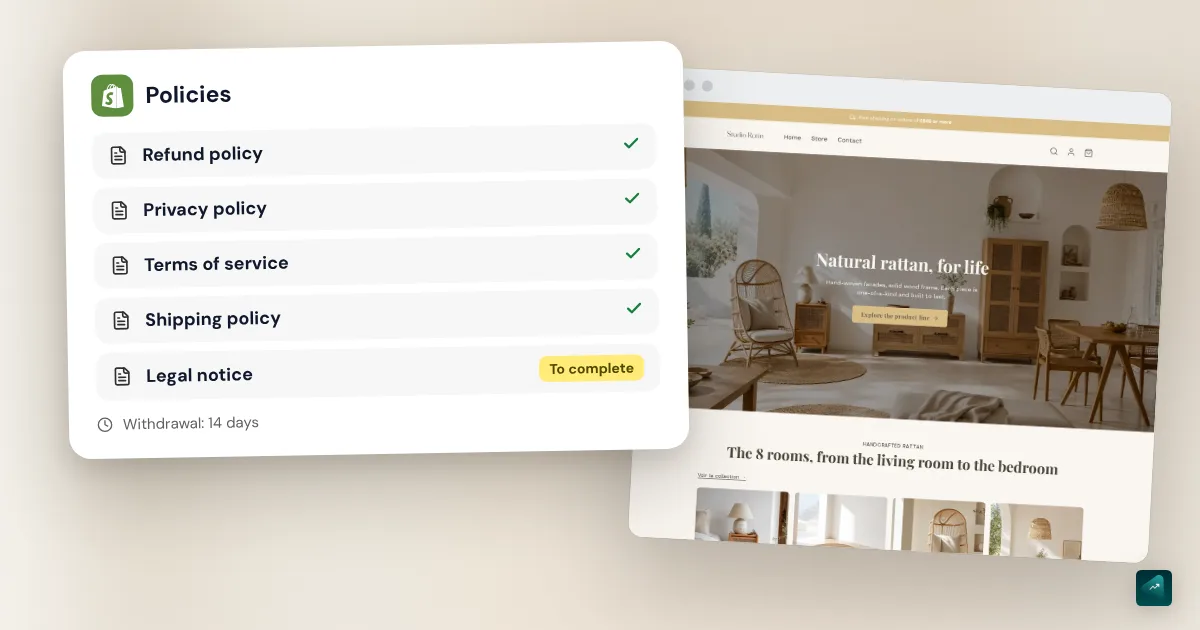
Your terms of sale and return policy come on top. Shopify offers automated versions under Settings > Policies. Read them anyway with your real delivery times and conditions.
VAT as a French micro-entrepreneur on Shopify
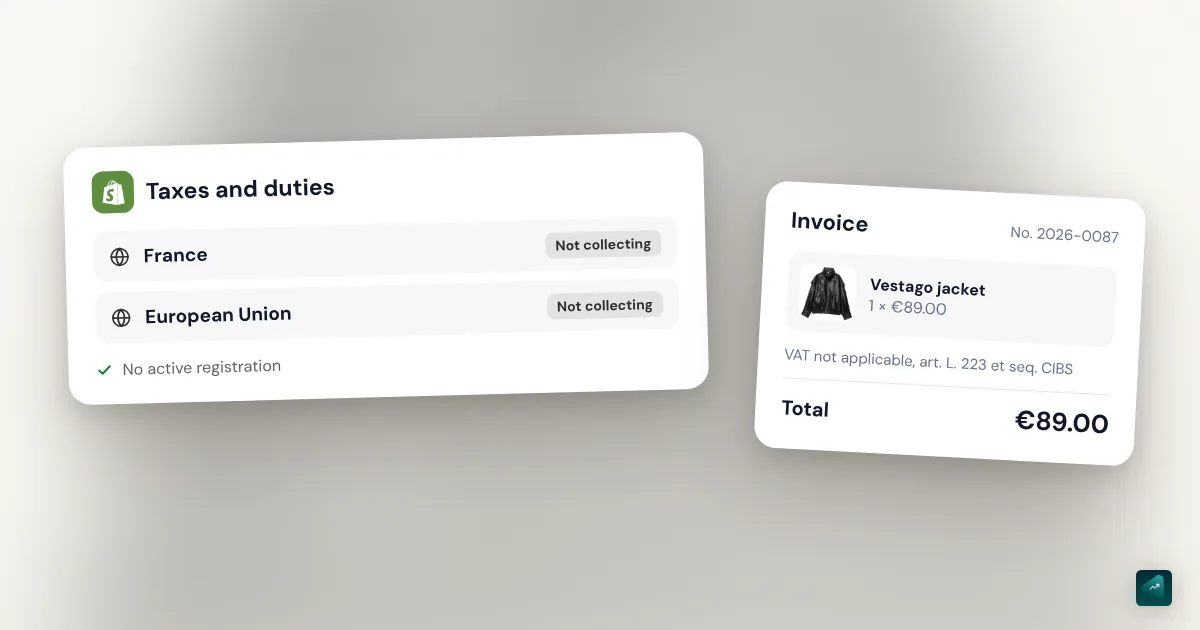
As a micro-entrepreneur, you usually benefit from the VAT small business exemption, called franchise en base. You don't charge VAT to your customers, and you don't reclaim it on your purchases. The 2026 thresholds haven't changed. The single €25,000 threshold planned by the 2025 budget law was dropped.
| Activity | You stay exempt if last year's revenue didn't exceed | VAT applies from the day you exceed, within the year |
|---|---|---|
| Sale of goods | €85,000 | €93,500 |
| Services | €37,500 | €41,250 |
Each invoice then carries the line "TVA non applicable, art. L. 223 et s. du code des impositions sur les biens et services (CIBS)". That's the wording in force since September 1, 2026. The old one, "TVA non applicable, art. 293 B du code général des impôts", stays accepted until December 31, 2027. If you leave the line out, you risk a tax reassessment.
In Shopify, VAT is set up under Settings > Taxes and duties. That's where you enter a VAT number so Shopify can collect it. Under the exemption, you have no number to enter. Place a test order and check that no VAT shows up at checkout. The full setup, screen by screen, is in Shopify VAT in France for micro-entrepreneurs.
If you sell to customers in other EU countries, another threshold matters. Shopify's help puts it at €10,000 of sales a year to those countries. Beyond that, your customer's country VAT applies, and an accountant becomes really useful. If your products come from China, import VAT and the €3 customs duty are covered in selling without inventory.
Invoices, records, and bank account
When you sell a product to a consumer, an invoice is only required in a few cases. Distance selling is one of them, so every order from your store needs one. It carries a unique number that follows a sequence. Your name appears on it with "EI." Under the exemption, the "TVA non applicable" line goes on it too.
As a micro-entrepreneur, two records are enough. The sales ledger lists each payment received in order, with how it was paid and the invoice reference. The purchase ledger does the same for what you buy, inventory and suppliers included. You keep them for 10 years, along with the receipts. A spreadsheet or accounting software works fine.
For payments, your personal account is enough at first. A dedicated account becomes mandatory if your revenue goes over €10,000 two years in a row.
E-invoicing is coming too. Since September 1, 2026, every French business registered for VAT purposes must be able to receive e-invoices. A micro-entreprise will also have to issue them from September 1, 2027. Your sales to consumers don't go through e-invoicing, but some sales data may have to be sent to the tax office. What the reform changes for a Shopify store is covered in France e-invoicing for Shopify stores.
Does Shopify report your sales to the tax office?
Marketplaces like Vinted or Leboncoin send their sellers' sales to the tax office. Beyond 30 sales or €2,000 of revenue in a year, the amounts show up pre-filled on your French tax return. That's the European DAC7 rule.
It targets platforms that connect sellers with customers. A Shopify store works differently. You rent software to run your own site, and Shopify doesn't bring you any customers. I found no text, from Shopify or from the authorities, that puts Shopify among those platforms.
That doesn't change what you have to do. Nobody reporting your sales for you doesn't make them any less taxable. If anything, it's one more reason to declare them yourself.
While your paperwork goes through
Ova doesn't register your business and doesn't handle any paperwork for you. While your registration goes through, it can build the rest of the store. It prepares the theme and the product pages. For example, you could type "add a legal notice page with my name followed by EI and my SIRET." Read the result, since it isn't legal advice. Describe your project to Scale Ova: generating is free, and the subscription only comes in when you publish to Shopify.
Next, the complete guide to building your Shopify store walks through every setting, and Is Shopify free explains what the trial and the plans cost.
FAQ
Can you sell on Shopify without a registered business?
Does Shopify ask for a business number at sign-up?
Can you open a Shopify store without a business just to test?
Which business type should a French auto-entrepreneur choose in Shopify Payments?
Do you need a VAT number to sell on Shopify?
How much does it cost to register a micro-entreprise?
Does Shopify report my sales to the tax office?
Can you open a Shopify store at 16?
Sources
- Shopify, terms of service: minimum age, business use, taxes on the merchant, checked October 29, 2026
- Shopify Help Center, Shopify Payments requirements in France: "Individual" and "Sole proprietorship" types, SIRET, personal tax number, bank account, 90-day deadline, checked October 29, 2026
- Shopify Help Center, preparing to launch your store: private mode during the trial, checked October 29, 2026
- Shopify Help Center, EU tax setup: Settings > Taxes and duties, €10,000 threshold, checked October 29, 2026
- Service-Public, income from a side activity: used goods, buying to resell, €305 threshold, platform reporting, verified April 15, 2026 (in French)
- Service-Public, risks in case of illegal work: concealed activity, 3 years and €45,000, 35% surcharge, verified July 3, 2026 (in French)
- Service-Public, registering a micro-entreprise: free registration, one-stop portal, documents required, checked October 29, 2026 (in French)
- Service-Public, micro-entrepreneur social contributions: 12.3% for selling goods, verified January 1, 2026 (in French)
- Service-Public, exceeding micro-entreprise thresholds: €203,100 for sales, verified February 21, 2026 (in French)
- Service-Public, VAT small business exemption: 2026 thresholds unchanged, article 293 B line, verified January 1, 2026 (in French)
- Service-Public, mandatory information on a business website: what to display and penalties, checked October 29, 2026 (in French)
- Service-Public, everything about invoicing: invoice required for distance selling, e-invoicing timeline, new CIBS wording from September 1, 2026, tolerance until December 31, 2027, verified August 7, 2026 (in French)
- Service-Public, micro-entrepreneur bookkeeping: sales and purchase ledgers, 10-year retention, bank account, verified September 7, 2026 (in French)
- European Commission, DAC7: platforms that connect sellers with customers, checked October 29, 2026