You have your product, maybe even your supplier, and you're stuck on the name. That's normal. The choice feels permanent, as if it will decide whether the store works.
At the start, it doesn't decide much. People buy because the product speaks to them and the store feels trustworthy. The name matters for two reasons. It has to stick after someone watches your video, and it must not get you into trouble with an existing brand. Here is a method to find one in an evening, with examples and the checks to run.
Before you brainstorm, write three sentences
A name pulled out of thin air is hard to judge. Start by writing three sentences about your store.
- What you sell. For example, "hand-poured scented candles."
- Who you sell to. For example, "people in their thirties decorating their first apartment."
- What your customer should feel. Calm, pride, the urge to treat themselves.
These three sentences give you your word bank. Write down everything they bring to mind. Think of the materials and gestures around the product. Also note the words your customer uses. You'll draw from that list for every family of names.
The 4 families of store names
Almost every store name falls into one of four families. Each has its strengths, and none beats the others.
| Family | Real example | Strength | Limit |
|---|---|---|---|
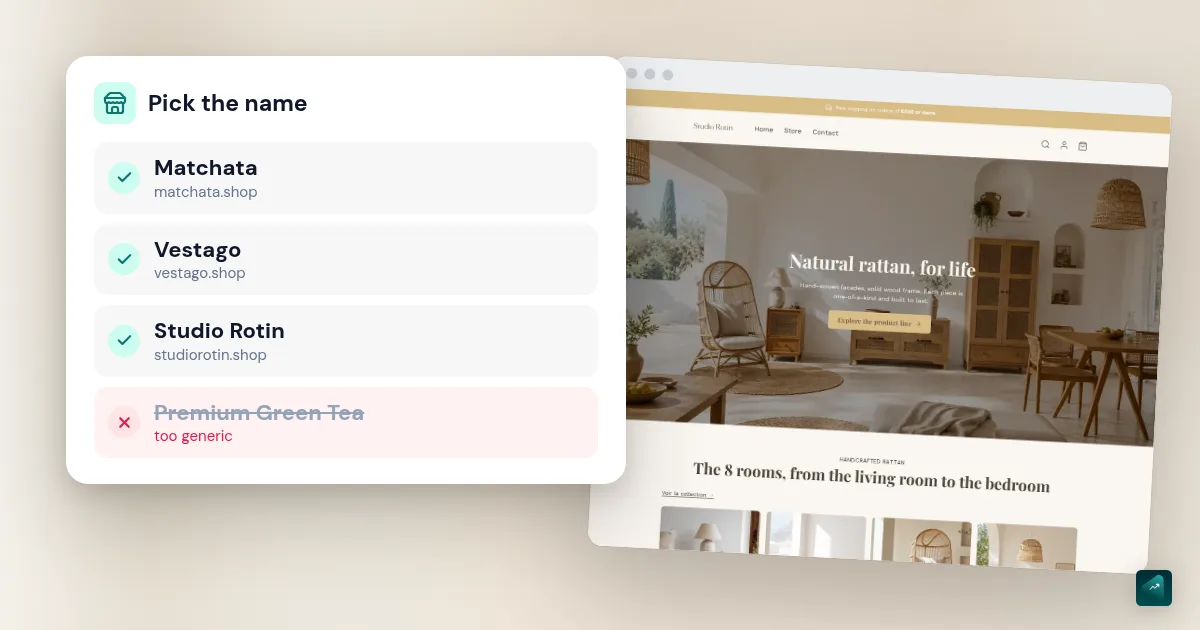
| The name that says what you sell | Studio Rotin | Instantly clear | Hard to protect, boxes you in if your range grows |
| The word built from the product | Matchata, Vestago, Mixup | Hints at the product and stays yours | Can sound forced if badly built |
| The invented word | Lumai, ZOHI | Often available everywhere | Means nothing until you tell your story |
| The personal or place name | A first name, a street, a village | Warm, credible for handmade goods | Often taken, less memorable |
The real examples in the table are demo stores generated by Scale Ova. Their names were created from a simple product description.
The name that says what you sell
Studio Rotin sells rattan and wood furniture ("rotin" is French for rattan). Visitors know what they'll find before they even land on the page. That's reassuring for a niche store.
The downside is that a purely descriptive name is hard to protect. A word that simply names the product can't become your trademark. And if you add metal lamps one day, "Rattan" starts to feel narrow.
The word built from the product
Matchata sells matcha, and Vestago sells a jacket ("veste" in French). Mixup sells a portable blender. You take a word from the product and reshape it. You can add a syllable, cut one or glue two words together.
It's often the best compromise for a first store. The name hints at the product without describing it, so it's more likely to be available. The trap is the mashup nobody can pronounce. If you have to spell it every time, it doesn't work.
The invented word
Lumai sells a tinted lip balm, and ZOHI sells an energy chewing gum. These words mean nothing at first. The store gives them their meaning.
An invented word has two advantages. The .com is often available, and the trademark is easier to register. In exchange, your customer can't guess what you sell. Your homepage and your videos have to do all the work.
The personal or place name
Your first name, your grandmother's or your street's name makes a warm store name. It works well for handmade jewelry, ceramics or specialty food. Customers feel there's a person behind it.
These names are often already taken, especially common first names. And if you ever sell the store, your name goes with it.
A store with a built name, for real
Matchata is a demo store generated by Scale Ova from a description. It sells ceremonial-grade matcha in a 30 g pouch. Its name glues "matcha" to an ending that sounds good in both French and English.
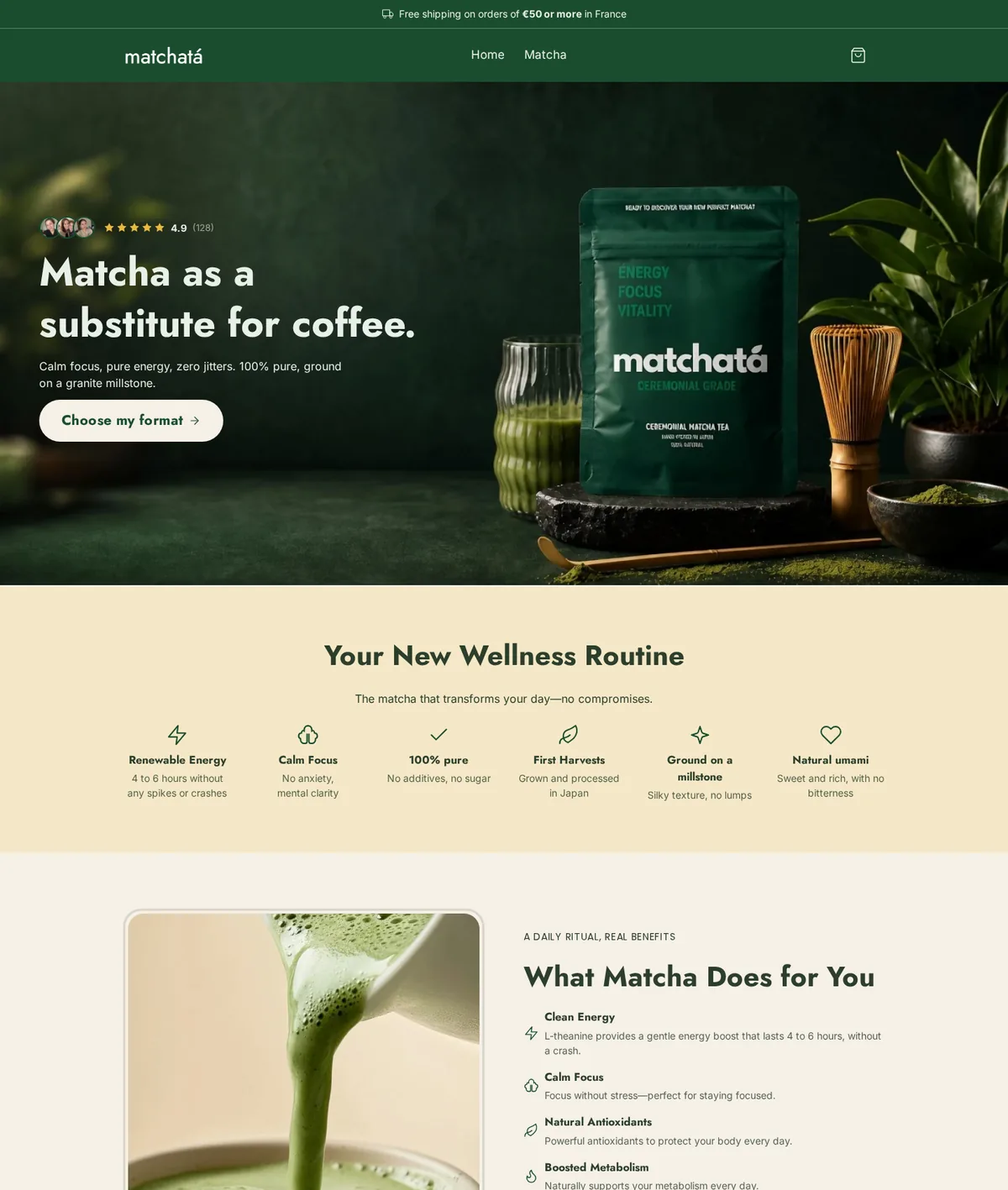
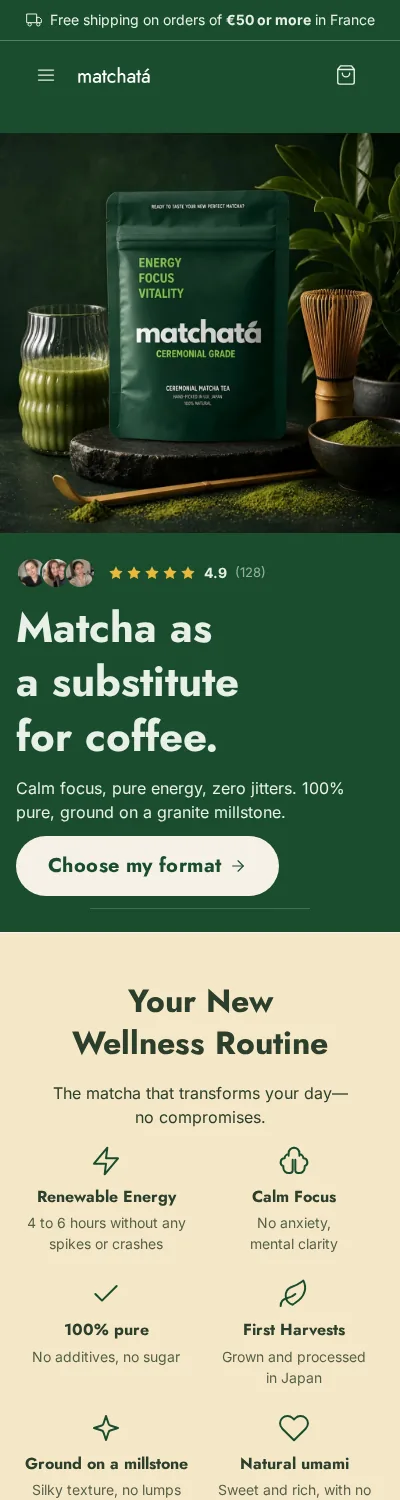
Look at how the name lives on the store. It's short and it fits in a logo on mobile. You can guess the product without the name describing it. That's what you want for most products.
Online store name ideas by niche
The names below are made up for this example. None has been checked against trademark databases or domain registrars. They show how each family applies to a niche. If one appeals to you, run it through the five checks below before you get attached.
| Niche | Built name | Invented word | Personal or place name |
|---|---|---|---|
| Jewelry | Orlina | Vessa | Margot's Studio |
| Women's clothing | Linea | Mavra | Clemence Street |
| Kids' clothing | Tinysteps | Bimou | Leon's Days |
| Candles and decor | Waxelle | Okalo | Fig House |
| Skincare | Skinlune | Sorai | Alba Garden |
| Sports and fitness | Musclo | Krev | Vauban Club |
| Pets | Pawlette | Fopi | Biscuit's Place |
For an original name, avoid what everyone in your niche does. Jewelry stores called "Something Jewels" all blur together. Your customer won't remember yours once the tab is closed.
The 5 checks before you choose
Keep three names and run them through these checks, in this order. The first one rules names out fast, the last one takes longer.
- The phone test. Say the name out loud to someone, once. Ask them to type it into their phone. If they hesitate on the spelling, your customers will too when they search for you after your video.
- The domain name. Check that the .com is available at a registrar or directly from Shopify. If your exact name is taken, a word like "shop" or "get" in front may do. Avoid hyphens and numbers, which get lost when spoken.
- Social handles. Search the name on Instagram and TikTok. You don't need the exact handle, but an active account with the same name in your niche will confuse people.
- A trademark search. In the US, search the USPTO trademark database at tmsearch.uspto.gov. In France, use the free trademark search on data.inpi.fr. Look mostly at trademarks filed for the same products as yours.
- Closeness to a famous brand. A name that recalls a big brand is risky, even for a different product. France's INPI notes that well-known brands are protected beyond their own products.
Add one last quick check. Type the name into Google and look at the first page. If it's full of a company in your niche, change the name while it still costs you nothing.
What's required, and what isn't
Choosing a store name doesn't require any paperwork. What's required is the legal name of your business on your documents. Registering a trademark is a choice.
Your business name
Rules depend on your country. In France, a sole trader's business carries their first and last name. It must come with the words "entrepreneur individuel" or the initials "EI," on invoices and legal pages. Leaving it out can cost a fine of up to €750, according to Service-Public. If your store name becomes your trade name, you declare it when you register, or within a month if you pick it later.
In the US, a store name that differs from your own name is a "doing business as" name, or DBA. Most states require you to register it, and some counties and cities do too. The SBA notes that a DBA gives you no legal protection on the name.
Registering a trademark
A trademark gives you a clear right to the name for the products you choose.
| What the offices say | Checked on October 29, 2026 |
|---|---|
| USPTO, base application fee | $350 per class of goods or services |
| INPI (France), online filing | €190 for one class, €40 per extra class |
| INPI, length of protection | 10 years from filing, renewable indefinitely |
| INPI, opposition window | 2 months after the application is published |
Goods and services are sorted into 45 classes. Clothing, for example, falls under class 25. At the INPI, you can't add products once you've paid, so pick your classes carefully.
Should you file on day one? Not necessarily. If you're testing an idea on a small budget, you can wait to see if it takes off. But if you're investing in stock or ads, the filing fee is small. It's far smaller than a forced rebrand after six months of sales.
What a domain name doesn't protect
Buying the .com of your name gives you no right to the brand. If someone registered that name before you for the same products, they can ask you to stop using it. That's why the trademark search comes before buying the domain.
Naming your Shopify store, and where the name goes
Shopify uses three different names for your store. People often mix them up.
- The store name. It's the one shown on your site. By default, it's "My Store." You change it in Settings > General, under Store contact details, in the Store name field. You can change it as often as you like. The one exception is Shopify Payments, where you contact Support to change the business name on the payments account.
- The myshopify.com address. Shopify generates it when you sign up. Changing the store name doesn't change it. You can pick a new one for free in Settings > Domains, but only once.
- The domain name. It's the address your customers type, like yourstore.com. You buy it separately, and the Shopify domain name guide covers prices and setup.
Don't hold up your store over the name. You can start with a placeholder and change it before you open. The complete guide to building your Shopify store walks through every step in order.
Once you have a name and a logo, turn them into a favicon for your Shopify store.
Free name generators, useful but not enough
Shopify, Qonto and Squarespace each offer a free name generator. You type a few words and get dozens of suggestions. It helps when you're stuck and need ideas.
None of these tools runs a trademark search for you. Qonto even says so on its page. It doesn't guarantee that the names it suggests are available or unique. Treat these lists as a brainstorm, and run your favorites through the five checks like any other name.
Going further
If you don't have a name yet, describe your product and your customer to Scale Ova. Ova then creates a short name drawn from your store and uses it in the header and everywhere the store names itself. You can also ask for other options in one sentence. For example: "I sell fig candles to people in their thirties. Give me five softer names." Renaming takes one sentence too, across the whole store. The five checks are still yours to run, as with any name you find yourself. Generating and editing are free, and a Scale Ova subscription is only needed to publish to Shopify.
FAQ
How do I find a store name for free?
Do I have to register my store name as a trademark?
Can I change my Shopify store name?
Should the store name include the product name?
Can I use a name another store already uses?
Sources
- USPTO, how much does it cost?, $350 base application fee per class, checked on October 29, 2026
- INPI, filer and cost of a trademark (in French), €190 for one class and €40 per extra class
- INPI, the trademark after filing (in French), 10-year protection and 2-month opposition window
- INPI, filing a trademark (in French)
- Service-Public, required mentions for sole traders (in French)
- SBA, choose your business name, DBA registration
- Shopify Help Center, adding business settings for your store