You want to open a gaming store online: keyboards, mice, headsets, mousepads, accessories. The market is there, so are the brands, and that is the starting point: in this aisle, you almost always resell someone else's brand, or you create one on a product that comes out of a shared factory. Both are done. We look at a real store, then rebuild it for your product.
If you are new to Shopify, the complete guide to building your store covers the basics shared by every niche. Here, we only talk about gaming gear.
The market, in three numbers
In 2025, video games generated 5.856 billion euros in France, up 3 %. PC gaming weighs 1.512 billion, 26 % of the market, and hardware sales are up 8 %. (SELL, French games industry body, 2025 report published 31 March 2026)
- PC gaming is stable, not exploding. You are not riding a wave, you are entering a mature aisle where gamers compare, read reviews and know the prices.
- Consoles drive hardware. Console sales jumped 14 %. Console accessories (controllers, headsets, stands) are an entry point often less contested than the 8,000 Hz mouse.
- Gamers buy numbers. Polling rate, response time, switch type, weight in grams. A gaming store that speaks in adjectives does not sell. The demo below speaks in numbers.
The store: one keyboard, one colour, numbers
The store below is a demo generated by Scale Ova from the page of an existing product: a compact 68-key mechanical keyboard, Hall effect magnetic switches, 8,000 Hz, in pink, sold at 120 €. It is a reseller store, centred on one reference. You can visit it page by page.
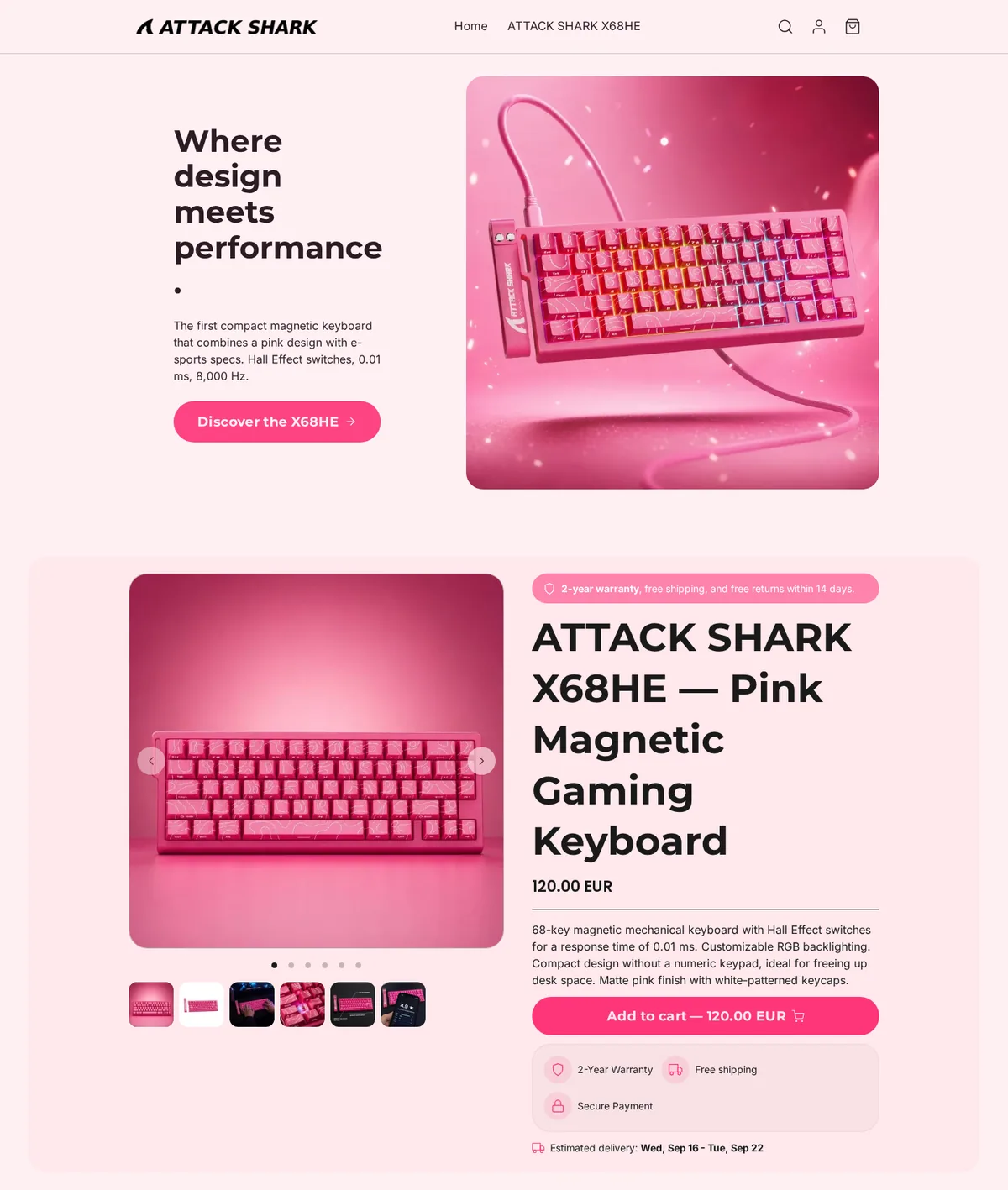
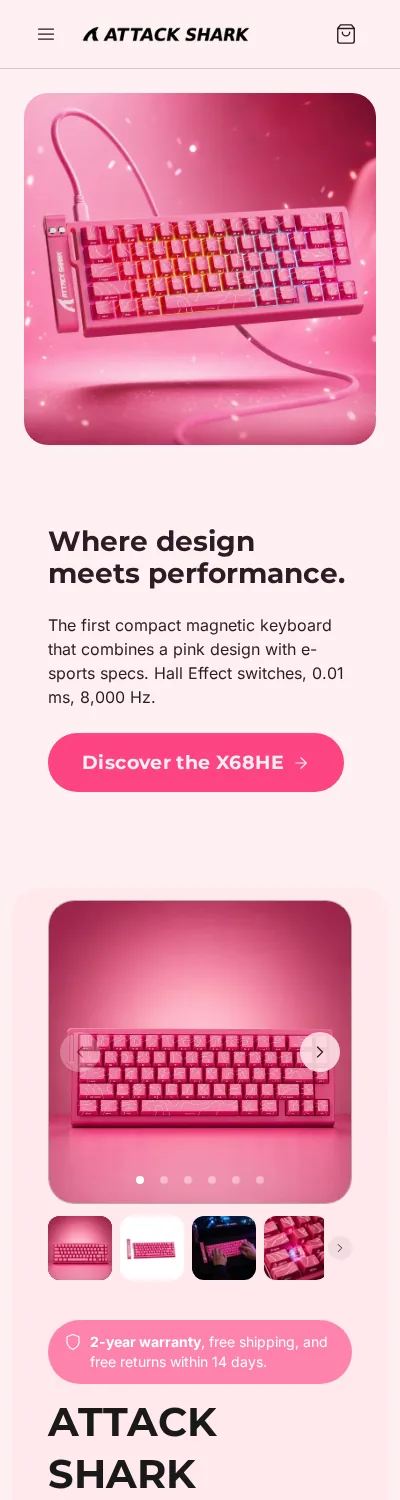
Look at how it sells. The headline sets the positioning in five words, "where design meets performance", and the subtitle moves straight to the numbers: 0.01 ms, 8,000 Hz, Hall effect. The keyboard is photographed on a background of its own colour, cable visible: the product is the image. And the product page does the rest: a guarantee, free shipping, 14-day returns bar above the name, a description that speaks the language of reviews, the price in the button, and an estimated delivery date under the button.
The anatomy, marker by marker
Eight elements make a gamer understand, trust and buy. Spot them on the demo, then reproduce them for your product.
- The reduced menu: home and the product. On a store centred on one reference, anything that is not the product distracts.
- The positioning headline: design and performance, the promise in five words. The gamer knows straight away whether it is for them.
- The numbers in the subtitle: 0.01 ms, 8,000 Hz, Hall effect. In this aisle, the subtitle makes the sale, not the headline.
- The button to the product: one button, leading to the product page, not to an "our story" page.
- The visual in its colour: the keyboard on a background of the same shade, cable visible. The product is the image, there is nothing else.
- The reassurance bar: guarantee, shipping, returns, in one line above the name. It is what the gamer looks for before the price.
- The name, the price, the technical description: layout, switches, backlighting, keycaps. The page speaks the language of reviews.
- The estimated delivery date: a date range displayed. On a product you can find elsewhere, it is often what decides.
The product page in numbers: what sells in this aisle
A gamer lands on your page with a YouTube review in the other tab. The page does not have to convince them the product is good, they already know. It has to give them a reason to buy here, now. Here is what the demo's page does, and why.
- Specs before adjectives. 68 keys, Hall effect, 0.01 ms, 8,000 Hz, RGB backlighting, patterned keycaps. The demo's description fits in five lines and every line is a number or a component name. It is what the gamer looks for, and what they compare.
- A gallery that shows the product in use. Six photos: the keyboard alone, in hand, on the desk, the backlighting in the dark, the underside. The gamer checks the finish, the tilt, the light, everything a review does not show up close.
- The price in the button. "Add to cart, 120 €": the list price is known, hiding it is pointless, showing it in the button saves a click.
- The estimated delivery date under the button. A date range, not "3 to 5 working days". On a product available on three marketplaces, it is often what decides, and it is a commitment to keep.
- The bar above the name. Guarantee, free shipping, free 14-day returns. The gamer looks for these three lines before the price: put them before the price.
- Colour as an argument. The same keyboard exists in black everywhere. Pink, with a matching background and cable, is a reason to buy this one, here.
- Accessories, as soon as you have two references. Keycaps, a coiled cable, a matching mousepad. On a 120 € basket, that is where the average order is made, and where service beats the marketplace.
What you write: the specs, the use, the setup
A gaming peripheral sells on three registers, and the first one comes ready-made from the maker.
- The specs. Polling rate, response time, switch type, weight, battery life. You take them from the official sheet, cite the source, keep the sheet: you are the one answering for them to the customer.
- The use. The compact layout that frees up the desk, adjustable magnetic switches for competitive play, the detachable cable for travel. What the gamer does with it, not what the product is.
- The setup. The colour, the light, the matching desk. The gamer is also buying a photo of their desk they will show off.
Three details that protect your page: "the first", "the fastest", "1,000 times faster" are superiority claims that need proof you can show; the two-year guarantee the demo displays is the legal guarantee every seller in the EU owes, while a "lifetime guarantee" is a commercial promise you must honour, so only write the one you keep; and if you show a crossed-out price, the reference price is the lowest price applied in the previous 30 days, and on a product with a known list price, a fake one is spotted in ten seconds.
On what basis you sell: reseller, import or own brand
In gaming gear, the question is not "which product", it is "on what basis do I sell it". Three answers, and for a first store, the first one is enough.
| Route | How you source | What matters | For whom |
|---|---|---|---|
| Reseller of an existing brand | Trade account with the brand or its European distributor | A product placed on the market in Europe with the brand's consent can be resold freely. A brand with selective distribution may require approval and ban marketplaces, not online selling itself | Start fast, on service |
| Parallel import from outside Europe | Directly from Asia or the US, bypassing the brand | The brand can oppose the import of a genuine product bought outside Europe, and you become the importer: compliance, eco-fee, manual, all on you | Nobody, for a first store |
| Your own brand (ODM manufacturing) | A factory builds an existing model with your logo | Your name on the product makes you the manufacturer: technical file, declaration of conformity, CE marking, eco-fee | A second step, once you know what sells |
- Reseller: the safest route. You ask the brand or a European distributor for a trade account, buy a few units, sell at or below the recommended price. The margin is thin, service makes the difference: delivery date kept, support in the customer's language, matching accessories. That is what the demo does.
- Parallel import: more margin on paper, two risks underneath. The brand can have genuine products imported without its consent seized. And the device may have no local-language manual, no European adapter, no valid declaration of conformity: producing them is on you.
- Own brand: the only route that builds something of your own. Minimum order on quote, often several hundred pieces per reference, lab tests, technical file. Keep it for later.
What to settle before the first sale
A keyboard or a mouse is an electrical device. No licence, no diploma, but a few things to set up once and for all, and as a reseller of a European brand, most of them are already handled by the brand.
- CE marking and the declaration of conformity. Someone in the EU holds them. If you resell a European brand, it is the brand. If you import or it is your brand, it is you, with the lab tests that go with it. It is the question that decides everything: ask it before ordering.
- The maker and the responsible person in the EU, on the listing. Name and address, under the description. If the product carries your brand, that is you.
- The eco-fee: if you import or it is your brand, you join a take-back scheme (ecosystem or Ecologic in France), get a unique identifier for your terms of sale, and show the eco-fee separately from the price through to the customer. Order of magnitude: ten cents to one euro per small device. As a reseller of a European brand, the brand declares it, the display is still on you.
- Guarantee, returns, delivery: two years of legal guarantee, 14 days to withdraw, and a delivery date announced and kept. The range displayed by the demo is a commitment.
- VAT: 20 %. On a 120 € keyboard including tax, you keep 100 € before tax, minus purchase price, shipping and the eco-fee. If you import, an EORI number for customs.
What it costs over 12 months
The heaviest line is not the store: as a reseller, it is stock and the thin margin; as an own brand, it is testing and the minimum order.
| Item | Amount | Where the figure comes from |
|---|---|---|
| Shopify, Basic plan monthly, year 1 | About 327 € (3 free days, 1 €/month for 3 months, then 36 €/month) | Shopify France pricing page, 11 September 2026 |
| First stock as a reseller | A few units per reference at the brand's or distributor's trade price, on quote | Your distributor |
| First batch as an own brand | Factory minimum order times unit price, freight, duties and import VAT, on quote | Your manufacturer |
| Testing and technical file (own brand or import) | Lab tests, on quote; sometimes provided by the factory, to be checked | Testing laboratory |
| Eco-fee | About 0.10 € to 1 € per device for small IT equipment, passed on to the customer separately from the price | ecosystem 2026 scale |
| Photos and video | On quote, or a clean desk and one light: the product is the image | You or a photographer |
Not counted: advertising, which is up to you. The store itself, with Scale Ova, is generated for free from the product page or a description, and the subscription only starts when you publish.
The steps, in order
- Choose your basis. Reseller of a brand, or own brand later. Everything else follows.
- Open a trade account with the brand or a European distributor, or ask for an ODM quote with minimum, tests and technical file included or not.
- Check the product. CE marking, local-language manual, declaration of conformity, European adapter. Whatever is missing is on you.
- Generate the store. Give the product page or describe it. Look at the result, fix it by conversation. The demo above came out of this process.
- Build the page in numbers. Sourced specs, gallery in use, price in the button, delivery date, guarantee and returns bar, eco-fee shown separately.
- Settle the take-back scheme, VAT and the mentions, if you import or it is your brand.
- Set up shipping and legal pages, test an order end to end, then refund it.
- Publish, measure, bring people in. An analytics tool from day one, honest reviews and comparisons, content on tuning and setup, verified reviews, ads if the margin allows.
Going further
Want to see what your store would look like with your product? Give the product page or describe it to Scale Ova, look at the result, ask for changes, and only pay if you publish. If you start with a single reference, one product store examples compares three single-product stores line by line. For the product page itself, how to write a product page that converts gives the method section by section.
FAQ
Do I need a licence to sell gaming gear online in Europe?
What price should I sell a gaming peripheral at?
Can I resell a brand without its consent?
Can I import peripherals from China to resell them?
Is the two-year guarantee mandatory?
How much does an online gaming store cost?
Sources
- French video game market up 3 % in 2025, according to SELL, AFJV, 31 March 2026, and SELL 2025 market report
- French Intellectual Property Code, article L713-4 (exhaustion of trademark rights), Légifrance
- Court of Justice of the EU, case C-439/09 Pierre Fabre Dermo-Cosmétique, 13 October 2011 and case C-230/16 Coty Germany, 6 December 2017
- Regulation (EU) 2023/988 on general product safety, EUR-Lex
- ecosystem, 2026 eco-fee scales and display rule, household EEE scale of 27 March 2026
- French Consumer Code, articles L217-3 and following (legal guarantee of conformity), L221-18 (withdrawal), L216-1 (delivery), L112-1-1 (price reductions), Légifrance
- Shopify, France pricing, Basic plan and trial, checked 11 September 2026