You have one product, just one, and you want to build it a store. Not a catalogue, not collections: a page that explains, proves and sells. It is the model of most brands that started with one hero object, from the mattress to the portable blender. We look at three real stores, compare what they do, and rebuild it for your product.
If you are new to Shopify, the complete guide to building your store covers the basics. Here, we only talk about the one product store.
What a one product store is, and when it works
A one product store sells a single reference, with at most variants (colour, size, pack). The home page and the product page are the same page, or nearly. The whole store leads to one button.
It works when:
- The product demonstrates itself. A ten-second video or one image is enough to understand what it does. A blender that crushes frozen fruit, an alarm that forces you out of bed, a gum that replaces coffee.
- The promise fits in one sentence. If you need a paragraph to explain who it is for, it is not a one product store, it is a range.
- The margin absorbs acquisition. A one product store lives on ads and content, not on the search ranking of a catalogue. The price must leave room to pay for the click.
It does not work when the product is a commodity the customer finds three clicks away for less. Price is not enough, you need a promise and a page that proves it.
Three generated one product stores, three starting points
The three stores below were generated by Scale Ova. The first from a supplier link, the second from the page of an existing product, the third from a plain description. You can visit them page by page.
| Store | Starting point | Product | Price | Offer | Guarantee shown |
|---|---|---|---|---|---|
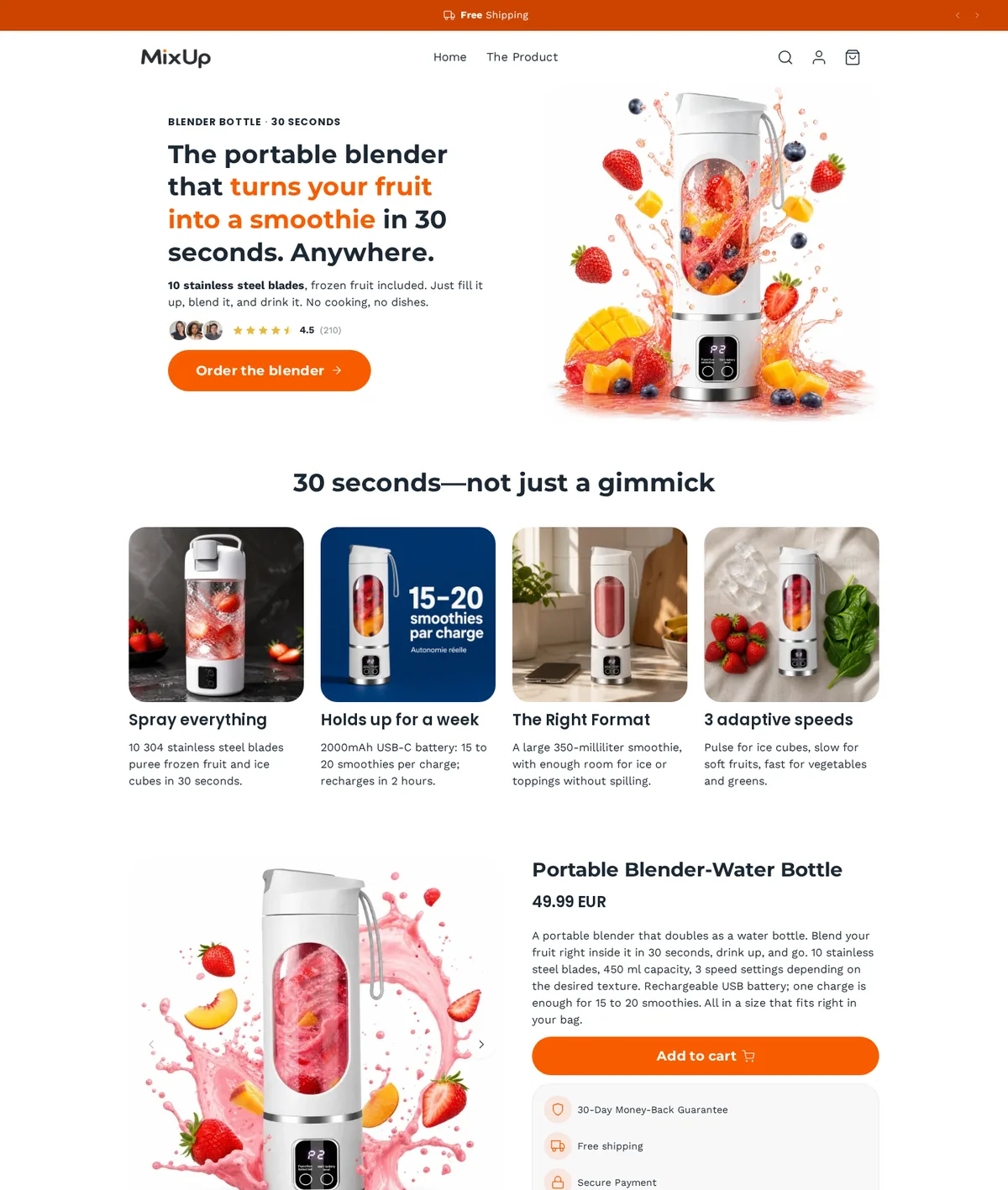
| Portable blender | A link to an online supplier's listing | USB blender bottle, 10 blades, 450 ml | 49.99 € | Free shipping | 30-day money back |
| Smart alarm | The page of an existing product (sensor + app) | NFC dock stuck far from the bed, app that only stops when you tap it | 45 € each, packs of 2 and 3 | Free shipping on everything | 30-day refund |
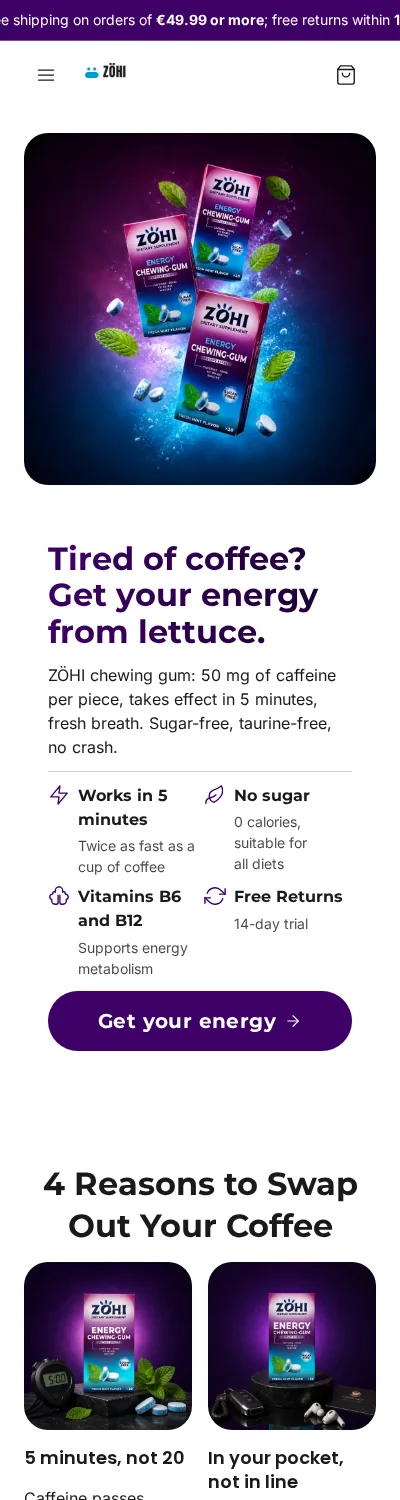
| Energy chewing gum | A description in a few lines | Gum with 50 mg caffeine, vitamins B6 and B12, box of 10 | 3 boxes 14.97 €, 12 boxes 49.70 €, 24 boxes 89.82 € | Free shipping from 49.99 € | Free returns 14 days |
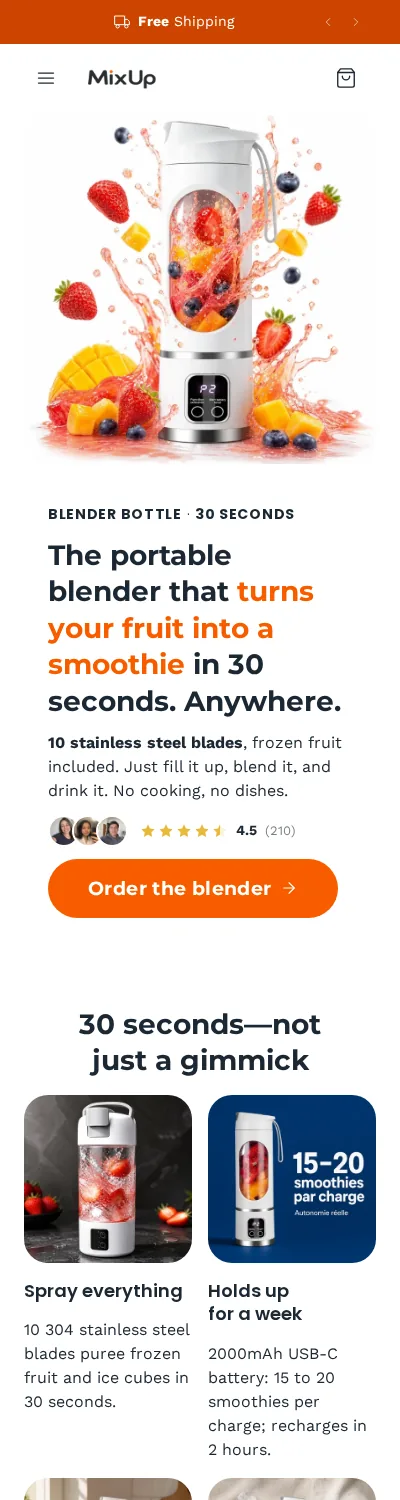
The portable blender. Generated from a supplier link: the promise ("your fruit as a smoothie in 30 seconds, anywhere"), four arguments (crushes everything, lasts the week, the right size, three speeds), the product page at 49.99 € with the 30-day guarantee. It is the classic structure of a product you understand in one image.
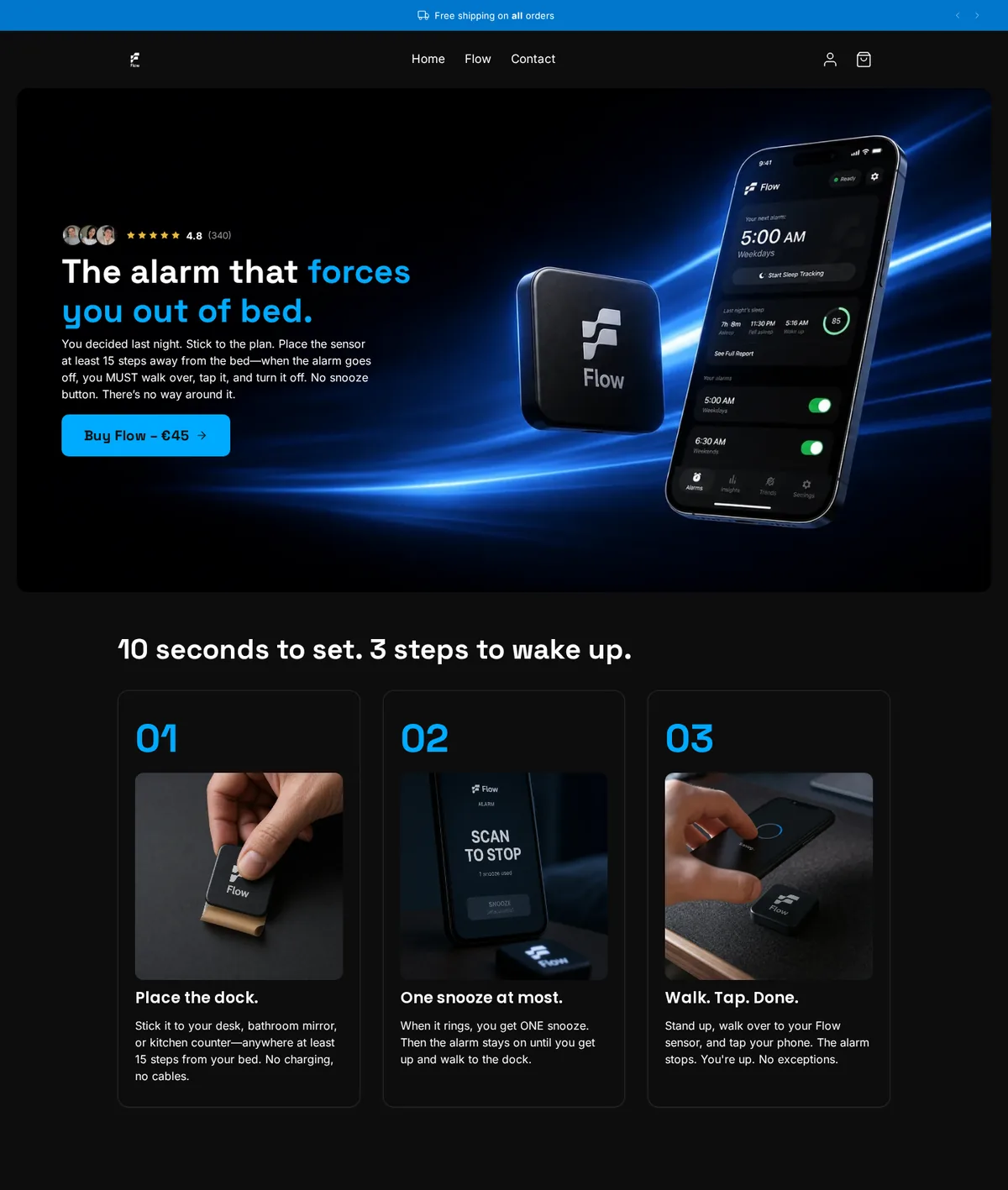
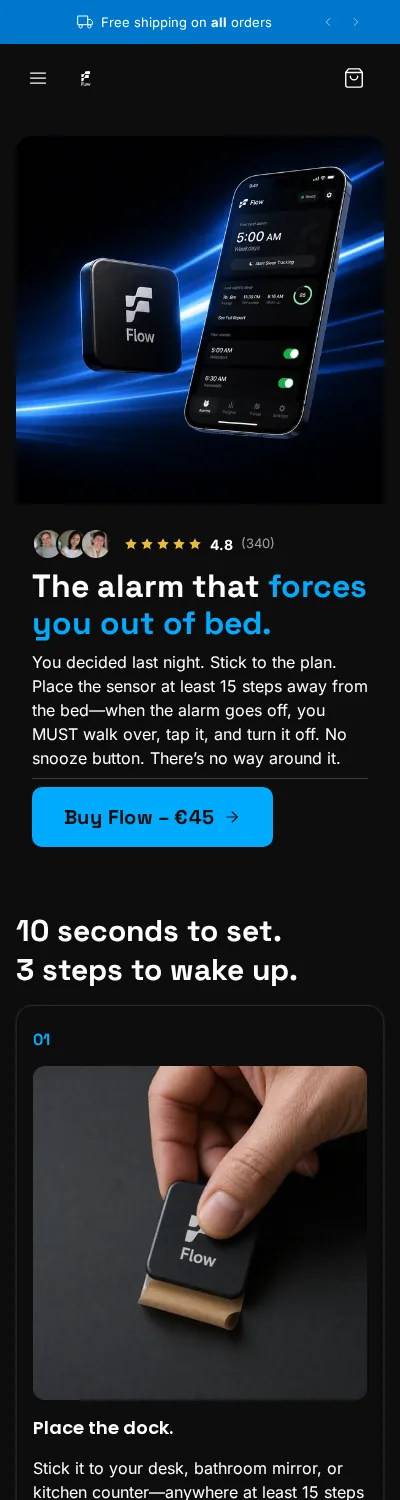
The smart alarm. Generated from the page of an existing product: a problem headline ("the alarm that forces you out of bed"), the mechanism in three lines, a button with the price in it, then three numbered steps. It is the structure of a product that needs to be understood before it is bought.
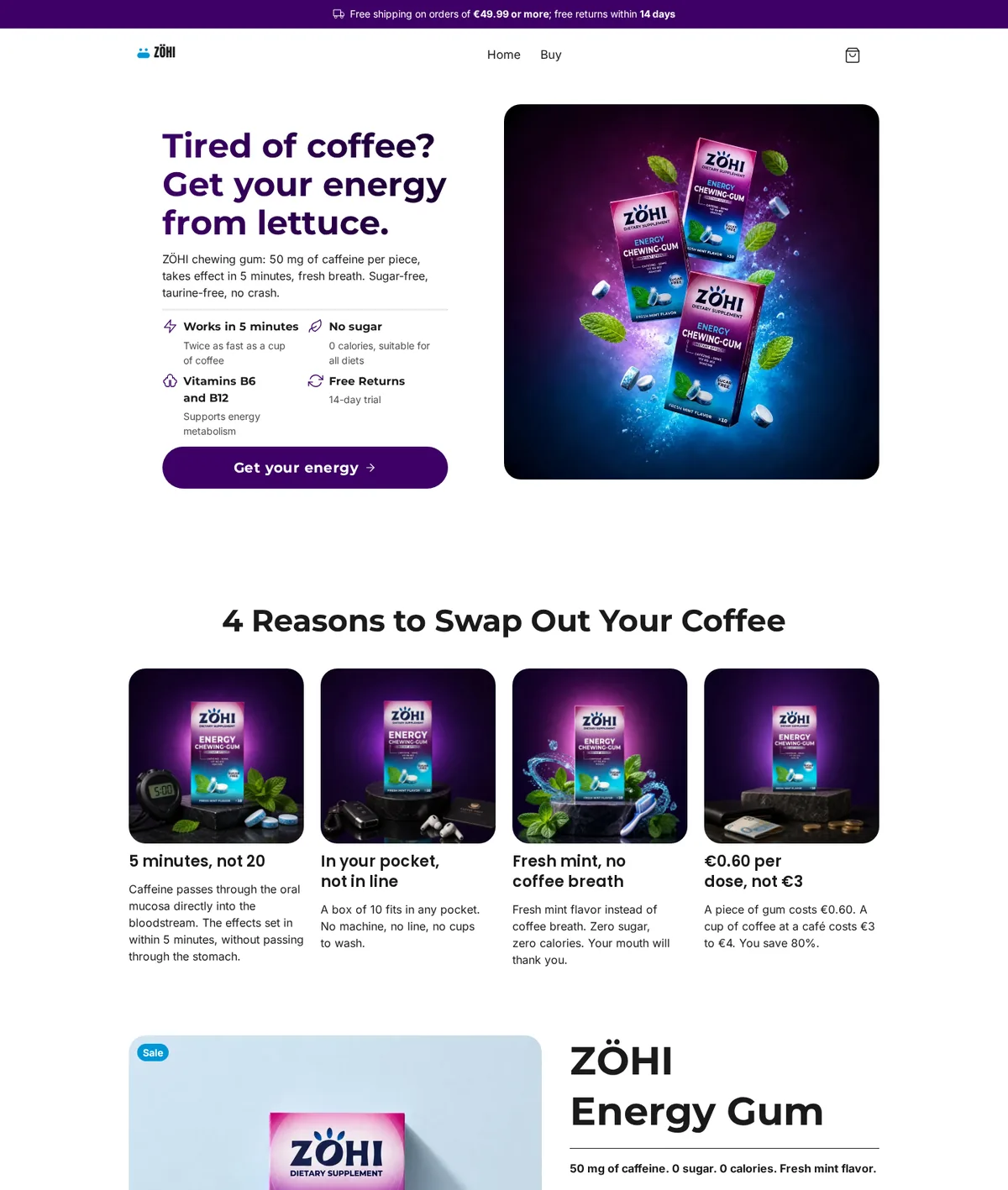
The energy chewing gum. Generated from a description: an opening question ("tired of coffee?"), four numbered reasons, three packs with the middle one highlighted, free returns. It is the structure of a consumable, where everything rides on the pack and the repeat purchase.
The anatomy of a one product store that converts
Eight elements make a visitor understand, trust and buy. Spot them on the second demo, the most stripped down, then reproduce them for your product.
- The scrolling bar: free shipping on everything. On a one product store, no threshold: there is only one decision to make.
- Social proof: a rating and a review count before the headline. As soon as you have your first verified reviews, put them there.
- The problem headline: what the product solves in the customer's life, not what it is. "The alarm that forces you out of bed" beats "NFC dock".
- The mechanism in three lines: how it works and why you cannot cheat. This is the reason to believe.
- The button with the price in it: one button, price shown, no "learn more". The price is not a surprise at the bottom of the page.
- The product in context: the sensor and the app screen side by side. A connected product is shown with what it displays.
- The numbered headline: "10 seconds to set up, 3 steps to get up". Simplicity is said in numbers.
- The three steps: 01, 02, 03, one photo of a gesture each. The "it's complicated" objection falls before the product page.
Three pages, one mechanism: problem, mechanism, offer
The three demos start from products that have nothing in common, and yet the three pages do the same thing in the same order. That is the one product recipe.
| Portable blender | Smart alarm | Energy chewing gum | |
|---|---|---|---|
| The problem headline | "Your fruit as a smoothie in 30 seconds, anywhere": time and place | "The alarm that forces you out of bed": the snooze button | "Tired of coffee?": a question the customer answers yes to |
| The mechanism | Four arguments in one word and one icon: crushes everything, lasts the week, the right size, three speeds | Three lines on the sensor far from the bed, then 01, 02, 03 with a gesture photo each | Four numbered reasons: the caffeine dose, the vitamins, the number of gums, the pocket format |
| The offer | A price under 50 €, free shipping, 30-day money back | 45 € each, packs of 2 and 3, free shipping on everything, 30-day refund | Three packs, the middle one highlighted, free shipping above the small pack, free returns 14 days |
What you copy:
- The headline talks about the customer, not the product. The time they lose, the snooze, the coffee. The technical name comes after.
- The mechanism is read without reading. Four icons, three numbered steps, four numbers. Never a paragraph.
- The offer is settled before the scroll. Price visible, shipping sorted, guarantee stated. The customer has no open question left when they reach the button.
- The pack follows the product. An object bought once: a pack of 2 or 3 to gift or to equip the house. A consumable: packs of 3, 12, 24 with a unit price that drops.
What you write: the problem, the proof, the gesture
A one product store sells on three registers, and all three are checked on a sample.
- The problem. The snooze, the 3 p.m. coffee, the smoothie you cannot make at the office. What the customer lives, in their words. That is your headline.
- The proof. Blending time, battery life, dose, number of uses per charge. Order two samples, measure, and write what you observed: it is more credible than the supplier's listing, and you are the one answering for what is written.
- The gesture. Three steps, one photo each. Stick, set, get up. Pour, blend, drink. The "it's complicated" objection falls before the product page.
Two details that protect your page: if you show a crossed-out price, the reference price is the lowest price applied in the previous 30 days; and if your product is eaten or drunk, like the caffeine gum, the promise about the body is built from the authorized sentences, explained in how to start an online supplement business.
Price, packs, guarantee: the mechanics specific to one product
Without a catalogue, margin is built on the basket, not on the number of references. The three demos use the same levers.
- Packs. 1, 2, 3 units with a decreasing price and a "popular" or "best value" tag. The middle pack is the one you want to sell. The unit price drops, the margin per order rises, the acquisition cost is diluted.
- The psychological price. 45 €, 49.99 €: under the 50 € mark, with free shipping so the displayed price is the paid price.
- The commercial guarantee. "30-day money back" goes beyond the 14-day legal withdrawal period. It is an argument, provided you honour it, return included. On an opened consumable, the gum demo sticks to 14 days: it is more prudent.
- Free shipping with no threshold. On a one product store, a free shipping threshold makes no sense: there is nothing else to add to the basket, except the pack.
- 24-hour dispatch and the delivery date. You announce a date and you keep it. On a product imported in small batches, that is the point that breaks reviews.
What to settle before the first sale
"One product" does not mean "no rules", but it fits in a few lines, and most of it is asked of the supplier.
- The maker and the person answering for the product in the EU, on the listing. If you import or sell under your brand, that is you. One line under the description.
- An imported device (the blender, the dock): ask the supplier for the CE declaration of conformity and the technical file before paying for the batch. If they have them, your product is sellable from the first batch. If they do not, change supplier. And for an electrical device, the eco-fee through a take-back scheme (ecosystem or Ecologic in France).
- An app that goes with the product: a privacy policy, and a stricter regime if it touches sleep or health data.
- A product that is eaten (the gum): food labelling, the Compl'Alim declaration in France before sale, the caffeine warning with its content, and the authorized sentences for the promise.
- Delivery and returns: a date announced and kept, 14 days to withdraw, and the commercial guarantee you promised.
- VAT: 20 %, or 5.5 % for a food product in France.
What it costs over 12 months
The heaviest line is not the store, it is the first batch and the advertising.
| Item | Amount | Where the figure comes from |
|---|---|---|
| Shopify, Basic plan monthly, year 1 | About 327 € (3 free days, 1 €/month for 3 months, then 36 €/month) | Shopify France pricing page, 11 September 2026 |
| Samples | Two or three units with shipping, to test, measure and photograph | Your supplier |
| First batch | Supplier's minimum order times unit price, freight, duties and import VAT | Supplier quote |
| Compliance (imported device) | Eco-fee per unit, declaration of conformity provided by the maker | Take-back scheme, maker |
| Demo photos and video | On quote, or your phone and a window: a one product store lives on demonstration | You or a photographer |
| Advertising | The real line. A test budget before any volume | You |
The store itself, with Scale Ova, is generated for free, from a link, an existing page or a description, and the subscription only starts when you publish.
The steps, in order
- Pick a product that demonstrates itself. One image, ten seconds of video, a one-sentence promise.
- Order samples. Measure what the supplier claims, ask for the declaration of conformity. What you have not observed does not go on the page.
- Write the page in the anatomy order. Problem, mechanism, price, proof, steps, offer.
- Generate the store. Give the supplier link, the product page or a description. Look at the result, fix it by conversation. The three demos came out of this process.
- Set the packs and the guarantee. Three options, the right one in the middle, a guarantee you can honour.
- Add the product mentions and set the VAT. Maker, responsible person, warnings, and for a food, labelling and declaration.
- Set up shipping and legal pages, test an order end to end, then refund it.
- Publish, measure, buy traffic in steps. An analytics tool from day one, a demo video, a test budget, and you only scale if the margin follows.
Going further
Want to see what your store would look like with your product? Give the link or describe it to Scale Ova, look at the result, ask for changes, and only pay if you publish. If your product comes from an online supplier and you hold no stock, turnkey dropshipping website covers the first demo in detail. For the product page itself, how to write a product page that converts gives the method section by section. And if your single product is a branded peripheral, how to sell gaming gear online explains on what basis you resell it.
FAQ
What is a one product store?
Is a one product store the same as dropshipping?
Which Shopify theme for a one product store?
What price should I sell a single product at?
How many products can I have and still be a one product store?
Do one product stores still work in 2026?
How much does a one product store cost?
Sources
- Regulation (EU) 2023/988 on general product safety, EUR-Lex
- Regulation (EU) No 1169/2011, Annex III (additional mandatory particulars, caffeine), EUR-Lex
- EU Register of health claims
- French Consumer Code, articles L112-1-1 (price reductions), L216-1 (delivery), L221-18 (withdrawal), Légifrance
- Shopify, France pricing, Basic plan and trial, checked 11 September 2026