You have a product in mind, a balm, a serum, a soap, an oil, and you want to build a brand and sell it online, without being a chemist. That is possible, and it is even the normal route: a laboratory manufactures, you carry the brand. What sets you apart from a beauty counter is the store: the sensation it promises, the photo, the product page. We look at a real store, then rebuild it for your product.
If you are new to Shopify, the complete guide to building your store covers the basics shared by every niche. Here, we only talk about cosmetics.
The market, in three numbers
The French cosmetics industry generates 35.6 billion euros in revenue, 60 % of it from exports, with 58,000 direct jobs. In 2025, exports fell for the first time since 2008, to 22.4 billion euros. (FEBEA, key figures and press release of 6 February 2026)
- The market is huge and held by global houses. You are not playing on their field. An independent brand wins on one precise promise and a product people show off.
- The export dip does not concern you. You sell in France and Europe, direct, with no distributor, at a margin the big houses do not have.
- A cosmetic is bought with the eyes. The customer wants to see the product on skin, feel the texture through the screen, and know who made it. Your store has to do all three.
The store: one balm, one sensation, one offer
The store below is a demo generated by Scale Ova from a description: a tinted lip balm, candy scent, sold on its own. You can visit it page by page.
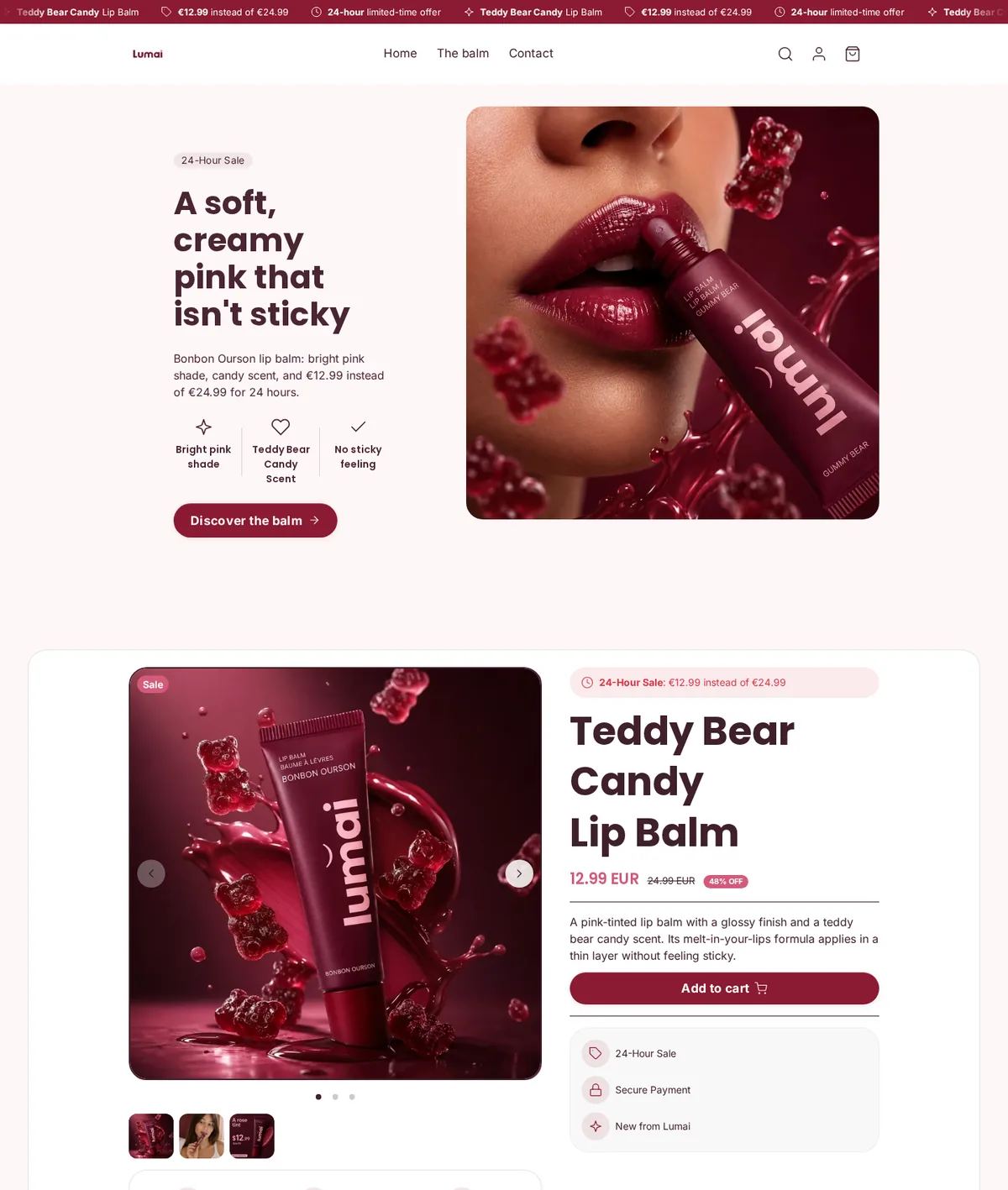
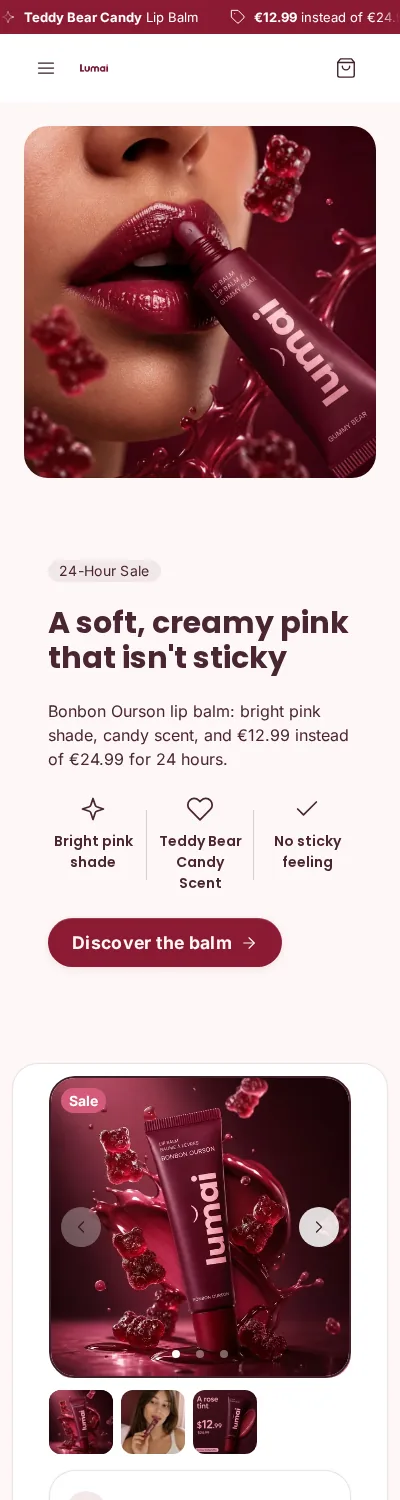
Look at how it sells. The headline does not say "tinted lip balm", it says "melting pink, no sticky feel": a sensation, and the number one objection to a tinted balm answered in the headline. The photo shows the product on lips, in a candy scene, not a tube on a white background. Three benefits fit in one word and one icon each. And the product page does the rest: a price shown before any text, a time-limited offer repeated in the top bar, a three-line description, one button, three lines of reassurance.
The anatomy, marker by marker
Eight elements make a visitor understand, trust and buy. Spot them on the demo, then reproduce them for your product.
- The scrolling bar: the product, its price, the current offer. One piece of information repeated, visible without scrolling, that gives a reason to buy today.
- The sensory promise: what the customer will feel, melting, no sticky feel. Not the formula. The headline is what sells.
- The three benefits: tint, scent, texture. Three words, three icons, nothing to read.
- The button to the product: one button, "discover the balm", leading to the product page. Not to an "our story" page.
- The worn visual: the product on lips, the real colour, the shine. In cosmetics, the photo sells before the text.
- The name, the price, the offer: a name that makes you want it, the price before any text, the discount percentage next to it. The customer sees what they gain in a second.
- The short description: texture, finish, scent, in three lines. The ingredient list lives further down the page, not here.
- The reassurance: the current offer, secure payment, new arrival. What removes the last doubt before the click.
The product page that makes people click today
On a 13 € cosmetic, the product page does not sell a formula, it sells a craving and a reason not to wait. Here is what the demo's page does, and why.
- The limited offer, repeated three times. Top bar, badge under the title, reassurance line. A 24-hour promotion on a low-priced first purchase is what turns "cute" into "added to cart". Keep it real: if you show a crossed-out price, the reference price is the lowest price applied in the previous 30 days, and the promotion really ends when you said it would.
- A gallery that shows three things. The product in a scene, the product worn, a visual with the price. The customer sees the colour on skin, the texture and the offer, without reading.
- The three-line description. Tint, finish, scent, gesture. What you feel on first application. The rest, directions and ingredients, comes below for those who want it.
- The entry price. A balm at 12.99 € is bought without thinking. It is the front door of the brand: the customer who loves it comes back for the second product or the set.
- The duo or the set, as soon as you have two references. Two shades at a bundled price, a balm plus its scrub. On a 13 € basket, shipping weighs heavily: the bundle clears the free shipping threshold and doubles the order.
- Reassurance under the button. Current offer, secure payment, new arrival. Three lines. Add dispatch time and returns as soon as you know them.
What you write: the sensation, the gesture, the visible result
A cosmetic sells on three registers, and none of them needs a laboratory to be proven.
- The sensation. Melting, no sticky feel, fresh, light, candy scent. What you feel on first application, and what anyone can check.
- The gesture. A thin layer in the morning, reapply after coffee, layers over a lipstick. It places the product in the customer's day.
- The visible result. A glossy pink tint, a shiny finish, lips that look fuller. What the photo shows, you can write.
The rule is simple and it works in your favour: a cosmetic cleans, perfumes, protects, keeps in good condition or changes appearance. You write what the customer will see and feel, and you leave "repairs", "heals", "treats" to medicines. A quantified effect, like "24-hour hydration", needs a test your laboratory may already have done: ask before writing it. And a photo promises as much as a sentence, so it shows the real product, the real finish.
Your product: private label, contract manufacturer or import
Three ways to have a product to sell. For a first brand, the first one is enough.
| Route | Lead time | Minimum | For whom |
|---|---|---|---|
| Private label with a French laboratory | 1 to 6 weeks depending on the laboratory | 20 to 500 units per reference | Launch a first reference with a file already done |
| Custom formula | Several months | Higher, on quote | A second reference, once you know what people like |
| Import or dropshipping from outside the EU | Immediate | None | Nobody, in this niche |
- Private label: a laboratory already has a formula, you put your label on it. Minimums published by French laboratories range from 20 units per reference (Cosmétique Marque Blanche) to 28 pieces (Le French Lab, labelling from 500), 250 to 2,000 pieces (Uspalla) or 500 pieces (Laboratoire Les Essentiels, which handles tests, file and notification). A balm like the demo's is a water-free formula, the simplest and cheapest to bring to market. The question that changes everything on the quote: "are the product file and the notification included?"
- Custom formula: your formula, developed by a contract manufacturer. Longer, more expensive, more distinctive. Keep it for later.
- Import or dropshipping: a supplier outside the EU ships under your name a product whose formula you do not know, and you are the one answering for it. On something people put on their skin, no.
One product, one promise, one photo: that is what the demo does, and that is what reads in three seconds.
What to settle before the first sale
A cosmetic is sold without a licence, without a diploma and without registering premises if you do not manufacture. But a file exists for each product, and one person answers for it. Here is what to set up once and for all.
- The responsible person is you as soon as your name is on the label. Private label or contract manufacturing, it is your company, with an address in the EU, that answers for the product.
- The product file and the safety assessment. Each formula has been assessed by a pharmacist, toxicologist or doctor, and the report lives in a product information file with the formula and manufacturing method. A good laboratory provides it with its formula: check it is written on the quote. Otherwise, count 300 to 500 € excluding VAT for a balm.
- The CPNP notification. Before the first sale, the product is declared on the EU portal, online and free of charge, by you or your laboratory.
- The label. Name and address of the responsible person, contents, durability or period after opening, precautions, batch number, product function, ingredient list in INCI nomenclature. The laboratory provides the mock-up, your name goes on it. And the same information on the product page, before purchase.
- What you write, seen above: the sensation, the gesture, the visible result. Never healing.
- VAT: 20 %. On 12.99 € including tax, you keep 10.83 € before tax.
What it costs over 12 months
The heaviest line is not the store, it is the first batch and its file.
| Item | Amount | Where the figure comes from |
|---|---|---|
| Shopify, Basic plan monthly, year 1 | About 327 € (3 free days, 1 €/month for 3 months, then 36 €/month) | Shopify France pricing page, 11 September 2026 |
| First private label batch | Minimum order times unit price, 20 to 500 units depending on the laboratory | Laboratory quote, file and label included or not |
| Product file and safety assessment, if not provided | 300 to 500 € excl. VAT for a balm, 500 to 800 € excl. VAT for a cream | Ecosmet 2026 price list |
| Possible tests (stability, challenge test, patch test) | 200 to 450 € excl. VAT per test, often already done on a private label formula | Ecosmet 2026 price list |
| CPNP notification | Free, 50 to 100 € per product if you delegate it | CPNP portal, Ecosmet |
| Label and packaging | Graphic design and printing, on quote | Your designer and your printer |
Not counted: advertising, which is up to you. The store itself, with Scale Ova, is generated for free and the subscription only starts when you publish.
The steps, in order
- Pick a product and a sensation. One reference, a five-word promise, a worn photo.
- Ask two laboratories for quotes: minimum, unit price, product file and notification included or not, label, lead time.
- Write the promise and the three benefits. The sensation, the gesture, the visible result. Nothing you cannot show.
- Generate the store. Describe the product, the sensation, the tone, the visual. Look at the result, fix it by conversation. The demo above came out of this process.
- Build the product page: entry price, real limited offer, worn gallery, three-line description, reassurance.
- Settle the label, the file, the notification and the 20 % VAT.
- Set up shipping and legal pages, test an order end to end, then refund it.
- Publish, measure, bring people in. An analytics tool from day one, content about the gesture and the visible result, reviews with photos, ads if the margin allows.
Going further
Want to see what your store would look like with your product? Describe it to Scale Ova, look at the result, ask for changes, and only pay if you publish. For the product page itself, how to write a product page that converts gives the method section by section. Two other niches with the same method: how to start an online supplement business and selling tea online.
FAQ
Do I need a licence to sell cosmetics online in Europe?
What price should I sell a cosmetic at?
Do I need a diploma to start a cosmetic brand?
Can I dropship cosmetics?
What can I write on my store?
How many units for a first batch?
How much does a cosmetics store cost?
Sources
- Regulation (EC) No 1223/2009 on cosmetic products, consolidated version, EUR-Lex
- Regulation (EU) No 655/2013 laying down common criteria for claims, EUR-Lex
- DGCCRF, practical sheet on cosmetic products
- FEBEA, key figures of the cosmetics market and press release of 6 February 2026 on 2025 exports
- Ecosmet, 2026 product information file pricing, accessed 11 September 2026
- Shopify, France pricing, Basic plan and trial, checked 11 September 2026
- Minimum orders announced by Cosmétique Marque Blanche, Le French Lab and Laboratoire Les Essentiels on their websites, and by Uspalla in a Passion Marine article of 16 December 2025, accessed 11 September 2026