You want to start a tea brand, or a matcha brand, and sell it online. The market exists: in France, two households out of three buy tea or infusions. What sets you apart from a supermarket shelf is the store: the ritual it sells, the product page, the pack. We look at a real store, then reproduce it for your tea.
If you are new to Shopify, the complete guide to building your store covers the base shared by every niche. Here, we only talk about tea.
The market, in three numbers
In 2025, 68% of French households bought tea or infusions, for €25.3 per household per year, a market above €741 million. (Syndicat du thé et des plantes à infusion, 2025 figures published June 2026)
- €25 a year is the supermarket. You do not sell €3.80 boxes. The demo below sells 30 g of matcha at €34.90, and it holds because it sells a ritual, not an ingredient.
- Green tea drives the market (+4.3% in volume, 39% of tea volumes) and matcha is the engine: Japanese green tea exports jumped 42% in fiscal 2025.
- Organic is close to 30% of the shelf. A strong argument, with one catch online, covered in two lines further down.
The store: one matcha, one ritual, three formats
The store below is a demo generated by Scale Ova from a description: a ceremonial-grade matcha in a 30 g pouch, sold alone, in threes or in sixes. You can visit it page by page.
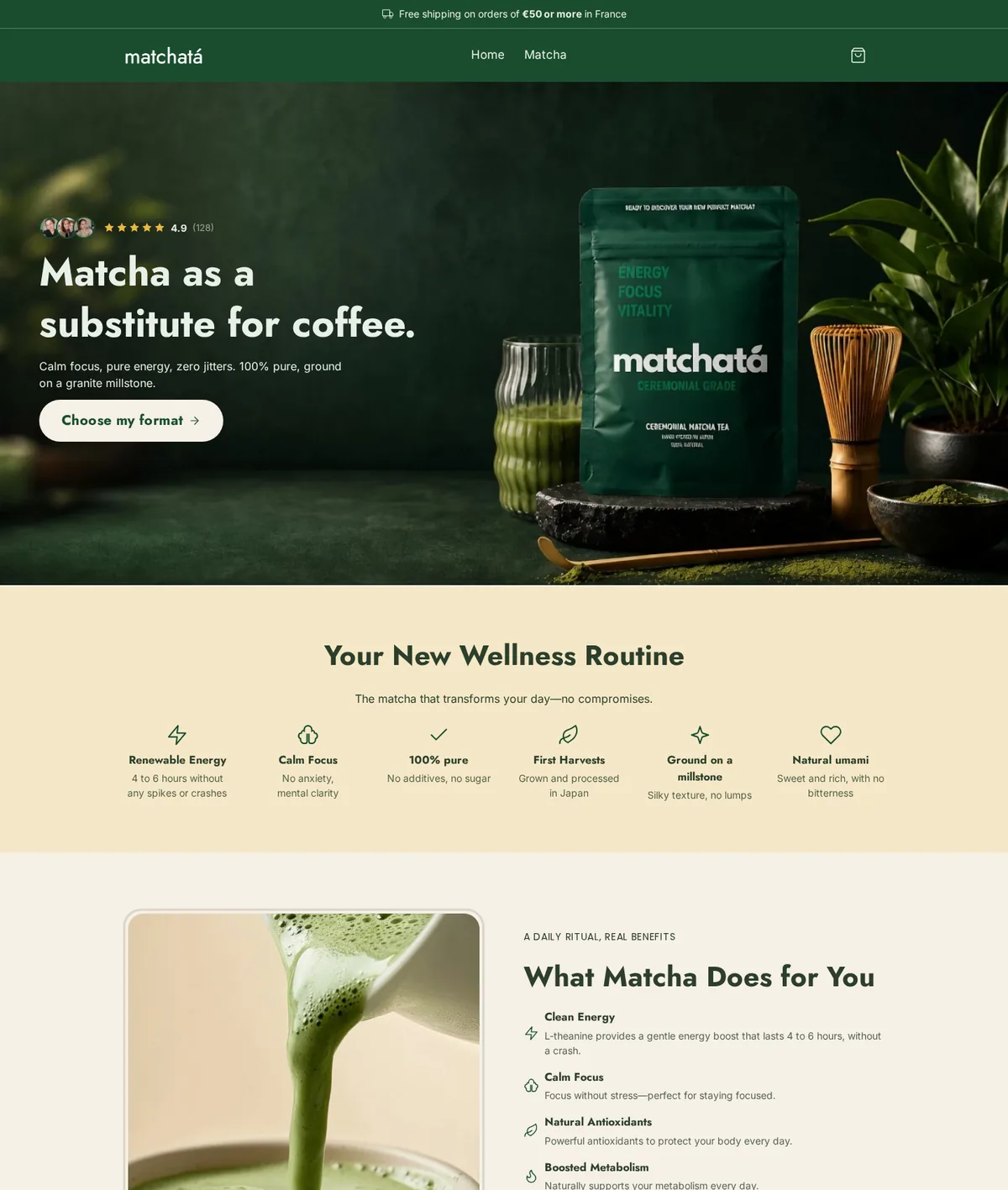
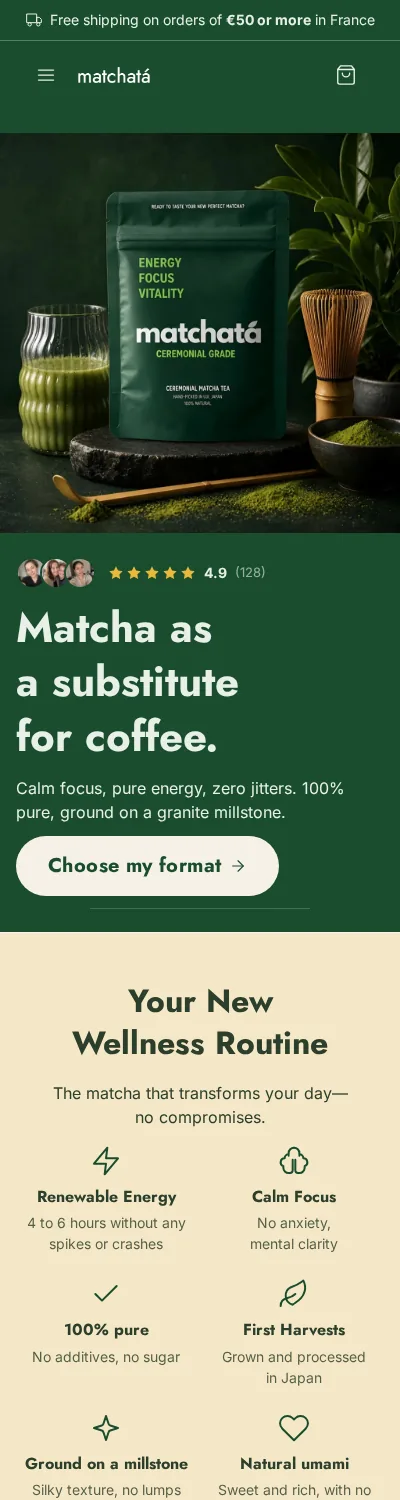
Look at how it sells. The headline does not say "organic matcha from Japan", it says "the matcha that replaces your coffee": a moment of the day, a gesture the customer already makes. The pouch sits in a scene, with the whisk and the bowl, not on a white background. Six benefits fit in one word and one icon. And the product page does the rest: 30 g is 30 to 50 cups, so under one euro a cup, three formats including a "buy 2, get 1 free", free shipping from €50, shipped within 24 h, 14-day money-back.
The anatomy, marker by marker
Eight elements make a visitor understand, trust and buy. Spot them on the demo, then reproduce them for your tea.
- The scrolling banner: free shipping from €50. One pouch costs €34.90: the threshold pushes towards the three-pack without saying anything else.
- Social proof: a rating and a review count above the headline. As soon as you have your first verified reviews, put them there.
- The replacement promise: what the product replaces in the customer's day. This is the headline that sells.
- The three proofs of quality: pure, stone-ground, first harvest. Three facts the customer can remember and repeat.
- The button to the format: one button, leading to the pack choice, not to an "our story" page.
- The pouch in a scene: the bag, the whisk, the bowl, the powder. The ritual is seen before it is read.
- The six benefits: one word, one icon, no paragraph. Sweetness, umami, texture, origin: what you feel at the first cup.
- The usage block: morning, 3 pm, weekend latte. It answers "when do I drink it", the real question of someone who has never made matcha.
The product page that moves people to the three-pack
On a consumable, the page does not sell a pouch, it sells a habit. Here is what the demo's page does, and why.
- The price per cup. "30 to 50 cups per pouch, under one euro a cup": €34.90 becomes a reasonable number, next to the morning coffee.
- Three formats, the right one in the middle. x1 at €34.90, x3 at €69.80 with the "buy 2, get 1 free" label, x6 at €139.60. The three-pack is the one you want to sell: it clears the free-shipping threshold and covers a month of ritual. If you show a crossed-out price, keep it true: the reference price is the lowest price charged in the previous 30 days.
- The duration. "Enough for one to two months": the customer knows when to reorder.
- The four-step method. Sift, pour 60 ml of water at 80 °C, whisk in an M, enjoy. Fear of doing it wrong is the first reason not to buy matcha.
- Storage. Cool, away from light, six months after opening, resealable pouch. It reassures on the six-pack.
- Reassurance under the button. Free shipping from €50, 14-day returns, secure payment, shipped within 24 h. Four lines, not a paragraph.
What you write: taste, origin, moment
Tea sells on three registers, and none of them is about health.
- Taste and texture. Umami, sweetness, no bitterness, silky foam. What you feel at the first cup.
- Origin and craft. Uji or Kagoshima, first harvest, shading, stone-ground. Verifiable facts about your batch, that the customer repeats to friends.
- The moment. The morning ritual, the 3 pm that replaces the second coffee, the Sunday latte. This is the register that brings people back.
Promises about the body (antioxidant, detox, energy, focus) are not allowed for tea, none is authorised in the EU register. Good news: they do not sell better than "the 3 pm ritual". Stay on what the customer will feel.
Your tea: wholesaler, custom blend or import
Three ways to have a tea to sell. For a first brand, the first one is enough.
| Route | Lead time | Minimum | For whom |
|---|---|---|---|
| Private label at a French wholesaler | About 3 weeks after label approval | 0 to 5 kg depending on the wholesaler, 100 pouches for packing | Testing a brand and a format without tying up cash |
| Custom blend | Longer, development then production | 10 to 15 kg | A second reference, once you know what your customers like |
| Direct import (Japan, China, India) | Weeks of transport | Set by the producer | A precise origin at a fair wholesale price, especially for matcha |
- Private label: published terms range from no minimum on the catalogue (L'Eden des Thés, Brittany) to 5 kg per blend at Grossiste-Thé.com, which packs near Paris from 100 pouches of 50 g, label and packing at €0.70 each per pouch.
- Direct import: for matcha, it is often the only way to get a precise origin and grade. Plan $180 to $320 per kilo FOB Japan for ceremonial grade bought by the kilo in 2026, less by volume; prices have doubled since 2023. Applied to the demo, a 30 g pouch at €34.90 holds $5 to $10 of matcha: the margin is there, if you pick the right grade. A "ceremonial" under $120 per kilo should make you doubt.
- Dropshipping: an unknown supplier ships a food under your name, without you seeing the batch or the date. For tea, no.
What to settle before the first sale
Tea is a food: no licence, no file, but a few points to set once and for all.
- The label: name, ingredients for a blend, allergens, net weight, best-before date, storage, your name and address, lot number, origin. And the same information on the product page, before purchase.
- The word "tea" refers to the tea plant. A blend of plants without tea plant is an infusion.
- Organic online: a distance-selling site does not get the shop exemption. If you write "organic" or show the logo, you notify the national organic agency and sign with a certification body before the first sale. Otherwise you do not write "organic", even if your wholesaler is certified.
- VAT: 5.5% in France, the food rate. On €34.90, €33.08 is left before tax.
- If you import: ask your supplier for batch analyses, you answer for the product.
What it costs over 12 months
The heaviest line is not the store, it is the first batch.
| Item | Amount | Where the figure comes from |
|---|---|---|
| Shopify, Basic monthly plan, year 1 | About €327 (3 free days, €1/month for 3 months, then €36/month) | Shopify France pricing page, 11 September 2026 |
| First private-label batch | 5 kg of blend, i.e. 100 pouches of 50 g, at the wholesale price of the chosen tea | Grossiste-Thé.com, published minimums |
| Packing and label | About €1.40 per pouch, kraft pouch extra | Grossiste-Thé.com, published grid |
| Printed doypack or tin | On quote, from a few hundred units | Your wholesaler or printer |
| Organic certification, only if you show organic | Free notification, paid annual inspection on quote | INAO, distribution note June 2023 |
Not counted: advertising, which depends on you. The store itself, with Scale Ova, is generated for free and the subscription only starts when you publish.
The steps, in order
- Pick a tea and a moment. One reference, one ritual, one format.
- Ask two wholesalers for quotes: minimum, price per kilo, packing, label, lead time.
- Write the promise and the three proofs. The moment, the taste, the origin. Nothing about the body.
- Generate the store. Describe the tea, the ritual, the tone, the visual. Look at the result, fix it by conversation. The demo above came out of this process.
- Build the product page: price per cup, three formats, method, storage, reassurance.
- Settle the label, the reduced VAT rate and, if you sell organic, the certification.
- Set up shipping and legal pages, test an order end to end, then refund it.
- Publish, measure, bring people in. An analytics tool from day one, content on preparation and taste, verified reviews, ads if the margin follows.
Going further
Want to see what your store would look like with your tea? Describe it to Scale Ova, look at the result, ask for changes, and only pay if you publish. For the product page itself, how to write a product page that converts gives the method section by section. Two other niches with the same method: how to start an online supplement business and how to start a cosmetic brand.
FAQ
Do I need a licence to sell tea online?
What price should I sell my tea at?
Can I sell organic tea online without being certified?
Can I dropship tea?
How much does ceremonial matcha cost wholesale?
How much does a tea store cost?
Sources
- The French tea and infusion market in 2025, figures from the Syndicat du thé et des plantes à infusion, Le monde de l'épicerie fine, 26 June 2026
- Japan's green tea exports surged in fiscal 2025 amid matcha boom, The Japan Times, 1 May 2026
- Regulation (EU) No 1169/2011 on the provision of food information to consumers, EUR-Lex
- EU register of health claims
- INAO, reading note on distribution under Articles 34.2 and 35.8 of Regulation (EU) 2018/848, June 2023 version
- French tax bulletin, VAT reduced rates, food products
- First Agri, matcha wholesale pricing 2026, updated 30 August 2026
- Shopify, France pricing, Basic plan and trial, checked 11 September 2026
- Minimum orders and packing prices published by Grossiste-Thé.com and L'Eden des Thés on their websites, checked 11 September 2026