You want to start a home decor store online, or sell furniture under your own brand. Rattan, light wood, jute, ceramics: the demand is there, and so is the competition, all the way to Temu and Shein. What makes the difference is not the widest catalogue, it is a coherent range, lifestyle photos and logistics that do not eat the margin. We look at a real store, then rebuild it for your range.
If you are new to Shopify, the complete guide to building your store covers the basics shared by every niche. Here, we only talk about furniture and decor.
The market, in three numbers
In 2025, the French furniture market is worth 13.6 billion euros including tax, down 1.8 %. Online pure players account for 8.7 % of it, 1.2 billion. (IPEA, furniture industry press conference of 3 February 2026)
- Most of the market is still in stores. Furniture is still bought by touching it. An online store wins on what the shop does not do: a short, coherent range, lifestyle photos, exact dimensions, an easy return.
- Two thirds of furniture sold in France is imported, 70 % of it from Europe. Importing is not a flaw, it is the norm. You can say so plainly on your store.
- 37 % of French people bought on Temu or Shein in the last 12 months, and home goods are now a target. You do not win on price. You win on the stated material, the photo, and the service.
The store: one material, one tone, eight pieces
The store below is a demo generated by Scale Ova from a description: a range of eight rattan and wood pieces, from the 49 € jute rug to the 250 € armchair. You can visit it page by page.
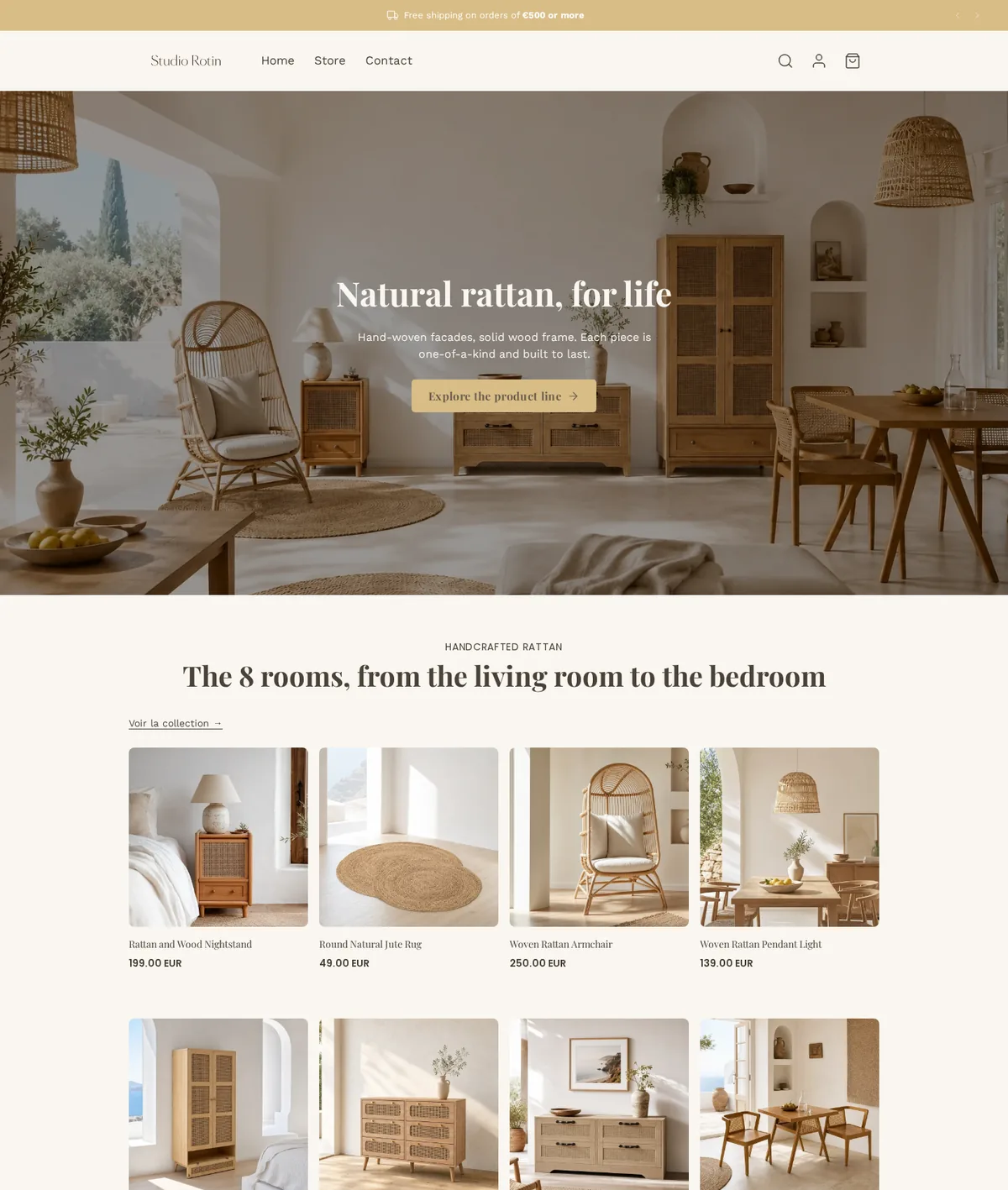
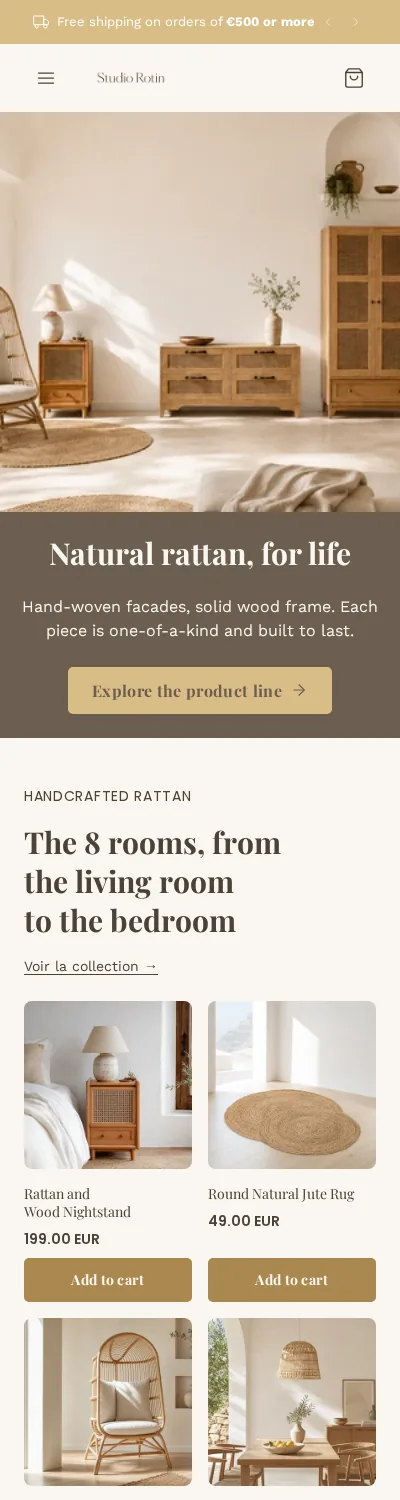
Look at how it sells. The headline does not say "rattan furniture", it says "natural rattan, for life": a material and a lifespan, not a trend. The photo is a whole room, with the light, the table, the armchair, the pendant: the customer sees their home, not a piece of furniture. The range fits on one screen, eight pieces from living room to bedroom, one material, one tone. And the mechanics do the rest: a 49 € rug as a first purchase, a 250 € armchair, free shipping from 500 € that pushes people to take both.
The anatomy, marker by marker
Eight elements make a visitor understand, trust and buy. Spot them on the demo, then reproduce them for your range.
- The top bar: free shipping from 500 €. On furniture, that threshold covers transport and pushes towards a two-item basket without saying anything else.
- The promise of durability: "for life", not "2026 trend". Furniture is bought for ten years, that is what sells.
- The material subtitle: hand-woven fronts, solid wood frame. The material is the first argument for a piece of furniture, and the first thing a customer compares.
- The button to the range: one button, "discover the range", leading to the collection. Not to an "our story" page.
- The interior scene: the piece in a lived-in room, with morning light. In decor, the lifestyle photo is what sells.
- The collection by room: from living room to bedroom, eight products on one screen. The customer pictures their home, not a catalogue.
- The product card: the material in the name, a photo in situ, the price. Nothing else to read before clicking.
- The entry product: a 49 € rug. The first purchase that builds trust, and the cheapest to ship.
The product page that avoids the return
On furniture, the product page has two jobs: make people want it, and make sure the customer is not surprised on delivery. Returning an armchair costs two shipments and a review. Here is what your page must carry, in this order.
- The lifestyle photo first, the detail next. The whole room for the craving, then the weave up close, the underside, the seat. The customer checks the finish they cannot touch.
- Dimensions before the text. Width, depth, height, seat height for a chair, and the doorway clearance for a wardrobe. It is the number one cause of returns in decor, and three lines settle it.
- The exact material in the name and on the page. Natural rattan, solid wood, jute. The customer buys the material as much as the shape, and it is the information the law requires on furniture.
- The delivered price, or price plus shipping, but stated before the button. A 250 € armchair with 39 € shipping discovered at checkout is an abandoned cart. The demo settles it with the 500 € threshold: the customer knows straight away how to get free shipping.
- Delivery time and returns, in plain words. "Ships in 5 days, delivered in 8", and the cost of sending back a bulky piece. Stating it filters impulse orders and protects your margin.
- The eco-fee shown separately from the price, as in any furniture shop in France. A few tens of cents to a few euros, displayed, not hidden.
- Care in two lines. A damp cloth, no direct sunlight. It backs up the "for life" in the headline.
What you write: the material, the room, the lifespan
Furniture sells on three registers, and all three are proven with a photo and an invoice.
- The material. Natural rattan, hand-woven, solid wood, jute. Words the customer repeats, as long as they are exact: natural rattan is a vine, woven resin is a plastic, you write one or the other. Same for solid wood versus veneered board.
- The room and the gesture. The reading chair by the window, the bedside table that holds the books, the rug under the coffee table. You place the piece in a day, not in a catalogue.
- The lifespan. "For life", "built to last", "unique". It sells, and it holds if you show the workshop, the weave up close, the frame.
Three details that avoid disputes: "handmade" is proven with a workshop photo and your supplier's invoice; "designed in France" means drawn in France and made elsewhere, "made in France" means what it says; and if you show a crossed-out price, the reference price is the lowest price applied in the previous 30 days.
Your range: wholesaler, private label or container import
Three ways to have product. For a first range, the first one is enough.
| Route | Lead time | Minimum | For whom |
|---|---|---|---|
| French wholesaler with stock | Ships in 24 to 48 h | Trade prices from 30 pieces per order at a wholesaler in the Paris region | Test a range and photos without tying up cash |
| Private label at the same wholesaler | A few weeks | 50 pieces per reference | Your name on the piece, without importing yourself |
| Direct import (Indonesia, Vietnam, India) | Two to three months with sea freight | A quarter container, about 7 m³, 3,500 to 5,000 € excl. VAT from Bali | A range that is truly yours, with several thousand euros up front |
- Wholesaler with stock: you pick from a catalogue of several thousand references, order 30 pieces, receive within 48 h. The shortest route to test a range and photos. Lower margin, but nothing tied up.
- Private label: the same product, with your name, from 50 pieces per reference. Your name on the piece makes you responsible for the product, more on that below.
- Container import: you buy from the maker. A quarter container to start, sea freight, a forwarder, duties and import VAT. The only route that gives you a range of your own.
- Decor dropshipping: a supplier outside the EU ships for you, three-week delays, impossible returns, breakage on you. For small objects, selling online without inventory compares the models. For furniture, no.
Eight pieces, one material, one tone: that is what the demo does, and that is what reads in three seconds.
Shipping, the real cost line of this niche
A rug goes as a parcel. An armchair goes by freight, a wardrobe on a pallet. Before setting a price, ask your supplier or carrier three things: packed weight and volume, rate by zone, breakage rate.
- The free shipping threshold is set from your target average order, not from a competitor. The demo puts it at 500 €, above a single armchair: the customer adds the rug or the pendant.
- Packaging is a product in its own right. Reinforced corners, double-wall cardboard, film. A piece that arrives damaged costs two shipments and a bad review.
- The return of a bulky piece is on the customer if you stated it before purchase, with its cost. Write it on the product page.
- Dimensions and weight on every page: that is what avoids the return, far more than the photo.
What to settle before the first sale
Furniture is sold without a licence and without a diploma. A few mentions to set up once and for all, and they overlap with a good product page.
- The furniture mentions: materials, process, finish, overall dimensions, "self-assembly" if delivered flat-packed, and what is included in the price. It is the mandatory labelling of new furniture in France, and online it goes on the product page. You already have it if you followed the product page section.
- The maker's name and address on every listing, or those of a responsible person established in the EU if the maker is outside. If the piece carries your brand, that is you. It is the EU product safety rule, and it fits in one line under the description.
- The eco-fee: if you import or your name is on the piece, you join a producer responsibility scheme (Ecomaison for furniture in France), get a unique identifier for your legal notice, declare your sales and show the eco-fee separately from the price. 2026 orders of magnitude: 0.36 € for a rug, 3.23 € for a 12 kg upholstered armchair. If you resell a French wholesaler's products under their brand, they are the member, the display is still on you.
- Delivery and returns: a delivery date announced and kept, 14 days to withdraw, and the cost of returning a bulky piece written before purchase, otherwise it is on you.
- A cushion or a jute rug carries its fibre composition, like a garment.
- VAT: 20 %. On a 250 € armchair including tax, you keep 208.33 € before tax and before shipping. If you import, an EORI number for customs.
What it costs over 12 months
The heaviest line is not the store, it is the first stock and shipping.
| Item | Amount | Where the figure comes from |
|---|---|---|
| Shopify, Basic plan monthly, year 1 | About 327 € (3 free days, 1 €/month for 3 months, then 36 €/month) | Shopify France pricing page, 11 September 2026 |
| First stock from a wholesaler | 30 pieces at trade price, on quote | Paris-region wholesaler, published terms |
| Private label | 50 pieces per reference, on quote | Same wholesaler |
| Direct import | 3,500 to 5,000 € excl. VAT for a quarter container from Bali, plus sea freight, forwarder, duties and import VAT | Same wholesaler, import offer |
| Eco-fee | 0.27 € to a few euros per piece depending on weight and material, passed on to the customer separately from the price | Ecomaison 2026 scale |
| Lifestyle photos | On quote, or a room at home and natural light | Your photographer |
| Packaging | On quote, per format | Your packaging supplier |
Not counted: advertising, which is up to you. The store itself, with Scale Ova, is generated for free and the subscription only starts when you publish.
The question that changes everything on the quote: "is the price delivered to me, packed, with the piece's technical sheet?" If yes, your first stock costs the quote plus the eco-fee. If not, add shipping, packaging and the time to write the pages yourself.
The steps, in order
- Pick one material, one tone, eight pieces. A range reads in one image, not in a catalogue.
- Ask for two quotes: delivered price, packaging, technical sheet (materials, finish, dimensions, weight), minimum order.
- Write the promise and the material. The room, the lifespan, the gesture. Nothing you cannot show.
- Generate the store. Describe the range, the material, the room, the tone. Look at the result, fix it by conversation. The demo above came out of this process.
- Build the product pages: lifestyle photo then detail, dimensions, material, delivered price, delivery time, returns, eco-fee shown separately, care.
- Set shipping: rates by zone, free shipping threshold, return cost stated.
- Settle the eco-scheme, VAT and the mentions, test an order end to end, then refund it.
- Publish, measure, bring people in. An analytics tool from day one, lifestyle photos, content about the material and care, reviews with photos, ads if the margin allows.
Going further
Want to see what your store would look like with your range? Describe it to Scale Ova, look at the result, ask for changes, and only pay if you publish. For the product page itself, how to write a product page that converts gives the method section by section. Another niche where the photo decides, with the same method: how to start an online clothing store.
FAQ
Do I need a licence to sell furniture online in Europe?
What price should I sell furniture at online?
Is the eco-fee mandatory for a small store?
Can I dropship home decor?
Natural rattan or woven resin, what should I write?
Who pays for returning a piece of furniture?
How much does an online decor store cost?
Sources
- Furniture industry, press kit of the 3 February 2026 conference (IPEA 2025 figures), L'Ameublement français, CNEF, IPEA
- Decree No. 86-583 of 14 March 1986 on furniture labelling, Légifrance
- Regulation (EU) 2023/988 on general product safety, EUR-Lex
- Ecomaison, regulatory obligations of producers and 2026 furniture fee guide, applicable from 1 January 2026
- French Environment Code, article L541-10-13 (unique identifier), Légifrance
- French Consumer Code, articles L216-1 (delivery), L221-5 (pre-contractual information), L221-18 (withdrawal), L112-1-1 (price reductions), Légifrance
- Regulation (EU) 1007/2011 on textile fibre names, EUR-Lex
- Shopify, France pricing, Basic plan and trial, checked 11 September 2026
- Trade price, private label and container import terms announced by Grossiste déco Bali on its website, accessed 11 September 2026