You want to sell without a garage full of boxes and without paying for stock upfront. It is possible, four models allow it. The word you typed is "free". So let us count, line by line, what costs €0 and what does not.
How free is free? What €0 really gets you
Building the store: free. Taking the first order: €1 a month for 3 months on Shopify, plus payment fees. Keeping the store open: from €27 a month in month four. Inventory stays at €0 in all four models.
| Item | Free? | Figure checked on 11 September 2026 |
|---|---|---|
| Generating the store (theme, pages, product pages, copy) | Yes | Scale Ova: free generation, no time limit |
| Shopify trial | Yes, 3 days | No credit card, store in private mode, checkout inactive |
| Shopify, months 1 to 3 | Almost | €1 a month |
| Shopify, from month 4 | No | Basic: €27 a month yearly, €36 monthly, as displayed in Europe |
| Dropshipping supplier app | Yes | DSers Basic plan free: import, bulk orders, tracking |
| Print-on-demand service | Yes | Printful: no subscription, you pay product and shipping per order |
| Selling digital files | Yes | Shopify Digital Products app, free, made by Shopify |
| Domain name | No | €10 to €20 a year; the myshopify.com subdomain is free but not presentable |
| Payment fees | No | 1.5% + €0.25 per card payment on Basic with Shopify Payments |
| Product sample | No | One unit plus shipping, to order before you sell |
| Advertising | No, but optional at first | Content, social, outreach: €0 and time |
The sentence to remember: no inventory does not mean no cost, but the starting cost fits in a phone bill. A dropshipping store on Shopify with DSers costs €3 over its first three months, excluding domain and payment fees.
The 4 no-inventory models, with the tools and what they cost
| Model | What you sell | Verified tool | Tool cost | The real hard part |
|---|---|---|---|---|
| Dropshipping | Products shipped by a supplier | DSers (AliExpress, 1688) | Basic plan free; Advanced $19.90 a month | Supplier, delivery times, support |
| Print-on-demand | T-shirts, posters, mugs printed after the order | Printful | €0 a month; product plus shipping per order; optional Growth plan at $24.99 | Designs that sell |
| Digital products | Files, templates, courses | Shopify Digital Products | Free | Making something useful |
| Affiliate | Other brands' products, for a commission | An affiliate programme and a site | €0 | Building an audience |
1. Dropshipping
The customer orders on your store, you pass the order to the supplier, they ship. You never touch the parcel, but the customer bought from you.
What is free: DSers, the most used app for AliExpress (5 out of 5 on 6,218 reviews as of 11 September 2026), has a Basic plan at $0 with one-click import, bulk orders and tracking sync. The paid plans ($19.90 and $49.90 a month) add product research and AI supplier selection, not needed to start.
What is not: the sample. Order the product before selling it, check the packaging, the tracking and the real delivery time. If you have never held it, you cannot answer a customer reporting a defect.
I would pick it if you can vet a supplier and work on acquisition. I would avoid it if your only criterion is the cheapest product: the same photos and the same listing end up on dozens of stores, and you end up fighting on price. To start from a store already set up, read the analysis of turnkey dropshipping websites.
2. Print-on-demand
You create a design, the provider prints and ships on each order.
What is free: Printful (4.8 out of 5 on 3,857 reviews) has "no monthly fees". You pay the product and shipping when a customer orders, with no minimum. The Growth subscription at $24.99 a month gives discounts, it is optional.
What is not: your own unit. On-screen colours, print quality and the garment's cut can be far from the mockup. An August 2026 review on the app mentions quality "gone downhill" and support refusing refunds: order, look, then sell.
The model suits creators who have a visual universe or a community. The provider solves production, not demand.
3. Digital products
A file needs neither stock nor shipping: Notion template, sewing pattern, preset, guide, course, photo, music.
What is free: the Shopify Digital Products app, made by Shopify, at $0, sends the download link after purchase and limits the number of downloads. Nothing else to install.
What is not: production time and proof of quality. It is the cheapest way to test, provided you have a skill that really helps someone. Plan for updates and support too.
4. Affiliate
You recommend another brand's product with a tracked link, and earn a commission on attributed sales.
What is free: everything, or nearly. No store, no payments to collect, a site or an account is enough.
What is not: the audience. No traffic, no commission. And it is not your store: you set neither the price, nor the experience, nor the programme's terms.
Which model for your situation
- You can create designs: print-on-demand.
- You can make a useful guide, template or course: digital product.
- You can find and sell physical products: dropshipping, after testing the supplier.
- You already have an audience: affiliate, the lightest path.
- You want to build a brand over several years: no inventory to validate, then stock on your best sellers to take back control of quality, margin and delivery.
The last case is the one I prefer. No inventory is a validation method, not an identity.
A no-inventory store, for real
The store below is a demo generated by Scale Ova from an AliExpress product link, a portable blender bottle. The typical dropshipping product, with home page, product page, bundles and pages. You can visit it page by page.
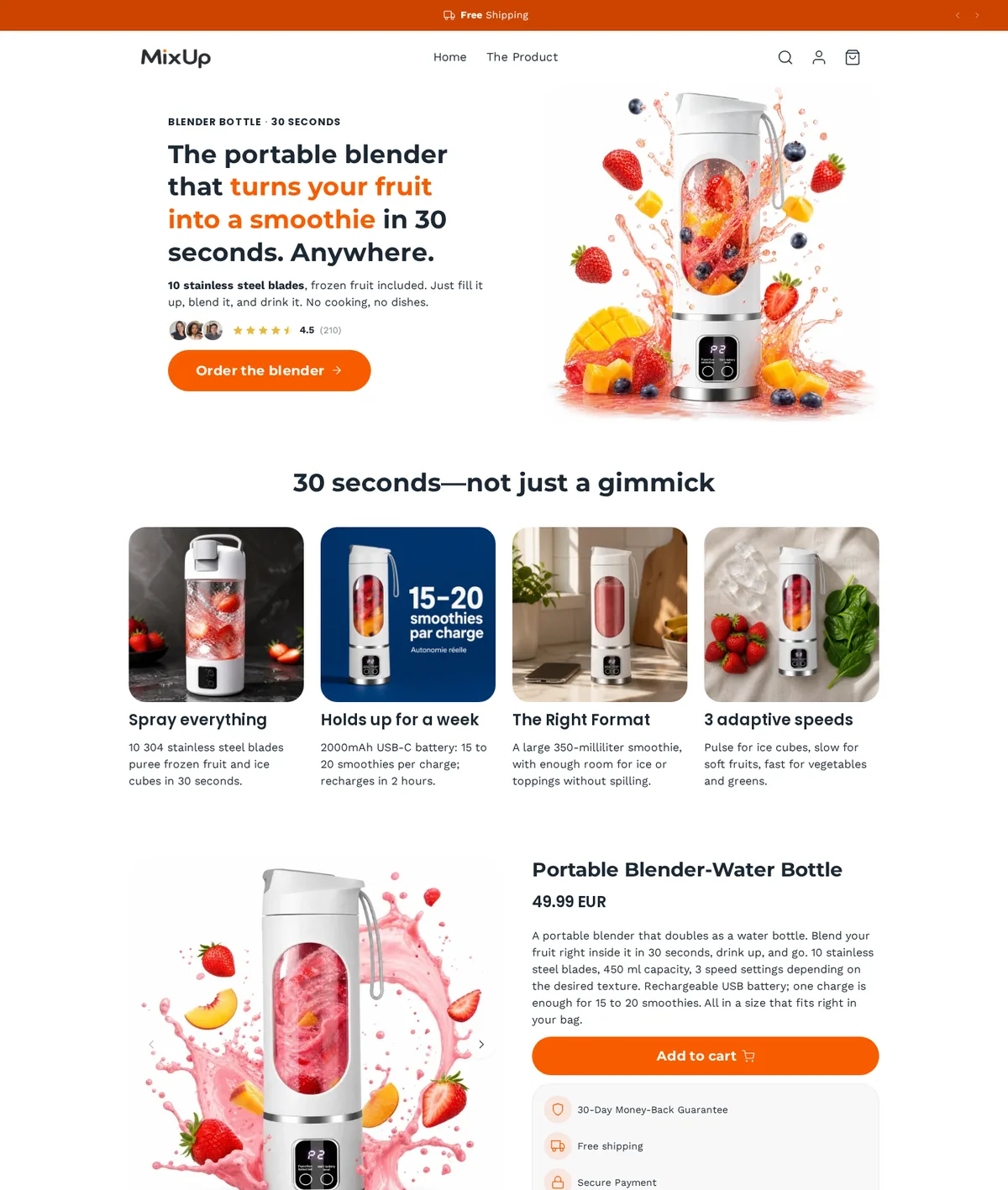
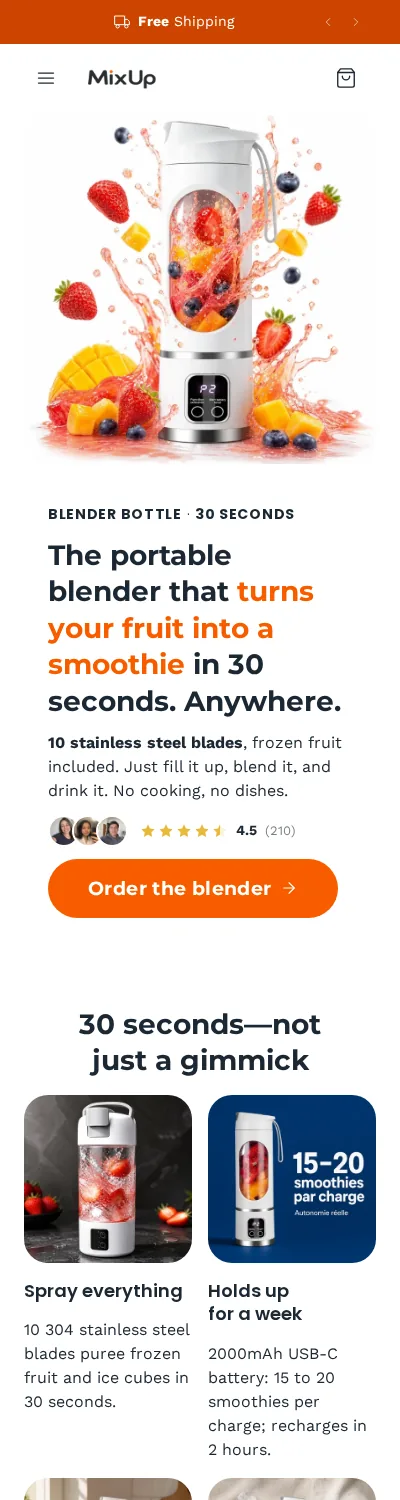
This is what "build for free" means here: you paste the product link or describe your idea, the complete store comes out in minutes, you look at it, ask the AI for changes ("make the home page midnight blue", "add a two-pack", "rework the product page for a sporty audience"), click an element to adjust it. No time limit, no card. You start the Shopify trial when it is ready, and your 3 days go to payment and shipping. The Scale Ova subscription, from €49 a month, is only needed to publish.
How to start your no-inventory store, step by step
- Pick a single offer. One product, a small coherent collection or a clear file. You must be able to say in one sentence who it is for and why they buy it from you.
- Check the product or the content. A sample ordered for physical goods, three to five testers from the target audience for digital. Fix before working on the logo.
- Calculate what is left after the sale. Supplier price, shipping, VAT, payment fees (1.5% + €0.25), returns, platform, acquisition. A €40 sale can lose money once everything is taken out.
- Build the store before the Shopify trial. Generate it, fix it, prepare legal pages, payment provider and shipping. The complete guide to building a Shopify store details the setup.
- Start the trial and publish. 3 days to connect payment and shipping, then €1 a month for 3 months. The trial details are in is Shopify free.
- Test a complete order. Payment, email, hand-off to the supplier, tracking, refund. A store is not ready because the home page looks nice.
- Find the first visitors without ads. Show the offer to the target audience, publish around the problem solved, answer in the communities where it is discussed, note the objections. Ads come once the page has already convinced a few people.
What you still have to handle
Dropshipping is legal. The supplier ships, but you are the seller: customer information, announced delivery time, right of withdrawal (14 days in the EU), refunds, product compliance. The French consumer authority DGCCRF spells it out in its practical guide.
In practice, the customer does not want to hear that "the supplier stopped answering". They paid your store. Before the first sale, check the supplier's identity, product compliance, the delivery times you announce, the return procedure, and your legal notices and terms. An auto-generated policy is a template, not legal advice. Some niches suit no inventory poorly: for supplements and cosmetics, the declarations and claims remain your responsibility.
Which platform
Shopify connects DSers, Printful and Digital Products in one click, and costs €3 over its first three months. WooCommerce does not charge for the software, but hosting, domain, updates and extensions are on you. Etsy and marketplaces bring traffic in exchange for fees and less control over the customer relationship.
AI can prepare the theme, the copy and the product pages. It checks neither the supplier nor the market. That is the limit I explain in automated online store: what can really be automated.
My advice if you start with no budget
With €0, I would not start with a full dropshipping store. I would pick a small digital product I can make myself, or affiliate content on a topic I know, to check that I can get people interested.
With a small budget, I would test a single physical product: a sample, a short store generated and fixed for free, the Shopify trial started once it is ready. Describe your product to Scale Ova, see what comes out, and only pay if you publish.
FAQ
Can you start an online store without inventory for free?
How much does a dropshipping store cost the first month?
What is the difference between reselling without inventory and dropshipping?
Is dropshipping legal?
Which app for dropshipping without inventory on Shopify?
Can you sell on Amazon without inventory?
Can a no-inventory store be profitable?
Sources
- Shopify, pricing, 3-day trial, €1/month for 3 months, Basic €27/€36, card rates, checked 11 September 2026
- DSers on the Shopify App Store, Basic free, Advanced $19.90, Pro $49.90, rating and reviews, checked 11 September 2026
- Printful, pricing, no monthly fees, product and shipping per order, Growth plan, checked 11 September 2026
- Printful on the Shopify App Store, rating, reviews and $24.99 plan, checked 11 September 2026
- Shopify Digital Products on the Shopify App Store, free app made by Shopify, checked 11 September 2026
- DGCCRF, dropshipping: how to comply with the rules, seller obligations (in French)