You make jewelry and want to sell it online. Or you've found suppliers and want to build your own brand. Either way, jewelry looks easy to sell. It's light, cheap to ship and photographs well. What guides often skip are the rules specific to jewelry. A 2023 check by the French consumer protection agency (DGCCRF) found that 17% of the fashion jewelry and watches it tested were non-compliant and dangerous.
This guide is for anyone selling jewelry to customers in France. Most of the chemical rules come from EU law, so they apply across the EU too. It only covers what changes with jewelry. For the basics every store shares, the complete guide to building a Shopify store takes over.
Making or reselling jewelry
The first question is where your jewelry comes from. If you buy it to resell, you run a retail business. If you make and sell it, the French government site counts you first as a craftsperson, then as a retailer. Its own example is a potter who sells their work. Either way, you register on the official business formalities portal. The micro-entrepreneur status is available in both cases.
This choice mostly changes how you sell. A maker sells her craft and one-of-a-kind pieces. She can show the workshop and talk about each material. A reseller sells a curated selection and a style. They have to stand out from stores that sometimes sell exactly the same designs.
If you resell fashion jewelry bought in Asia, you're the first one responsible for what you put on sale. You'll see why just below. To choose and test a supplier, how to find a supplier for your online store lists the questions to ask before ordering.
What the law requires on jewelry
Nickel, lead and cadmium in fashion jewelry
Fashion jewelry contains no precious metal, gemstone or pearl. It can be steel, brass, glass or wood. In France, its listing must show the price, the product name and the main materials, in French.
The real constraint is chemical. The EU REACH regulation sets limits for jewelry that touches the skin:
- Nickel: the metal must not release more than 0.5 µg per cm² per week from parts in prolonged contact with the skin. For an earring post or piercing, the limit drops to 0.2 µg.
- Lead: each part of the piece must contain less than 0.05% by weight.
- Cadmium: metal parts must contain less than 0.01% by weight.
The DGCCRF is blunt about it. Every professional must be able to prove, if checked, that their jewelry meets these limits. In practice, ask your supplier for a recent test report for each material. If they don't have one, have a sample tested by a lab before you sell. Nickel causes contact allergies, and a customer who reacts will send the piece back.
Fineness and hallmarks for gold and silver
Precious metal jewelry is almost always an alloy. In France, its listing must show the fineness, meaning the share of precious metal, in thousandths. Only certain finenesses can be called "gold" or "silver":
- gold: 999, 916, 750, 585 and 375 thousandths;
- silver: 999, 925 and 800 thousandths;
- platinum: 999, 950, 900 and 850 thousandths.
So an "18 karat" piece is written as "gold 750 thousandths." For plated jewelry, the wording depends on the thickness of the layer. "Gold plated" (plaqué or) needs at least 3 microns of gold. Under 3 microns, the piece is only "gilded" (doré). Vermeil means silver covered with at least 5 microns of gold at 750 thousandths or more. Calling a gilded piece "gold" misleads the buyer about the material.
Then comes the hallmark. A precious metal piece carries an official hallmark, applied by French customs or an approved body. Customs exempts gold or platinum pieces under 3 grams. It also exempts silver pieces under 30 grams. So a thin 2-gram gold ring doesn't need the official hallmark. It must still meet a legal fineness and carry the maker's or responsibility mark, which identifies the maker or importer.
These rules apply to anyone in France who holds or sells gold, silver or platinum for business. Before you start, you file a declaration of existence with a customs assay office. You also keep a register of purchases and sales, called the livre de police. Since July 1, 2025, these rules sit in the French Commercial Code. If you're starting with 925 silver or gold, call the customs information line (Infos Douane Service) at 0 800 94 40 40 before your first sale.
The exact name of stones, and their treatments
A stone is sold under its exact name, on the listing and in ads. French rules ban the terms "semi-precious" and "semi-fine." The word "precious" is reserved for true precious stones. It can't describe a synthetic stone, an imitation, amber or mother-of-pearl.
If a stone was heated, dyed or irradiated to change how it looks, you must say so. The listing shows "treated" or the name of the treatment. Before the purchase, you also give the customer a sheet describing the treatment and care. For online sales, this information must be on the product page.
No health claims
This is the trap with natural stone bracelets. Jewelry doesn't cure anything, and the law forbids claiming it does. In its 2023 investigation, the DGCCRF found claims like "slimming bracelet" or "fights depression." Those claims are banned. You can talk about a stone's color, origin or symbolism. You can't credit it with an effect on the body or mood.
Returns on jewelry
Your customer in the EU has 14 days to withdraw, like any online purchase. An engraved or custom-made piece is excluded, because it's personalized. For earrings, many stores refuse returns for hygiene reasons. That refusal only works if the piece was delivered sealed and the customer opened it. State it clearly in your return policy before the sale.
Photographing a small object
A piece of jewelry is a few millimeters wide, and that's where amateur photos show. The customer can't touch it or try it on. So your photo has to answer three questions for them. It shows the material, the real size and how it looks when worn.
Start with a sharp photo on a plain background, with soft light and no glare. Window light is enough, with a sheet of white paper to fill in the shadow. Then add a close-up of the clasp and the finish. That's what the customer would check in a shop.
The worn photo matters most. A ring on a hand or a necklace on a neck shows the scale better than a size in millimeters. Keep the same light and background across the whole collection. Your store will then look like a brand, not a supplier catalog.
Finally, give the dimensions in the text. List the chain length, the diameter and the thickness. For a ring, add a size guide. A ring in the wrong size is an easy return to avoid. The full product page method is in how to write a Shopify product page that converts.
Pricing without fooling yourself
Jewelry has one quirk. The cost of materials is often small compared with the selling price. What costs money is your time, the packaging and the ads. Many makers underprice because they only count the beads and the wire.
Take an example to see the math. Picture a bracelet that costs you €6 in materials and half an hour to assemble. Count the box, the card, the shipping and the payment fees too. Then add the ad cost to get one sale. If you want to pay yourself €20 an hour, your half hour is already worth €10. A €25 price can then lose you money as soon as you pay for ads.
Do this math before you set your prices, not after the first order. If the price you need feels too high, work on the offer instead of cutting it. A two-piece gift set or free engraving justifies a higher price.
Packing and shipping jewelry
Jewelry also sells at the moment the parcel is opened. A simple box, some tissue paper and a care card cost little. They make up a big part of the experience, especially when the piece is a gift. Pick packaging that also protects fragile pieces from knocks.
For shipping within France, La Poste separates two cases. Fashion jewelry can go in an envelope at letter rates, if it's under 3 cm thick with packaging. For a sale, still prefer a tracked option. A customer who receives nothing will ask for a refund, and without tracking you have no proof.
Precious metals are another matter. La Poste says the law only allows them to be sent as jewelry, with declared value (valeur déclarée). That option covers up to €5,000 for loss, theft or damage. You buy it at a post office. For other countries, check the local rules, because many ban importing gold or gemstones.
Never write "jewelry" on the parcel. Discreet packaging draws less attention in transit.
Your Shopify jewelry store
On Shopify, a jewelry store is easier to browse by type or material than by price. Make one collection for necklaces, one for rings, one for 925 silver. Customers look for a type of jewelry first, then a material they can wear.
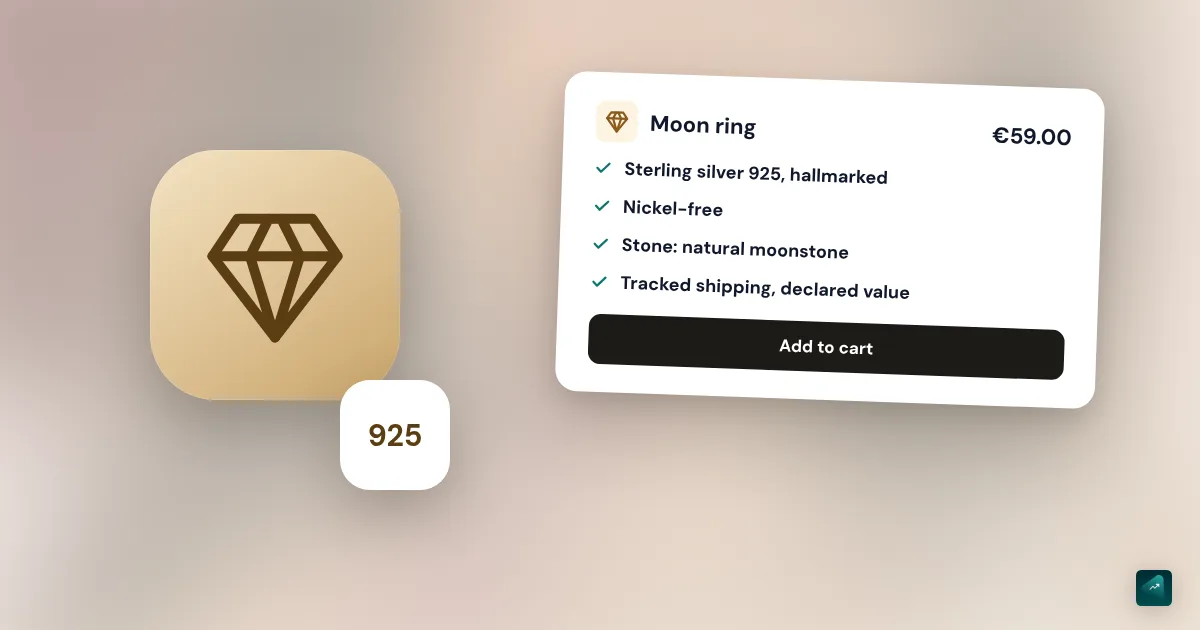
Each product page carries the details covered above. It gives the exact material and the fineness for precious metal. It shows the dimensions, the size for a ring and any stone treatment. Add two lines of care advice for silver that tarnishes or plating that wears. A "nickel-free" label reassures a lot, but only if your test report backs it up.
Other fashion niches follow the same logic of photos and sizing. The guide on how to start an online clothing store applies it to clothing.
The steps, in order
- Pick your model. Your own creations, a curated resale selection, or a brand made by a workshop.
- Register your business, as a micro-entrepreneur if you're starting out in France.
- Check your materials. A nickel, lead and cadmium test report for fashion jewelry. Fineness and hallmark for gold and silver, with the declaration to customs.
- Photograph a first collection of six to ten pieces, on one background, with worn shots.
- Work out your price with your time, packaging, shipping and ads.
- Build your store with collections by type, complete product pages and a clear return policy.
- Choose your shipping by value, tracked for fashion jewelry and declared value for precious metal.
- Place a test order, then show your pieces where your customers already wear them.
Building your jewelry store with Ova
Ova builds the complete Shopify store from your description. It generates the theme, pages, collections and product pages. You might write, for example, "a store for handmade 925 silver jewelry, fine necklaces and rings, minimalist style, shipped in a gift box." Then you adjust in conversation, like "add a ring size guide" or "create an earrings collection." It also writes your return policy and legal pages.
Ova doesn't check your jewelry for you. Fineness, hallmarks and lab tests stay your responsibility, and you review each product page before publishing. Generation and edits are free, and the subscription is what lets you publish to Shopify. Describe your jewelry store to Scale Ova and see what comes out.
FAQ
Do I need a qualification to sell jewelry online?
Is a hallmark required on silver jewelry in France?
Can I sell handmade jewelry without registering a business?
Can I dropship jewelry?
What's the difference between "gold plated" and "gilded"?
How do I ship gold jewelry in France?
Sources
- DGCCRF, jewelry labeling and safety: fashion jewelry, fineness, plated and gilded, gemstones, REACH limits, written August 11, 2026, read October 29, 2026
- DGCCRF, fashion jewelry and watches: professionals lack rigor: 2023 investigation, 17% of items non-compliant and dangerous, banned health claims
- French customs, hallmarking your pieces: exemption under 3 g for gold and platinum, under 30 g for silver, maker's mark, read October 29, 2026
- French customs, precious metals: gold, silver or platinum: declaration of existence, livre de police, hallmarks
- French customs, scope of the precious metals guarantee: who is covered, move to the Commercial Code on July 1, 2025, updated December 11, 2025
- French customs, filing a declaration of existence: procedure with the assay office
- La Poste, how to send jewelry: precious metals with declared value up to €5,000, fashion jewelry at letter rates under 3 cm, read October 29, 2026
- Shopify Help Center, EU right of withdrawal: exemptions for personalized items and unsealed goods, read October 29, 2026
- Service-Public Entreprendre, determining the nature of your activity: retail, craft or mixed activity, the potter example, checked September 1, 2024