Your store is ready, but you need something to fill the orders. This is often when people grab the cheapest AliExpress result, the first one that comes up. Three weeks later, they find out their first customer is still waiting for the parcel.
Your customer never sees your supplier. If delivery drags or the product doesn't look like the photo, it's you they write to. So when you choose a supplier, you choose half of the experience you sell. Here's how to choose well without spending weeks on it.
Three things to decide before you search
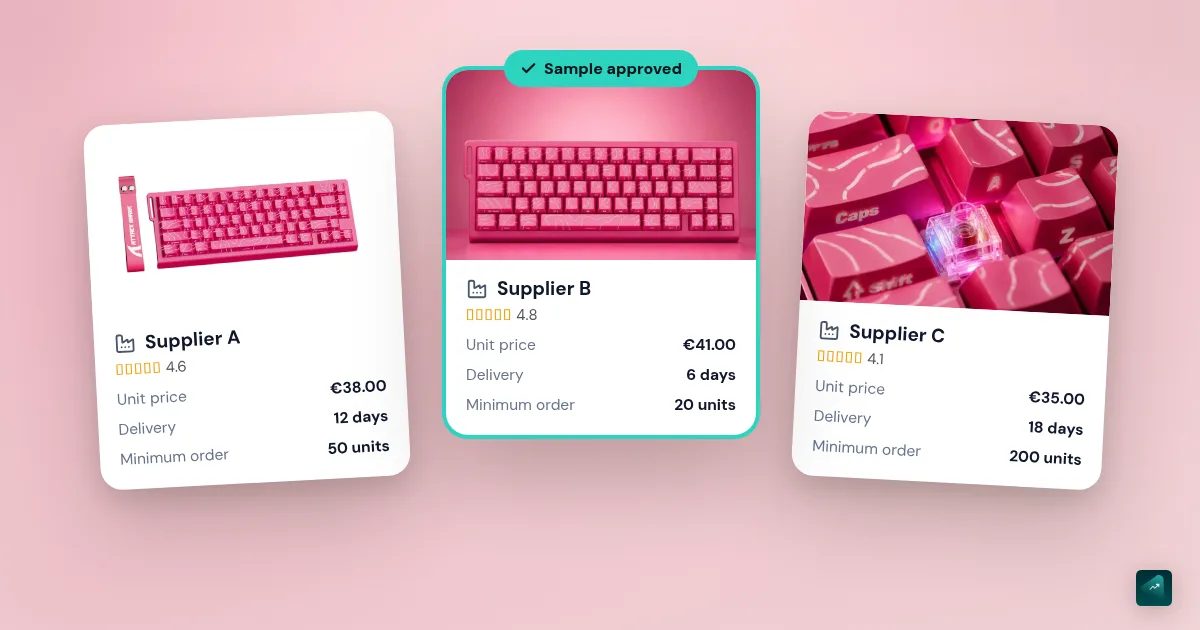
The delivery time you want to promise. It's the criterion that matters most to your customer. A product shipped from Asia usually takes one to three weeks to reach Europe, depending on the carrier. From a European warehouse, it takes a few days. That time shows on your product page, and it carries weight. In Baymard's cart abandonment research, 20% of shoppers who abandon do so because delivery is too slow.
The money you're willing to put up. With dropshipping, you put up nothing. You pay the supplier only once your customer has paid you. A first order from a wholesaler or a manufacturer is the opposite. It's stock you finance before you've sold anything.
The control you want to keep. Maybe you want your logo on the packaging, a flyer in the box or consistent quality. The more that matters to you, the more you move toward a wholesaler or manufacturer. And the further you get from generic dropshipping.
| Supplier type | Stock to pay upfront | Customer delivery | Customization | Best for |
|---|---|---|---|---|
| Dropshipping from Asia | None | 1 to 3 weeks | Low | Testing an idea with no budget |
| Dropshipping from Europe | None | A few days | Medium | Selling in Europe with a decent delivery time |
| Brand wholesaler | A first order | A few days | None, they're their brands | Reselling existing brands |
| Manufacturer (white label) | A minimum batch | Production, then fast | Full | Building your own brand |
| Print on demand | None | 1 to 2 weeks | Good on the design | Apparel, posters, personalized items |
No-inventory models and their costs are compared in selling online without inventory, which covers the four options. Here, we look for the right supplier once your model is chosen.
Where to look, depending on what you sell
Test fast, no stock: AliExpress and CJdropshipping. You'll find millions of products there, with no minimum order. Apps send your Shopify orders to the supplier automatically. It's the right place to check that a product interests people before putting money into it. CJdropshipping also has warehouses outside Asia for part of its catalog. On those products, delivery is shorter.
Deliver in a few days: European dropshipping wholesalers. BigBuy, for example, states over 400,000 products stored in Valencia, Spain. Dispatch is announced within 24 hours. The catalog is less original than AliExpress, but you can promise fast delivery. And that shows in your conversion rate.
Resell brands: Ankorstore and Faire. These are wholesale marketplaces where independent brands sell to shops. Each brand sets its minimum order. On Ankorstore, most keep it at €100. You usually need a business number to open an account.
Have your brand manufactured: Alibaba and Europages. Alibaba is where you find factories, mostly in Asia. Europages helps you find European manufacturers among 2.2 million listed suppliers. On Alibaba, always pay through the platform. That's the condition for Trade Assurance to refund you when the factory ships late. It also covers quality that doesn't match what was agreed.
Print on demand: Printful and Printify. You create the design, and they print and ship each order one by one. It's ideal for selling apparel, mugs or posters without storing anything.
A trick few people use. Look at the label or packaging of a competing product. You can also search Google for "manufacturer + your product + country". Many factories have a website and sell directly, often with more flexible minimums than you'd think.
Connect it to Shopify so everything goes out on its own
A well-chosen supplier that's badly connected leaves you copying orders by hand. Tracking numbers then get forgotten. Most suppliers have a Shopify app that does this work for you. At a minimum, it should do these four things:
- Import products into your store with photos, variants and prices. You then edit them.
- Send orders to the supplier when a customer buys, in one click or automatically.
- Send the tracking number back to Shopify. Your customer then gets the shipping email without you touching anything.
- Sync stock and price, so you don't sell a product that's out of stock or whose cost went up.
| Supplier | Shopify app | What to know |
|---|---|---|
| AliExpress | DSers | Free up to 3,000 products; automatic stock and price sync requires the $19.90 per month plan |
| CJdropshipping | CJdropshipping app | Products, orders and tracking from one interface |
| BigBuy | BigBuy connector | European stock, catalog sync |
| Printful, Printify | Their own app | You pay per order, no subscription to start |
For AliExpress, the step-by-step DSers tutorial shows installation and importing a product. It also explains how to link your variants to the supplier's and place a bulk order.
The eight questions to ask before paying
A serious supplier answers precisely. A risky one answers fast and with enthusiasm, but without numbers. Ask in writing and keep the answers.
| Question | Why you ask | The answer that should worry you |
|---|---|---|
| What's the dispatch time, then delivery time to my customers' country? | It's the time you'll display | "Fast", with no number of days |
| What's the minimum order? | The money you'll tie up | A minimum that changes when you push |
| Can I order a sample? | Compare the real product to the photo | A refusal, or "the sample is different" |
| What happens if a product arrives broken? | Your customer won't want to wait | "That never happens" |
| How am I told about a stockout? | Don't sell what no longer exists | No automatic stock tracking |
| Is the parcel tracked all the way to delivery? | Your customer will ask you | Tracking that stops when it leaves the country |
| Can you add my logo or remove yours? | Your customer shouldn't see another name | Another shop's invoice or flyer in the box |
| Which payment methods? | Your protection if things go wrong | Bank transfer only, off-platform |
Time their replies too. A supplier who takes four days to answer before you've bought anything won't be faster when you have an unhappy customer.
Also be wary of photos that appear on ten other stores. A price far below everyone else's should worry you the same way. Be just as careful with any request to pay off-platform in exchange for a discount.
Work out your real cost, not the listed price
The supplier price is just one line of your cost. Your real cost per order adds shipping and payment fees to the product price. You also have to count whatever is added when the parcel comes from far away.
If you import from outside the European Union, two lines have been added in recent years. Since July 2021, VAT applies from the first euro. And since July 1, 2026, a parcel under €150 pays a €3 duty per category of items. Five T-shirts count as one category, so €3. On an €8 product, that changes everything.
Think about the label too. For a product made outside the EU, your product page must show the manufacturer and a responsible contact in the Union. Ask your supplier for that contact from the start. A good supplier already has one.
Put your numbers into the Shopify profit margin calculator before setting your selling price. If the margin doesn't hold on paper, it won't hold once you add advertising.
The test order, before the first sale
Never sell a product you haven't received yourself. Place a real order delivered to your home, like a customer would. Ideally, go through your own store to test the whole chain.
Write down the order date and the delivery date. The gap between them is your real delivery time, the one you'll display. Then open the parcel like a customer would. Look at the packaging and the condition of the product, then compare it to the photos. Also check there's no invoice or ad from another shop inside. Take your own photos while you're at it. They'll make your product page more credible than the supplier's.
If you're torn between two suppliers, order from both on the same day. In two weeks, you'll know which one to keep. And once the product is validated, the checklist for your first sales is waiting before you send traffic.
Show the right delivery time on your store
Once you know your real delivery time, show it wherever your customer decides. It should appear on the product page, under the buy button and in the cart. A ten-day delivery announced clearly sells better than a five-day promise that takes twelve. In Shopify, shipping profiles let you set a different time and price per product. That helps when part of your catalog comes from Europe and the rest from Asia.
No store yet? You can generate it with Scale Ova from your product. You look at it and change it for free. You only pay when you publish it on Shopify.
FAQ
How do I find a reliable supplier?
European or Chinese supplier?
How do I connect a supplier to Shopify?
Do I need a company to buy from a wholesaler?
How much should I order the first time?
Sources
- Reasons for cart abandonment, Baymard Institute, accessed October 29, 2026
- DSers pricing, accessed October 29, 2026
- BigBuy, dropshipping from Europe, accessed September 18, 2026
- Ankorstore, changes to minimum orders, Ankorstore blog
- Europages, B2B marketplace, figures shown on September 18, 2026
- Trade Assurance, Alibaba.com, accessed September 18, 2026
- €3 customs duty for low-value parcels, European Commission, June 29, 2026, accessed October 29, 2026
- E-commerce: the rules change on July 1, 2021, French customs
- Regulation (EU) 2023/988 on general product safety, EUR-Lex