If you're just starting out, the complete guide to building your Shopify store covers the basics, so you know what you're being sold when you pay for a turnkey site.
Which route for your budget, in 30 seconds
"Turnkey" means three things depending on who's selling it: a platform where you do everything, a store delivered by a provider, or an existing store you buy. Your budget decides.
| Your budget | What you can actually get | The route that holds | What's left for you |
|---|---|---|---|
| Under €100 | No serious service. A Shopify install with a free theme and products copied from AliExpress | Do it yourself: an AI generator to see the result for free, a free theme (Dawn, Horizon) | Everything, but you keep everything: access, theme, decisions |
| €100 to €600 | A freelancer delivers a configured store with 10 to 30 products, in 5 to 10 days | A freelancer with the list below, or AI plus your time | Supplier, extra products, traffic, customer service |
| €600 to €1,500 | An entry-level agency pack: more polished design, integrated products, support | Only if the contract spells out brand direction and post-delivery support | Traffic, margin, returns |
| Over €1,500 | An existing store with history (Flippa, DotMarket), or a custom agency build | Buying if you can read accounts, an agency if you have a real spec | All the due diligence, or managing the agency |
Three things to keep in mind:
- Nobody delivers customers. A delivered store has no audience, at €99 as at €1,500.
- The listed price isn't what you'll pay. A €599 pack means 10 products. Compare what's included, not the big number.
- You're buying time saved on setup. The question is whether that time is worth the price. To answer it, first look at what a ready-to-sell store contains.
A turnkey store, for real
Before talking prices, look at what a store that's "ready to sell" looks like. Mixup is a demo generated by Scale Ova from a description: a portable blender bottle, the textbook dropshipping product. You can visit it page by page.
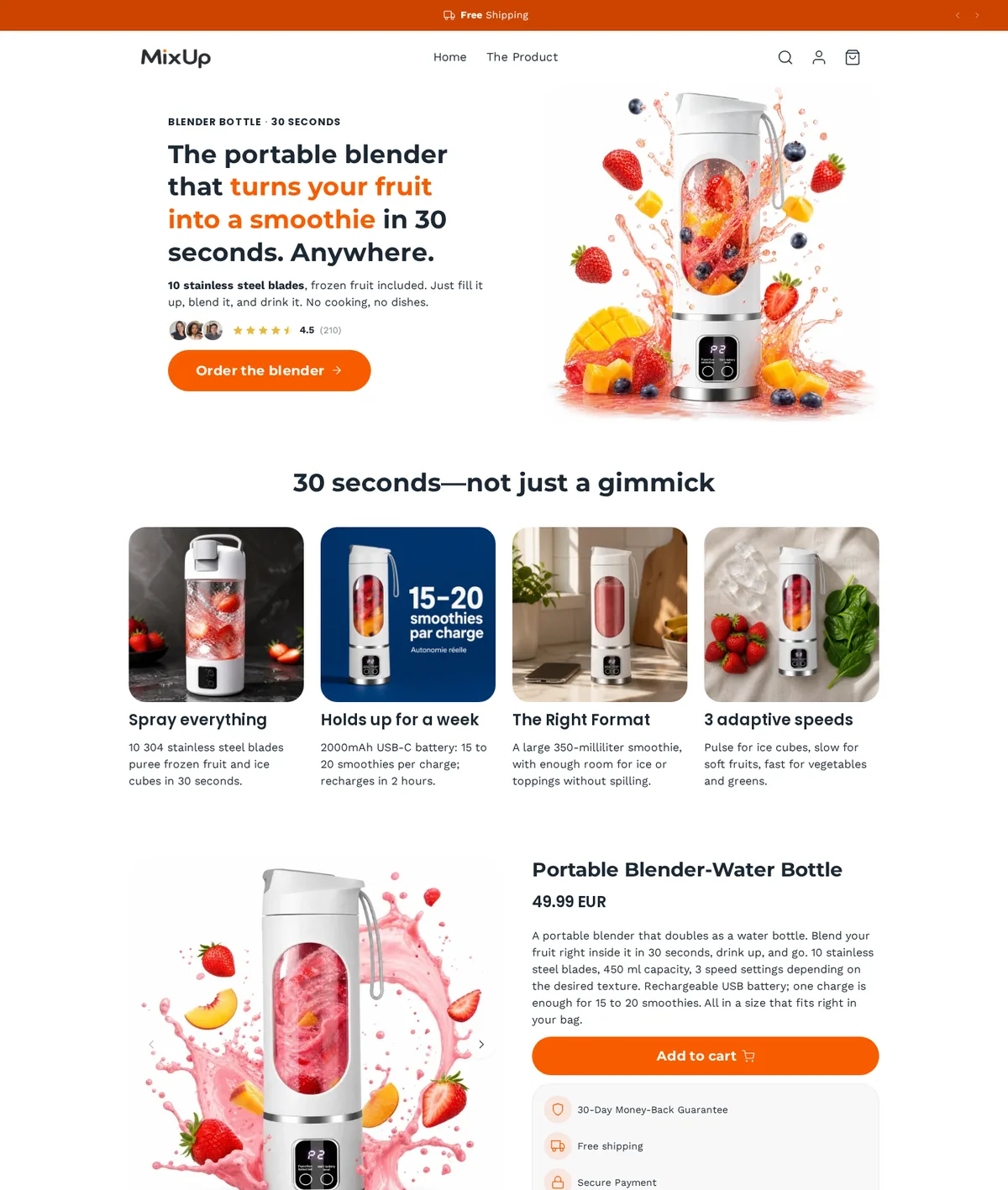
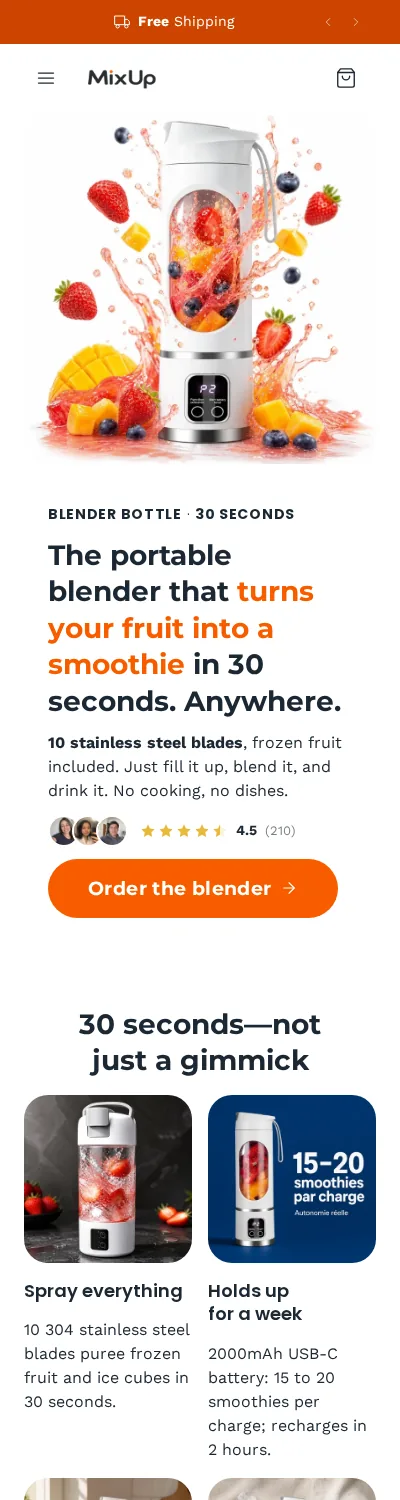
What you're looking at: a home page with a clear promise, benefits with images, a product page at €49.99 with add to cart, reassurance (money-back guarantee, free shipping), a menu, a cart. That's the minimum any turnkey offer should deliver. Here, it took a few minutes, with no designer. The same demo is compared with two other single-product stores, generated from an existing page and from a description, in one product store examples.
What a capture doesn't show, and what most offers forget: the supplier hooked up with real delivery times, payments tested, shipping rates set, emails proofread, legal pages adapted. That's where the difference plays out between a store that's ready to sell and a store that looks ready.
The anatomy of a store that's ready to sell
Seven visible elements make a visitor understand, trust you, and buy. Spot them on the demo, then demand them from any vendor.
- The reassurance bar: free shipping, returns, delivery time. One piece of information, visible without scrolling.
- The one-sentence promise: what the product changes, for whom, in how long. Not the product name, not "welcome to our site".
- Social proof: a rating, a review count, faces. With no reviews, remove the block rather than inventing them.
- The buy button: one, well contrasted, visible on load.
- The product in context: the product being used, not the grey-background supplier photo fifty other stores use.
- Concrete benefits: three or four cards, each answering an objection (battery, size, power, speed).
- The product page: price shown, one-click add to cart, guarantee and shipping repeated under the button.
Then there's what you can't see:
- a Shopify account in your name
- payments activated and tested with a real order
- shipping zones, rates, and taxes configured
- legal pages written for your business (terms, privacy, returns)
- proofread transactional emails
- a connected domain, an analytics tool installed
- a supplier hooked up with verified delivery times
If a single one of these is missing, the store isn't ready to sell, however good it looks.
The checklist to have ticked before you pay
Send this list to the vendor and ask for a written answer, line by line. Vague answer = not included.
- The Shopify account is created in my name and I'm the owner, not a collaborator.
- The theme is a free Shopify theme or licensed in my name, not a shared "exclusive" theme.
- The vendor tells me how many stores use the same template.
- The supplier's name is given before payment, with real delivery times per destination.
- A test order was placed on one of the vendor's existing stores, or I can place one myself.
- Payments are activated, and a test order was charged then refunded.
- Shipping zones, rates, and times are configured and consistent with the supplier.
- Legal pages are adapted to my business and my country, not copy-pasted.
- Confirmation and shipping emails are proofread and in my name.
- The domain is connected, the favicon and store name are mine.
- Product pages have photos and copy that aren't the supplier's.
- The store was tested on mobile, cart, payment, and emails before delivery.
- Post-delivery support is described: how many exchanges, over what period, on which topics.
- What's not included is written down: extra products, apps, traffic, SEO.
Out of these 14 points, a €599 offer rarely ticks more than half. Not necessarily a scam, just the scope. Your job is to know what you're paying for and what you'll do yourself.
What it really costs over 12 months
The service price is only part of it. Shopify is billed every month, whichever route you take. So let's put the real numbers side by side.
Take Shopify on the Basic plan, paid monthly. Here's what you pay in year one (prices taken from Shopify's French pricing page on September 11, 2026):
- 3-day free trial
- €1/month for 3 months
- then €36/month (€27/month if you pay the year upfront)
Total: €327 over twelve months, with no paid apps. Ads aren't counted: that budget is up to you, and it adds up whichever route you take.
| Route | Service or tool | Shopify, year 1 | Year 1 total | Not counted |
|---|---|---|---|---|
| Yourself with an AI generator (Scale Ova) | Free generation, €49/month to publish | €327 | €327 plus €49/month for the Scale Ova subscription | Your time on supplier and traffic |
| Platform with integrated suppliers (Dropizi) | €27/month, i.e. €324 | None, the platform replaces Shopify | €324 | All the build work is yours |
| Freelancer | €599 for 10 products (Lefreelancer.net) | €327 | €926 | Every extra product, support, traffic |
| Agency pack | €300 to €1,500+ (boutique-cle-en-main.com) | €327 | €627 to €1,827+ | The exact pack contents before contact |
| Buying an existing store | 2.5 to 4 times the seller's annual profit (Flippa) | €327 | Purchase price plus €327 | Due diligence, management time |
From one row to the next, what really changes is what you're holding at the end. With a generator or a serious freelancer, the store is yours and you know how it's built. With a platform, you depend on its catalog. With an acquisition, you get a track record, if it's true.
Turnkey offers in 2026, listed prices
The vendors ranking for this search never compare themselves to each other, so I did it. Prices taken from their official pages on September 11, 2026, on the French market.
| Offer | What it is | Listed price | What's missing |
|---|---|---|---|
| Dropizi | Platform where you build it yourself, integrated suppliers (BigBuy, AliExpress, Webdrop) | €27/month, 15-day trial | Nobody builds the store. "48 to 72 h" delivery depends on the supplier, check it product by product |
| Freelancer on ComeUp | One-off service | Most often €80 to €350 | Post-delivery support and SEO rarely included |
| Lefreelancer.net | Freelancer pack | €599, 10 products and 5 categories included, delivered in 10 days | Up to €429 on top for 110 products |
| boutique-cle-en-main.com | Agency packs | From €99. Basic €300 to €600, branded €600 to €900, premium €1,500+ | The contents of each tier aren't detailed before you get in touch |
| Amplifeo | Agency, on quote | Not listed, quote within 24 h | No public price, you can't compare before handing over your contact details |
| Flippa, DotMarket | Buying an existing store | 2.5 to 4 times annual seller's discretionary earnings, per Flippa | All the due diligence is on you |
The traps that keep coming back
Always the same, from one offer to the next. Each one shows up with a question from the list.
- The generic store resold in bulk: same template, same AliExpress products, delivered to dozens of buyers. Question 3.
- The "legal pack": copy-pasted terms presented as protection. They're worth nothing automatically, and you're the one who stays liable. Question 8.
- The revenue promise: no store sells without traffic. A vendor promising you sales by a fixed date has to show you the acquisition plan and the budget behind it.
- The unverifiable "local supplier": sometimes a real wholesaler with local stock, often an agent or a catalog shared between all their clients. Questions 4 and 5.
- The unlicensed "exclusive" theme: a premium theme without a proper license is a legal problem for you, not for the vendor. Question 2.
Turnkey store without dropshipping: private label, own stock, agency
"Turnkey store" doesn't necessarily mean dropshipping. Three other routes exist:
- Private label: a supplier manufactures under your brand, you hold stock or have it held. More control over quality and margins, but a real upfront investment.
- Store with your own stock: you buy and manage your inventory. The turnkey part covers the site and the initial logistics, not sourcing.
- E-commerce agency: it builds the store on a quote, with or without dropshipping. The turnkey promise is real if the contract details custom work, integrations, rights, and support.
In all three cases, the list above applies as is: who owns the access, who can edit the site, what is actually delivered.
Build your store yourself with AI, for less than a pack
Go back to the Mixup store. Scale Ova generated it from a description, in a few minutes. You can do the same for free with your product, and you only pay to publish to Shopify.
Compared to a classic turnkey:
- The store is built around your project, not a template resold to fifty people.
- You keep the access, the theme, and control. You edit in plain language, you start over if you don't like it, without paying again.
- No technical skills needed.
- You see the result before paying anything.
What it doesn't solve: traffic. No store, delivered or generated, sells without acquisition. But you didn't find that out after spending €599, and items 1 to 12 of the list are in your hands.
You can start from a simple description, from a competitor that already exists, or from a supplier product page. To understand what's behind it, I have a complete guide on AI for Shopify and an overview of AI store builders.
If dropshipping isn't for you, the article on selling online without inventory puts dropshipping, print-on-demand, and affiliate side by side.
Going further
Want to see what your store would look like before paying someone? Describe your product to Scale Ova and you get a complete, operational Shopify site in a few minutes. Discover Scale Ova
FAQ
How much does a turnkey dropshipping site cost?
Is a turnkey dropshipping site profitable from day one?
What must a "ready to sell" store contain?
Can you trust offers under €100?
What's the difference between buying a turnkey store and building your own with AI?
Is buying a store on Flippa safe?
Is a turnkey site with a local supplier better?
Sources
- Public price lists of Dropizi, Lefreelancer.net, boutique-cle-en-main.com, and Amplifeo, taken from their official pages on September 11, 2026
- Shopify: France pricing, Basic plan and trial offer, taken on September 11, 2026
- Flippa, e-commerce valuation method and 2026 multiples
- ComeUp, Shopify turnkey-store category and displayed budgets
- DotMarket: French-speaking alternative to Flippa
- FTC: Dropshipping consumer guidance