You're setting up your Shopify store and you've reached the legal pages. You want a free generator so you can tick the box and move on. That saves time. But these pages are also what gets read on your first dispute with a customer. A badly filled template doesn't protect you.
This guide is for anyone selling to customers in France, wherever you're based. It lists what French law requires, page by page, with the source of each rule. Then it shows where each page lives in the Shopify admin, and what you have to add by hand. This isn't legal advice. At the end, we'll look at when a professional is worth paying.
The required pages at a glance
| Page | Required? | Where to create it in Shopify | What you still have to add |
|---|---|---|---|
| Legal notice (mentions légales) | Yes, on any business website | Settings > Policies > Legal notice | Your full identity, your registration number, the host |
| Terms of sale (CGV) | Yes, as soon as you sell to consumers | Settings > Policies > Terms of service | Mediator, legal guarantees, a precise delivery time |
| Withdrawal and returns | Yes, the 14-day information is mandatory | Settings > Policies > Return policy | Model withdrawal form, return costs, online withdrawal function |
| Privacy policy | Yes, as soon as you collect data | Settings > Customer privacy | The apps and pixels you added |
| Cookie banner | Yes, for ad cookies and non-exempt analytics | Settings > Customer privacy > Cookie banner | Your third-party apps' cookies |
| Contact information | Useful, other pages reuse it | Settings > Policies > Contact information | A business address and phone number |
| Shipping policy | Not a required page, but the delivery time must be stated | Settings > Policies > Shipping policy | A delivery time you can actually keep |
Where legal pages live in Shopify
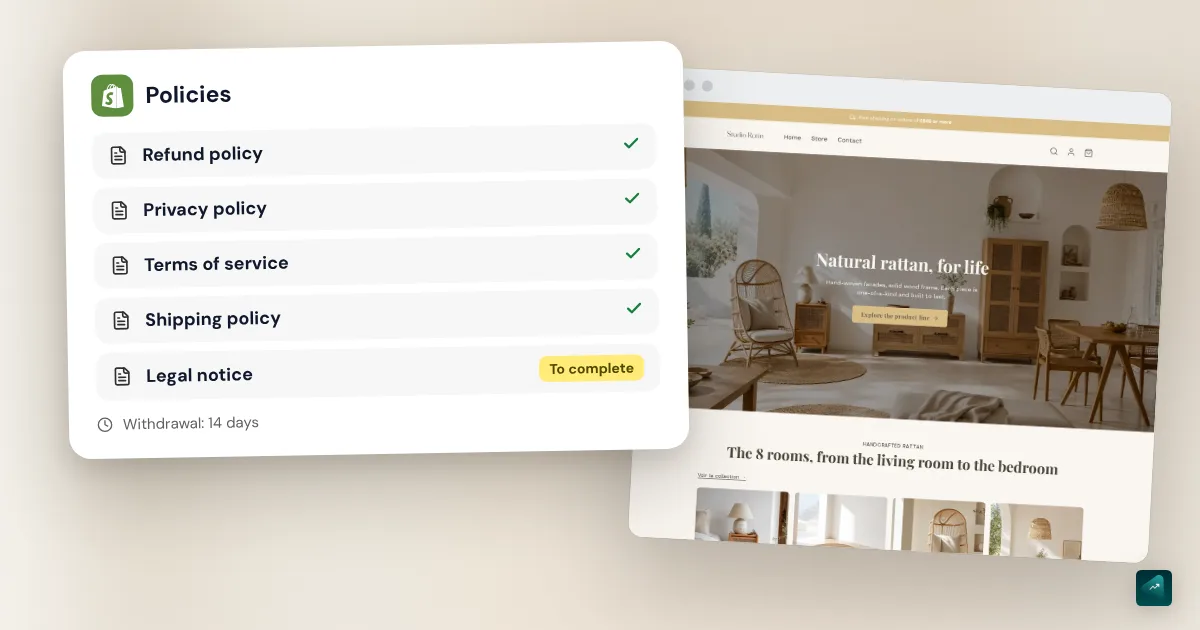
Everything starts in Settings > Policies, in the Written policies section. Shopify manages seven texts there. They are the return policy, privacy policy, terms of service, shipping policy, legal notice, contact information and subscription policy.
Four of them can be automated. These are the return and refund policy, the terms of service, the shipping policy and the contact information. Once automation is on, Shopify writes the text from your settings and keeps it updated when they change. Your address comes from your store contact details. Your return terms come from your return rules.
To turn on an automated policy:
- Go to Settings > Policies.
- In Written policies, click the policy you want.
- Turn on Use automated policy.
- Review the generated text, then click Save.
Each policy is turned on separately. Automating the return policy doesn't automate the others. On a store that already has policies, automation replaces your content, translations included. Copy it first.
To write a policy yourself, turn off Use automated policy for it. You can then start from Insert template when the option is there, edit, and save. The legal notice has no automated version, so you fill it in by hand.
Once saved, your policies are linked in the checkout footer. They aren't added to your store menu on their own. To put them in your site footer, go to Content > Menus and open the footer menu. Click Add menu item, search for the policy, then click Add and Save menu.
Shopify also offers free generators on its website, outside the admin. There are three of them, for the privacy policy, the refund policy and the terms of service. You fill in a form and the template arrives by email. There's no Shopify generator for a legal notice.
Why a generic template isn't enough
Shopify says so itself in its Help Center. Its templates are for information only and aren't legal advice. They don't guarantee compliance with the law either. You're the one responsible for what you publish.
One example shows the gap well. Shopify's refund policy generator page says there's no legal obligation to offer refunds or returns. For a customer in France, that's wrong. The French Consumer Code gives them 14 days to withdraw without giving a reason.
Templates also skip whatever depends on your situation. They don't know your consumer mediator, since you're the one who picks it. They don't know whether you're a sole trader or a company, and the required details differ. Many templates still link to the EU online dispute resolution platform. It closed on July 20, 2025, and the obligation to link to it went with it. If your terms contain an ec.europa.eu/consumers/odr address, remove it.
The legal notice
The legal notice says who is selling. In France it comes from the 2004 digital economy law, the LCEN. It can be a separate page or part of your terms of sale.
If you're a sole trader or micro-entrepreneur, you need:
- your first and last name, with the words "entrepreneur individuel" or "EI";
- your business address;
- an email address and a phone number;
- your registration number in the RCS or RNE;
- your VAT number, if you have one;
- the host's name, address and phone number.
If you run a company, the identity becomes the company name, legal form and share capital. The address is the registered office. The rest stays the same. In both cases, you add the name of the publication director.
For a Shopify store, the host is Shopify. Its Terms of Service name Shopify International Limited as the contracting party for European merchants. Shopify updated them on October 20, 2026. That company's registered office is at The Sidings, 4th Floor, Grand Canal Quay, Dublin D02 E7K8, Ireland. Copy that name and address rather than a template you found online.
Watch the address you publish. Shopify pulls your store contact details into its automated policies. If you work from home, your personal address shows up. Shopify suggests a PO box, but it also notes that some legal disclosures require a physical address. To let customers write to you, also add a contact page with a form.
Leaving out the legal notice is expensive. The penalty goes up to one year in prison. The fine reaches €75,000 for a sole trader and €375,000 for a company.
Terms of sale
The terms of sale (CGV) are the contract between you and your customer. They're mandatory as soon as you sell to consumers. In Shopify, they go in the Terms of service policy.
They need to include at least:
- the main features of the products and the price including VAT, in euros;
- delivery costs, date and terms;
- payment terms;
- the right of withdrawal, its deadline and conditions;
- the legal guarantee of conformity and the guarantee against hidden defects;
- any commercial warranty and after-sales service you offer;
- dispute resolution, with the competent court and your mediator.
The delivery time deserves a word. The law asks for a precise date or delivery time. With no date stated, you must deliver within 30 days of the order. Shopify's automated template uses your order processing time, but only when your estimated delivery dates are set up.
Selling to consumers without terms of sale can bring an administrative fine. It goes up to €3,000 for a sole trader and €15,000 for a company.
Your invoices follow their own rules. France e-invoicing for Shopify stores explains what the reform changes for your store.
Withdrawal, returns and refunds
This is the page customers read most. It's also where US-style templates get things most wrong.
Your customer has 14 days to withdraw, with no reason needed. For a product, the clock starts the day after delivery. Once they tell you, you have 14 days to refund everything they paid. Return shipping can stay at their expense, as long as you said so before the purchase. You also have to give them a model withdrawal form.
Some products are excluded. Custom-made or personalized products are, and so are perishable goods. So is a hygiene product unsealed after delivery. The list is set by law, and your terms can't extend it.
If you don't tell the customer about this right, their deadline gets longer. It can reach 12 months and 14 days. Failing to inform them is also fined, up to €15,000 for a sole trader and €75,000 for a company.
The admin steps to refund or cancel are in how to cancel an order on Shopify.
The withdrawal button, mandatory since June 19, 2026
Since June 19, 2026, an EU directive requires an online withdrawal function. Your customer must be able to withdraw directly on your store, during the whole period, without emailing you. The French government page describes two steps, "renoncer au contrat ici" (withdraw from the contract here) and then "confirmer la rétractation" (confirm withdrawal). Your store then sends an acknowledgment on a durable medium, such as an email.
Shopify suggests using its self-serve returns and cancellations, configured through your return rules. That flow goes through the customer account. Several merchants on the Shopify Community ask whether it's enough when the customer has no account. Others use a dedicated app from the Shopify App Store. Test the flow yourself, on a phone, with an order placed without an account. If you can't withdraw in two clicks, your customer can't either.
The legal guarantee of conformity
This has nothing to do with withdrawal, and many stores mix them up. A product that is defective or doesn't match your description gets repaired, replaced or refunded for 2 years after delivery. During those 2 years, a defect in a new product is presumed to have existed at purchase. For a used product, that presumption lasts 12 months. Writing "2-year guarantee" on a product page adds nothing, because it's already the law.
The consumer mediator
This is the obligation almost everyone forgets, and no template fills it in for you. Any business selling to consumers in France must let customers use a mediator for free. Store size makes no difference.
In practice, you sign up with a mediator listed by the French mediation evaluation commission (CECMC). You pay for the mediation, never the customer. You then display its name, postal address and website on your store and in your terms. The "Trouver un médiateur de la consommation" tool on service-public lists mediators by sector.
Having no mediator brings an administrative fine. It goes up to €3,000 for a sole trader and €15,000 for a company. Sort this out before you open, not at your first dispute.
Privacy, GDPR and cookies
As soon as you collect an email or a shipping address, you're handling personal data. Your privacy policy must explain what you collect, why and for how long. It also lists the customer's rights and how to use them. It must be separate from your terms of sale.
On a new store, Shopify turns on its automated privacy settings by default. They cover the privacy policy, the cookie banner and a data sharing opt-out page. You manage it all in Settings > Customer privacy. The banner shows automatically to visitors from the European Economic Area and the UK, if you have an active market there.
That banner has a limit that Shopify's help states plainly. It only governs Shopify's own tools. If you added a Meta pixel or another tracker by hand, you may need a third-party banner or extra setup. The same risk applies to an app that sets its own cookies. To install your pixels cleanly, the Meta and TikTok pixel on Shopify tutorial uses the official integration.
The French data protection authority's rule is easy to check. An advertising cookie can only be set after the visitor agrees. Refusing must be as easy as accepting. Open your store in a private window and see whether refusing is as visible as accepting. To set up the banner step by step and test it, follow the Shopify cookie banner guide.
Incomplete information about personal data is fined €1,500. Processing without consent goes much further, up to a €300,000 fine and 5 years in prison.
When to see a professional
The rules in this guide are enough for a small store selling everyday products in France. Shopify itself recommends adding disclosures if you sell alcohol or cosmetics. The same goes for children's products, electronics or subscriptions. Those have their own labeling and information rules. For cosmetics, the guide on how to start a cosmetic brand covers them.
I'd hire a lawyer in three situations. The first is when you sell a regulated product. The second is when you sell subscriptions or services. The third is when you sell outside the EU in volume. A review of your terms costs less than a lost dispute. Otherwise, a good template reviewed carefully and completed with your real details does the job.
Having Ova write and publish your policies
Once your store exists, Ova can read and rewrite each of your Shopify policies, legal notice included. It also creates pages and adds them to your menus. You might write, for example, "write my terms of sale and return policy for a sole trader selling candles in France, with 14-day withdrawal and return shipping paid by the customer." It shows you the text before saving it to Shopify.
Ova doesn't know your registration number or your mediator. It doesn't replace a lawyer either. Review each text, add your own details, then test the withdrawal flow yourself. Generation and edits are free, and the subscription is what lets you publish to Shopify. Describe your store to Scale Ova to get started. For the other settings before launch, the complete guide to building a Shopify store takes over.
FAQ
Does Shopify generate terms of sale?
Is there a Shopify legal notice generator?
Which host should a Shopify store list in its legal notice?
Is Shopify GDPR compliant?
Do I need terms of sale as a micro-entrepreneur?
Do I still need a link to the EU online dispute resolution platform?
Can a customer withdraw after 14 days?
Sources
- Service-Public Entreprendre, required information on a business website: legal notice, terms of sale, personal data and penalties, checked October 13, 2026, read October 29, 2026
- Service-Public Entreprendre, online selling rules: pre-contract information, delivery, withdrawal, online withdrawal function, penalties, checked June 19, 2026, read October 29, 2026
- Service-Public Entreprendre, consumer mediation: obligation, cost, what to display, penalty, checked October 16, 2026, read October 29, 2026
- Service-Public, legal guarantee of conformity: 2 years, 24 and 12-month presumption, checked August 17, 2026, read October 29, 2026
- Service-Public Entreprendre, cookies and other trackers: informing visitors, article 82 of the French Data Protection Act, read October 29, 2026
- CNIL, cookies and trackers: what the law says: prior consent, exempt trackers, refusing as easy as accepting
- Légifrance, French Consumer Code, article L221-18: 14-day withdrawal period
- EUR-Lex, Regulation (EU) 2024/3228: discontinuation of the EU online dispute resolution platform on July 20, 2025
- Shopify Help Center, adding store policies: managed policies, automation, templates, menus, legal disclaimer, read October 29, 2026
- Shopify Help Center, customer privacy settings: cookie banner, regions, limits with third-party trackers, read October 29, 2026
- Shopify Help Center, EU right of withdrawal: June 19, 2026 electronic withdrawal function, exemptions, extended period, read October 29, 2026
- Shopify Terms of Service: Shopify International Limited, contracting party for Europe, updated October 20, 2026
- Shopify, privacy policy generator: the three free generators, read October 29, 2026
- Shopify, refund policy generator: the page states there's no legal obligation to offer returns, read October 29, 2026