You have a product in mind, magnesium, collagen, vitamin D, melatonin, and you want to build a brand and sell it online. The market is there, 3 billion euros in France alone, and it keeps growing. What sets you apart from an online pharmacy with 200 references is the store: one promise, one product, one routine. We look at a real store, then rebuild it for your product.
If you are new to Shopify, the complete guide to building your store covers the basics shared by every niche. Here, we only talk about supplements.
The market, in three numbers
Food supplements reached 3 billion euros in France in 2025, up 2.6 %. 55 % of sales go through pharmacies. Distance selling is a little over 10 %. (Synadiet, 2025 observatory)
- The need already exists. 61 % of French people took supplements in 2024. You do not have to convince anyone that magnesium is useful, only that yours is the one to buy.
- Your competitor is the pharmacy counter. People buy where they trust. Your store has to reassure just as much: manufacturing, composition, dosage, reviews.
- The 10 % online is 300 million euros. An independent brand takes its place there on one precise promise, not on a catalogue.
The store: one product, one symptom, three plans
The store below is a demo generated by Scale Ova from a description: a magnesium bisglycinate made in France, sold as a one, three or six month supply. You can visit it page by page.
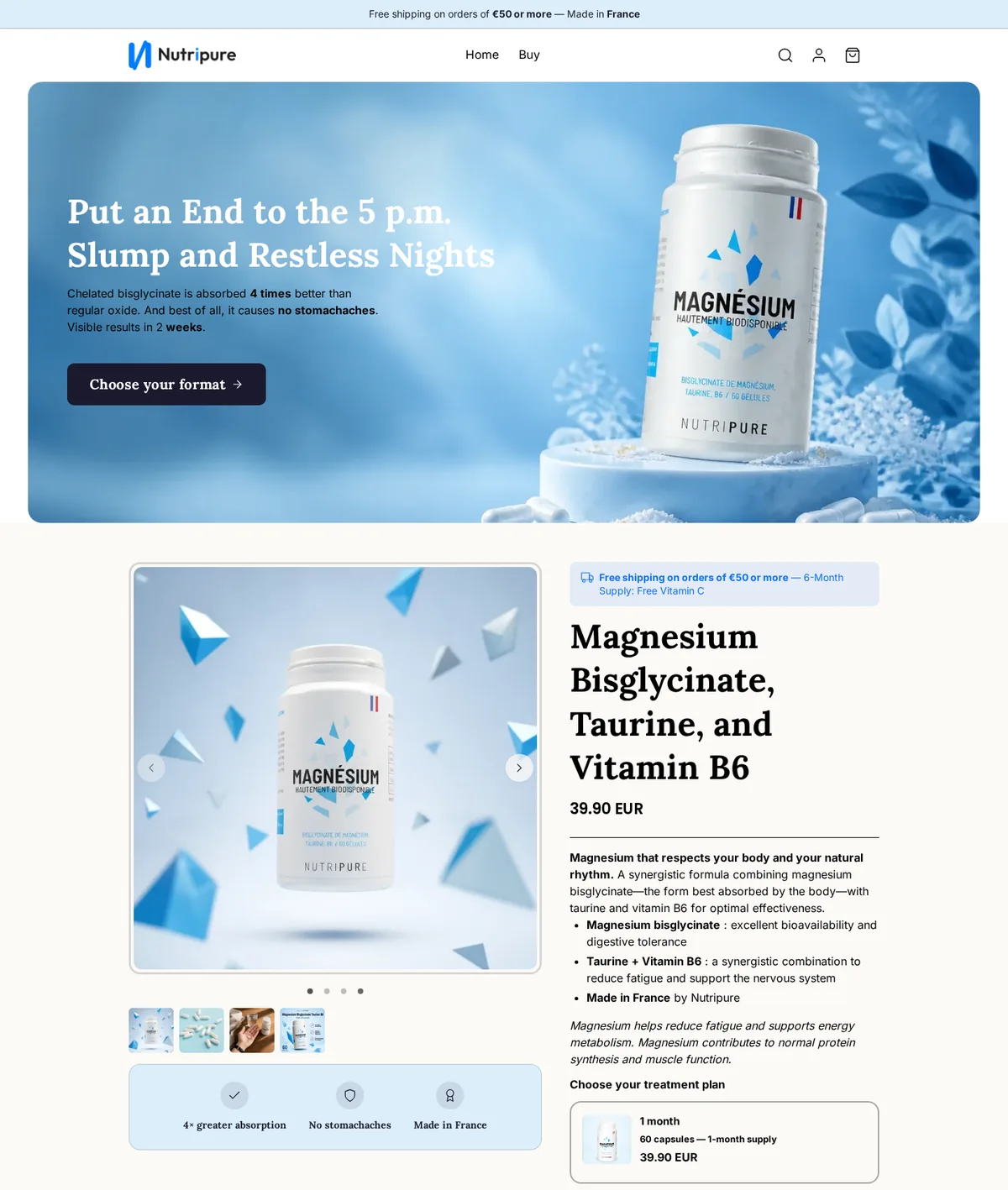
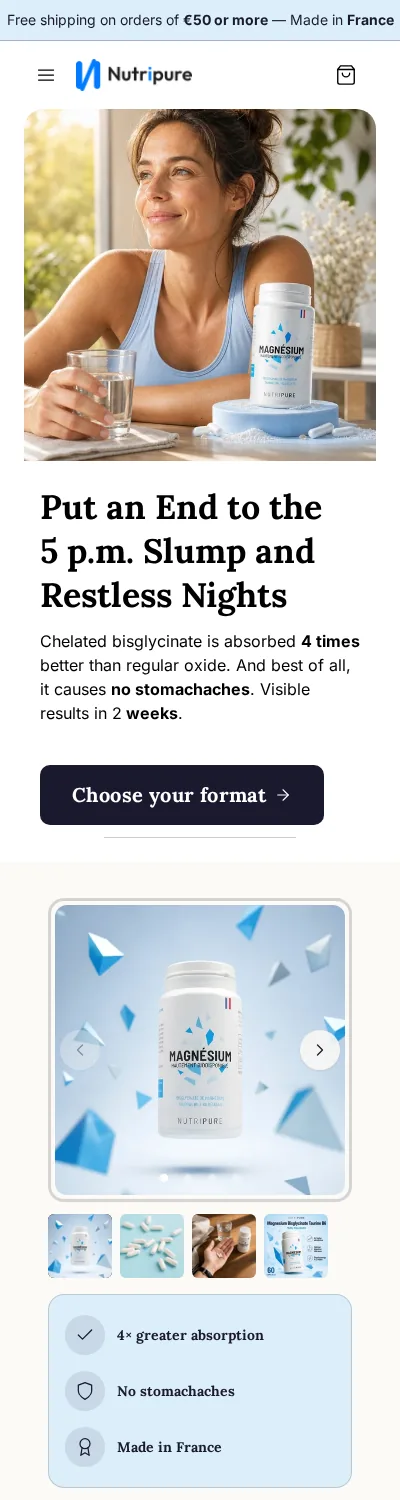
Look at how it sells. The headline does not say "magnesium bisglycinate 60 capsules", it says "put an end to the 5 p.m. slump and restless nights": the customer recognises themselves before reading the name of the molecule. Right below, the form argument is translated into a benefit, better absorbed, no stomach aches, a timeframe to see a result. The bottle carries the flag. And the product page does the rest: 39.90 € for a one-month supply, three durations to choose from, free shipping from 50 €, a gift on the six-month plan.
The anatomy, marker by marker
Eight elements make a visitor understand, trust and buy. Spot them on the demo, then reproduce them for your product.
- The reassurance bar: free shipping from 50 €, made in France. One month costs 39.90 €: the threshold pushes towards the three-month plan without saying anything else.
- The promise through the symptom: what the customer feels, the end-of-day crash, the broken nights. Not the name of the molecule. The headline is what sells.
- The proof of form: why this form rather than another, as a readable benefit. Better absorbed, better tolerated, a timeframe. Three facts the customer remembers and repeats.
- The button to the format: one button, "choose your format", leading to the plan selector. Not to an "our story" page.
- The packshot: a clean bottle, the flag, crystals. The product looks like what you find in a pharmacy, only more desirable.
- The name and the price: the name states the composition, magnesium, taurine, B6, the price comes before any text. The customer knows what they are looking at in a second.
- The sentence that carries the promise: in italics under the description, "magnesium helps reduce fatigue". It is the official wording, and it is what makes the bold headline at the top credible.
- The plan selector: one month, three months, six months, with a visible advantage for the longer plan. This is where the average order and the repeat purchase happen.
The product page that moves people to the three-month plan
On a supplement, the product page does not sell a bottle, it sells a routine. Here is what the demo's page does, and why.
- The supply as the unit. "60 capsules, one-month supply": the customer does not compare bottle prices, they compare a month of routine at 39.90 €, which is 1.33 € a day.
- Three durations, the right one in the middle. One month at the base price, three months tagged "popular", six months with a free product. The three-month plan is the one you want to sell: it clears the free shipping threshold and covers the time it takes to feel an effect. If you show a crossed-out price, keep it real: the reference price is the lowest price applied in the previous 30 days.
- The stated timeframe. "Visible results in two weeks" answers the question everyone asks and justifies the longer plan. Write it only if you can back it up.
- The three icons under the gallery. Absorption, digestive tolerance, made in France. One line each, no paragraph.
- A gallery that shows use. The bottle, the capsules in a hand, the readable label. A photo of the label reassures as much as any text.
- Reassurance under the button. Free shipping from 50 €, returns, secure payment, dispatch time. Four lines, not a paragraph.
- Subscription, if you want to go further. A supply that renews itself every month with 10 % off is the model of the brands that last. Shopify handles it natively with a subscription app.
What you write: the symptom, the form, the routine
A supplement sells on three registers, and the EU claims framework blocks none of them.
- The symptom. The 5 p.m. slump, the broken nights, the cramps after training. What the customer lives, in their words.
- The form and the origin. Bisglycinate versus oxide, dose per capsule, made in France, batch tested. Verifiable facts about your product, which the customer repeats.
- The routine. Two capsules in the evening, a three-month plan, automatic reordering. This is the register that brings people back.
For the promise itself, the rule is simple and it works in your favour: every vitamin, mineral or substance has a list of authorized sentences, "contributes to a reduction of tiredness and fatigue", "contributes to normal functioning of the nervous system". You build your page from those sentences, you put them in italics under the description like the demo does, and the punchy headline at the top holds because it rests on them. What you never write: cure, heal, treat. Not on the store, not in ads, not in emails.
Your product: private label, custom formula or dropshipping
Three ways to have a product to sell. For a first brand, the first one is enough.
| Route | Lead time | Minimum | For whom |
|---|---|---|---|
| Private label with a French contract manufacturer | Short, the formula exists | 100 to 500 units per reference depending on the manufacturer | Launch a first reference without developing anything |
| Custom formula | Long, development then production | Higher, on quote | A second reference, once you know what sells |
| Supplement dropshipping | Immediate | None | Nobody, in this niche |
- Private label: a laboratory already has a formula, you put your label on it. French contract manufacturers (Vibraforce, Propos'Nature, Laboratoire FGnutra, among others) announce 300 to 500 units per reference, some go down to 100. They know the dosages and provide a label mock-up. Ask for two quotes with the unit price at your volume, it is the only number that matters.
- Custom formula: your formula, produced by a manufacturer. Longer, more expensive, more distinctive. Keep it for later.
- Dropshipping: an unknown supplier ships under your name a product whose composition, label and batch you never see. On something people swallow, no.
One reference, one promise, three plans: that is what the demo does, and that is what reads in three seconds.
What to settle before the first sale
A food supplement is a food, not a medicine. No licence, no diploma, but a few things to set up once and for all.
- The Compl'Alim declaration. Each product is declared online before it goes on sale, with its composition and label. If your ingredients are on the French lists, you can sell as soon as it is filed. A serious manufacturer already has the file ready.
- The label. The words "food supplement", ingredients and allergens, quantity per daily dose, the dose not to exceed, "not a substitute for a varied diet", "keep out of reach of young children", your name and address. Your manufacturer provides the mock-up, your name goes on it. And the same information on the product page, before purchase.
- The authorized sentences, seen above: on the label, the store, the ads and the emails.
- Payment, to open before ordering the batch. Supplements are classed as high risk by most payment providers. Open your account with the label and the claims in front of you: a store that writes the official sentences passes review, a store that promises to cure gets shut down. And if you use a third-party provider, Shopify adds a 2 % fee per order on the Basic plan.
- VAT: 5.5 % for a supplement sold as a food in France, 20 % in some cases depending on the form. Check the line that matches your product before setting your price.
What it costs over 12 months
The heaviest line is not the store, it is the first batch.
| Item | Amount | Where the figure comes from |
|---|---|---|
| Shopify, Basic plan monthly, year 1 | About 327 € (3 free days, 1 €/month for 3 months, then 36 €/month) | Shopify France pricing page, 11 September 2026 |
| Third-party transaction fees | 2 % per order if you do not use Shopify Payments | Shopify France pricing page |
| First private label batch | Minimum order times unit price, 100 to 500 units depending on the manufacturer | Manufacturer quote, daily dose and label mock-up included |
| Label and packaging | Graphic design and printing, on quote | Your designer and your printer |
| Declaration and testing | Your time on Compl'Alim, batch testing if the manufacturer does not provide it | Compl'Alim, testing laboratory |
Not counted: advertising, which is up to you. The store itself, with Scale Ova, is generated for free and the subscription only starts when you publish.
The steps, in order
- Pick a product and a symptom. One reference, one promise, one authorized sentence that carries it.
- Ask two manufacturers for quotes: minimum, unit price, daily dose, label mock-up, lead time.
- Open your payment account with the label and the authorized sentences ready.
- Write the promise and the three proofs. The symptom, the form, the routine.
- Generate the store. Describe the product, the promise, the tone, the plans. Look at the result, fix it by conversation. The demo above came out of this process.
- Build the product page: price per day, three plans, timeframe, icons, gallery, reassurance.
- Declare the product on Compl'Alim, set the VAT.
- Set up shipping and legal pages, test an order end to end, then refund it.
- Publish, measure, bring people in. An analytics tool from day one, content about the symptom, verified reviews, ads if the margin allows.
Going further
Want to see what your store would look like with your product? Describe it to Scale Ova, look at the result, ask for changes, and only pay if you publish. For the product page itself, how to write a product page that converts gives the method section by section. And if you are still weighing stock against no stock, selling online without inventory compares the models. A food that is simpler to launch, with the same pack logic: selling tea online.
FAQ
Do I need a licence to sell food supplements online in France?
What price should I sell a supplement at?
What can I write on my store?
Can I dropship food supplements?
How many units for a first batch?
Why can payment be an issue?
How much does a supplement store cost?
Sources
- Synadiet, consumption and 2025 market figures, accessed 11 September 2026
- Decree No. 2006-352 of 20 March 2006 on food supplements, Légifrance
- Regulation (EU) No 432/2012, list of permitted health claims, EUR-Lex
- Compl'Alim, online declaration of food supplements (DGAL)
- BOFiP, VAT rate for food products, BOI-TVA-LIQ-30-10-10
- Stripe, restricted businesses, accessed 11 September 2026
- Shopify, France pricing, Basic plan, trial and transaction fees, checked 11 September 2026
- Minimum orders announced on the websites of Vibraforce, Propos'Nature and Laboratoire FGnutra, accessed 11 September 2026